

Agent Search Optimization: SEO, AEO, and Now ASO
Quick Answer
Agent Search Optimization (ASO) is the practice of making your website discoverable, evaluable, and actionable by AI agents that browse and complete tasks on behalf of real users. SEO gets you found. AEO gets you cited. ASO gets you chosen when Google-Agent, Chrome Auto Browse, OpenAI Atlas, or Perplexity Comet is the one comparing you against three competitors in two seconds. Click Track Marketing builds the full three-layer visibility stack for San Diego businesses.
A new kind of visitor just showed up on your website. It does not scroll. It does not read your hero copy. It compares you against four competitors, reads your reviews, checks your pricing, and hands a recommendation to a real person. Your site either works for that machine, or it gets skipped for a competitor's that does.
Google-Agent officially launched March 20, 2026. Chrome Auto Browse shipped in January. The window is closing.
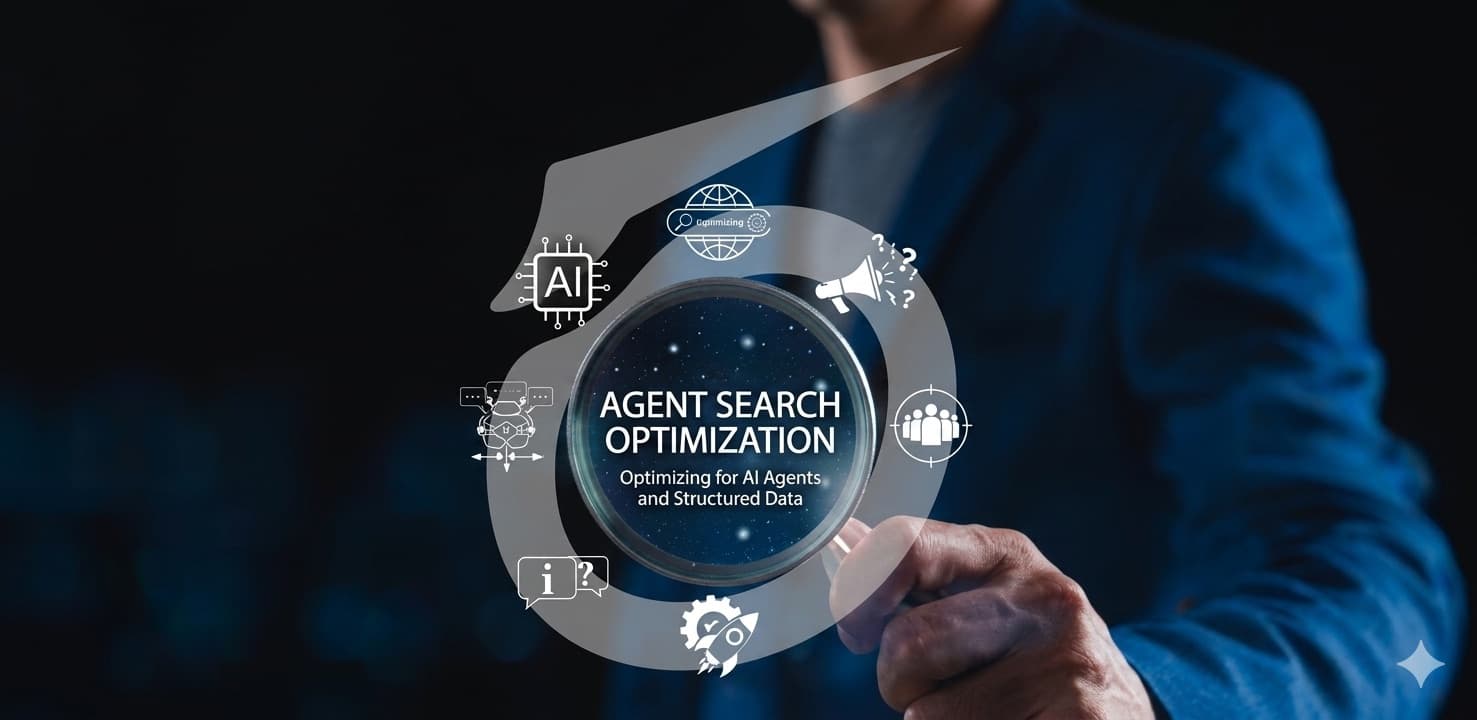
The Machines Are Reading Your Site Whether You're Ready or Not
Agents do not parse marketing copy. They parse structure. Schema, labels, prices, semantics, forms. The sites that surface clean signals get recommended. The sites that hide information behind animations and gated forms get skipped.
ASO is how you make sure your website shows up the way it should when the one browsing it is a machine acting on behalf of a real buyer.
The Three-Layer Visibility Stack
Strong SEO is the floor. AEO content sits on top of it. ASO sits on top of both. Skip a layer and the whole stack leaks.
SEO
Get FoundGooglebot indexes your pages. You compete for a spot on the first results page.
Your page ranks for "best HVAC company San Diego".
AEO
Get CitedLLMs pull answers from structured, authoritative content. You compete for one of a handful of citation slots.
ChatGPT names your brand when a customer asks who to hire.
ASO
Get ChosenAI agents browse your site on behalf of a real person. You compete for a recommendation they actually act on.
Google-Agent compares your pricing and books the call.
Three Events. Six Months. A New Layer of Search.
ASO stopped being theoretical in early 2026. Three developments turned it into an operational reality for every business with a website.
Google-Agent Goes Live
Google added Google-Agent to its official crawler documentation. Unlike Googlebot, it visits because a real person asked an AI to do something. It is user-triggered and rolling out through Chrome right now.
WebMCP Becomes a Standard
The Web Model Context Protocol is a browser-level standard from Google and Microsoft, coordinated through the W3C Web Machine Learning Community Group. It lets sites declare pages and forms as structured, callable tools for agents.
Agentic AI Foundation Formed
The Linux Foundation launched the Agentic AI Foundation with AWS, Anthropic, Google, Microsoft, and OpenAI as platinum members. Shared standards, not competing ones. This is coordinated industry infrastructure.
Agent Browsers Already Shipping to Real Users
SEO vs. AEO vs. ASO
Different audiences. Different formats. Different metrics. Same website, three jobs.
| SEO | AEO | ASO | |
|---|---|---|---|
| Primary audience | Search engine crawlers | LLMs generating answers | AI agents completing tasks |
| Core goal | Rank in search results | Get cited inside the answer | Enable task completion |
| Content format | Keywords, links, authority | Self-contained, citable passages | Machine-readable pricing, labels, and forms |
| Key success metric | Organic traffic and rank | AI mention share | Agent task completion rate |
| User agent | Googlebot, Bingbot | GPTBot, ClaudeBot, PerplexityBot | Google-Agent, browser agents |
| Schema priority | Title, meta, H1 hierarchy | FAQPage, Article, HowTo | FAQPage plus WebMCP form attributes |
| Maturity | 20+ years established | 2 to 3 years and growing | Months old. Move now. |
The Three Levels of Agent Search Optimization
ASO operates across three escalating levels. You need all of them. You can build them progressively.
Discoverability
Can agents find you?
Agents rely on search indexes to build their candidate list. If you are blocked, broken, or invisible to the new user agent strings, you never enter the consideration set. Most sites we audit still have a robots.txt written for 2019.
Allow Google-Agent, GPTBot, ClaudeBot, PerplexityBot, ChatGPT-User, and Google-Extended in robots.txt.
Publish a clean sitemap that reflects the pages agents actually need.
Audit your Cloudflare, Fastly, or WAF rules so bot protection stops scrapers, not agents.
Evaluability
Can agents understand you?
Once an agent lands, it compares you against three or four competitors in seconds. Every hidden price, vague claim, or unlabeled button is a reason to skip you. Sites that expose their value openly win. Sites that hide it lose before the agent finishes reading.
Put real pricing on the page. Ranges are fine. "Contact us" is not.
Write self-contained paragraphs that still make sense when pulled out by a model.
Replace checkmarks in comparison tables with actual numbers, timeframes, and outcomes.
Actionability
Can agents complete tasks?
This is where ASO leaves SEO and AEO behind. Being found and cited is not enough anymore. The agent has to be able to fill the quote form, check availability, or compare plan tiers on behalf of the user. Forms built around JavaScript-only rendering and unlabeled fields are agent dead ends.
Use semantic input types: email, tel, url, number, date.
Pair every input with a descriptive label an agent can read.
Prepare pricing and comparison pages for WebMCP annotations without exposing account, checkout, or auth flows.
"Your website either works for these machines, or it gets skipped for a competitor's that does. There is no third option."
— David Esau, Founder, Click Track Marketing
Your robots.txt Is Probably Blocking the New Agents
Most robots.txt files were written before any of these user agents existed. The default behavior on a lot of platforms silently blocks them. Here is what a 2026-ready robots.txt looks like for a local or service business:
# Traditional crawlers
User-agent: Googlebot
Allow: /

User-agent: Bingbot
Allow: /

# AEO / LLM training and answer bots
User-agent: GPTBot
Allow: /

User-agent: ChatGPT-User
Allow: /

User-agent: ClaudeBot
Allow: /

User-agent: PerplexityBot
Allow: /

User-agent: Google-Extended
Allow: /

# ASO layer: user-triggered AI agent fetchers
User-agent: Google-Agent
Allow: /

Sitemap: https://www.yoursite.com/sitemap.xml
A quick reminder about what sits next to robots.txt: a clean XML sitemap, and FAQPage, Article, and LocalBusiness JSON-LD on the right pages. That is the discoverability foundation every ASO-ready site shares.

Nine Steps to Make Your Website Agent-Ready
Every item on this list improves the site for humans too. None of it is agent-only optimization. It is the fundamentals of a modern, trustworthy web presence.
Update robots.txt for AI agents
Add explicit Allow rules for Google-Agent, GPTBot, ChatGPT-User, ClaudeBot, PerplexityBot, and Google-Extended. Most sites still block these by default and have no idea.
Let the AI crawlers in
The emerging standard for telling AI systems what your business does. Treat it like robots.txt purpose-built for language models and agents.
Deploy complete structured data coverage
FAQPage on service and resource pages. LocalBusiness JSON-LD on the homepage. Article schema with datePublished and dateModified on every blog post. Product schema on offering pages.
Put pricing on the page
This is the single highest-impact ASO change for most local and service businesses. Agents cannot recommend what they cannot read.
Write self-contained content
Every paragraph, every FAQ answer, every service description should stand on its own when lifted out of context. Agents extract snippets and the snippets have to hold up.
Audit form HTML for machine readability
Use semantic input types. Label every field. Confirm forms render as clean HTML rather than JavaScript-only canvases that agents cannot parse.
Whitelist AI agents in your CDN and WAF
Bot-blocking rules built to stop scrapers routinely block legitimate AI agents as collateral damage. Review Cloudflare, Fastly, or Akamai configuration and allow known agent user agent strings.
Monitor server logs for Google-Agent
The rollout began March 20, 2026. Filter your access logs for Google-Agent. Find the pages agents are actually hitting. Optimize those first.
Set change monitoring on key conversion pages
Agents need stable site structure. A button that moves in a redesign quietly breaks an agent workflow. The lead disappears before you know it existed.
This Is the Responsive Design Moment for Local SEO
Most ASO commentary online is written for SaaS and ecommerce. The implications for local and service businesses, which is what Click Track Marketing works on every day, are just as significant and arguably more urgent.
When a homeowner asks Gemini to "find me a good HVAC company in San Diego" or a fleet manager asks ChatGPT to "compare collision repair shops near me," an agent browses candidate websites, reads reviews, evaluates pricing, checks E-E-A-T signals, and surfaces a single recommendation. The businesses that have invested in SEO foundations plus AEO content plus ASO-ready architecture will own those results.
Here is what failure looks like. A collision shop with a five-year-old website, pricing hidden behind a lead form, no FAQPage schema, and a robots.txt that silently blocks Google-Agent never makes it into the agent's shortlist. The customer never sees the shop's name. The owner never sees a missed lead in analytics. The referral simply goes to the competitor with the open site. Mobile took years to shake out. ASO is moving in months.
The compounding effect is the point. The first local business in each category to go ASO-ready will get recommended by agents for years before the rest of the market notices. That is how SEO played out in 2008. That is how mobile-first played out in 2015. That is how ASO is playing out right now.
Our Answer Engine Optimization service and our AI-first web design already include most of the ASO foundation. This page is how we explain what comes next.
How Click Track Marketing Builds the Full Stack
Our standard delivery has always integrated all three layers. We just now have language for the third one.
SEO Foundation
Vite plus React plus TypeScript plus Tailwind on Vercel. Core Web Vitals optimization. Clean URL structures. Comprehensive sitemap management. Full meta control through react-helmet-async. The ranking floor the rest of the stack stands on.
AEO Infrastructure
FAQPage schema on every relevant page. LocalBusiness JSON-LD with full entity coverage. Article schema with datePublished and dateModified. AI bot permissions in robots.txt. Content written to answer specific questions in self-contained paragraphs that hold up under LLM extraction.
ASO Layer
Full AI agent permissions in robots.txt. Machine-readable pricing and comparison tables. Semantic HTML form architecture. CDN and WAF configuration reviews. Structured data coverage that explicitly supports agentic evaluation. As WebMCP matures, our build standards will incorporate form-level toolname and tooldescription attributes for key informational pages.
PeoplePixel. BuyerSignals. Peoplelytics.
Our PeoplePixel and BuyerSignals stack, managed through Peoplelytics, captures intent data from both human and agent-driven traffic. That means you can finally see which layer is delivering revenue, which pages agents evaluate before recommending you, and which conversions came from an agent session versus a human one.
ASO Is Critical for Your Business If...
You are a San Diego local or service business and you want AI agents to recommend you when a customer asks for the best in your category.
You have invested in SEO, you rank well in traditional search, but you have no idea whether ChatGPT, Gemini, or Perplexity agents see you.
Your pricing lives behind a "Contact Sales" form and your comparison pages are full of checkmarks instead of numbers.
Your robots.txt has not been touched since before Google-Agent or WebMCP existed, and your CDN is probably blocking agents as collateral damage.
You want to get ahead of competitors who are still treating their website like it is only read by humans.
Frequently Asked Questions About Agent Search Optimization
Want to know exactly which marketing is making you money?
Get a free attribution audit — we'll show you where your leads and revenue actually come from. Answer two quick questions to start.
Verified by third parties

Is Your Website Ready for the Agent Economy?
We run a full three-layer ASO audit covering SEO foundations, AEO infrastructure, and Agent Search Optimization readiness. Book a call and we will show you exactly where your site stands.
“CTM got our brand cited in Google AI Overviews within 60 days. The site is already built for whatever comes next.”
— San Diego Contractor