

Quick Answer
Intent-based marketing is a strategy that targets potential customers using real-time behavioral signals to identify who is actively researching a purchase, then delivers messages timed to that specific moment of interest. Rather than broadcasting to a broad demographic, it focuses on buyers who have already shown they are in the market. Tools like HubSpot, Demandbase, and Shopify's marketing stack all treat intent signals as the foundation for smarter outreach. The payoff is measurable: intent-driven campaigns improve reply rates 2 to 3 times and shorten sales cycles by 30 to 50 percent compared to targeting based only on ideal customer profiles.
What is intent-based marketing and how does it work?
Intent-based marketing, also called intent-driven marketing, is defined as the practice of using observed online behavior to infer purchase readiness and then matching messages to that readiness level. The industry term you will encounter most often is "intent data marketing," and it sits at the intersection of behavioral analytics and personalized outreach.
The core mechanism is straightforward. A prospect visits your pricing page, searches a competitor's name, or downloads a comparison guide. Each of those actions is an intent signal. You collect those signals, score them by confidence level, and route the prospect into a workflow built for where they are in the buying process. Consumer intent is inferred from content consumption patterns rather than assumed from job title or company size.

This matters because timing is as important as targeting. Reaching a buyer the day they start researching beats reaching them three months earlier with the same message. Intent data closes that timing gap in a way that demographic profiling cannot.
How does intent-based marketing differ from ABM and traditional marketing?
Account-based marketing (ABM) and intent-based marketing are often confused, but they answer different questions. ABM asks "who should we target?" and builds a list of named high-value accounts. Intent-based marketing asks "when should we target them?" and triggers outreach when those accounts show active buying signals. The two approaches are complementary, not competing.
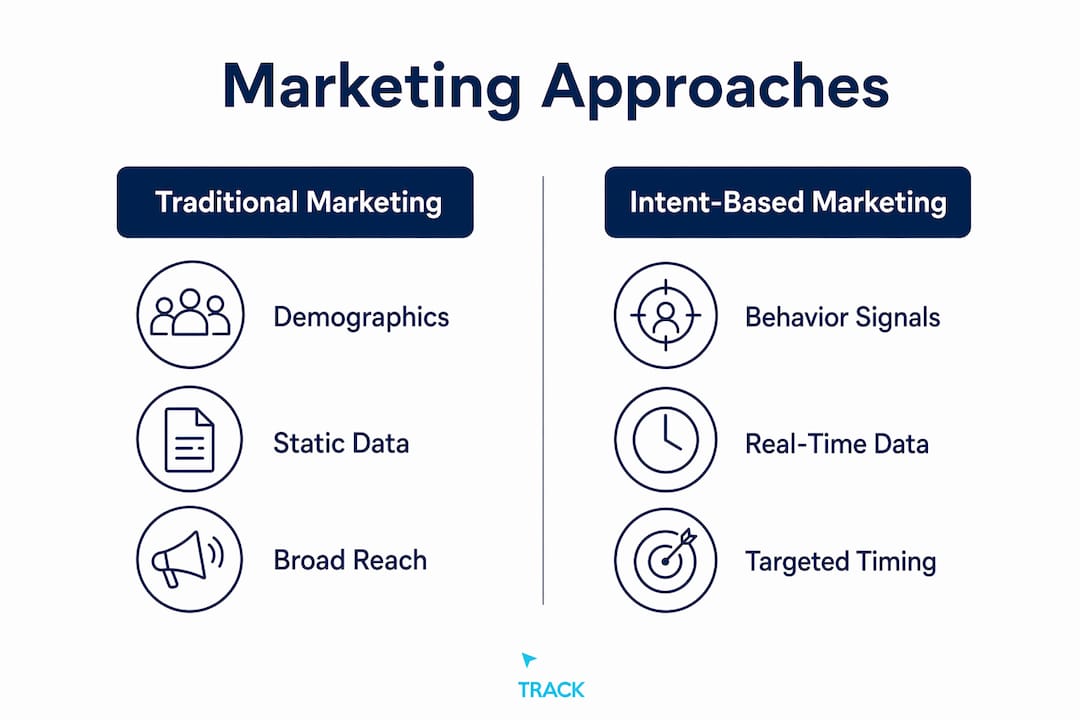
Traditional marketing relies on static inputs: demographics, firmographics, and purchase history. Intent-based marketing uses real-time behavioral data, which means the targeting updates continuously as prospects move through their research. A company that visited your site six months ago and went cold is a very different prospect from one that visited your pricing page twice this week.
The table below shows where each approach focuses its energy.
| Dimension | Traditional marketing | Account-based marketing | Intent-based marketing |
|---|---|---|---|
| Primary question | Who is our audience? | Which accounts matter most? | Who is ready to buy right now? |
| Data type | Demographics, firmographics | Named account lists | Real-time behavioral signals |
| Timing | Scheduled campaigns | Account-driven cadences | Triggered by buyer behavior |
| Personalization | Segment-level | Account-level | Intent-stage level |
| Best use case | Brand awareness at scale | Enterprise sales cycles | Mid-funnel conversion |
The strongest programs combine all three. ABM defines the target accounts. Intent data tells you when those accounts are in an active research cycle. Traditional channels carry the message at scale.
What are the key types of intent data?
Intent data comes from three sources, and understanding the difference determines how you use each one.
First-party data is collected directly from your own properties. This includes website visits tracked via pixel, CRM records, email engagement, app usage, and form submissions. It is the highest-confidence data you have because you own it and you know exactly what action triggered it. Pixel tracking is one of the most direct ways to surface this behavioral layer for your marketing team.
Third-party data comes from external platforms: search engines, review sites like G2 and Capterra, publisher networks, and data aggregators. Demandbase and similar platforms aggregate this data across thousands of sites to tell you when a company is researching a category, even before they visit your site. Third-party intent sources include behavioral actions on competitor sites, review platform activity, and broad solution-category searches.
Second-party data is first-party data shared by a partner. A software vendor and a complementary service provider might share behavioral data on overlapping audiences. This is less common but can be highly targeted.
Within each source, not all signals carry equal weight. High-confidence behaviors include:
- Pricing page visits (signals active evaluation)
- Demo requests (signals near-term purchase consideration)
- Competitor comparison searches (signals late-stage research)
- Repeated visits to solution-specific content within a short window
- Direct engagement with case studies or ROI calculators
Low-confidence signals, like a single blog visit or a social media impression, indicate awareness but not readiness. Weighting signals by confidence is what separates a useful intent score from noise.
How do you segment audiences based on intent signals?
Segmentation by intent level is the operational core of any intent marketing strategy. The standard framework divides prospects into three tiers based on observed behavior.
Low intent prospects are browsing. They read a top-of-funnel blog post or followed a social link. The right message here is educational: a guide, a framework, or a data-driven article that builds credibility without pushing for a sale. Sending a demo offer to a low-intent prospect wastes the contact and trains them to ignore your emails.
Mid intent prospects are comparing. They have visited multiple pages, returned to your site more than once, or engaged with a product-specific resource. Segmenting by readiness allows you to shift the message toward differentiation. Case studies, comparison content, and webinar invitations work well here.
High intent prospects are evaluating. A pricing page visit, a demo request, or a competitor search puts a prospect in this tier. The message should remove friction: a direct offer, a free trial, a consultation, or a personalized outreach from a sales rep. Distinguishing browsing from purchase readiness is what makes this segmentation worth building.
- 1Map your existing content to each intent tier so every prospect lands in a relevant sequence.
- 2Define the specific behavioral triggers that move a prospect from low to mid to high intent in your CRM.
- 3Build separate email workflows for each tier with distinct calls to action.
- 4Review segment performance monthly and adjust the trigger thresholds based on conversion data.
- 5Flag high-intent accounts for direct sales follow-up within 24 hours of the triggering event.
Pro Tip: Do not rely on a single signal to classify a prospect as high intent. A pricing page visit combined with a return visit within 48 hours is a far stronger indicator than either signal alone. Build composite scoring into your CRM from the start.
How to implement an intent-based marketing strategy
A working intent marketing strategy requires five connected components. Skip any one of them and the system produces data without results.
Define your ICP and intent signals first. Your ideal customer profile (ICP) determines which behavioral signals are worth tracking. A B2B software company cares about demo requests and pricing visits. A local service business cares about "near me" searches and contact form submissions. HubSpot's six-step framework starts here: define the ICP, then map the signals that indicate that profile is in an active buying cycle.
Choose and integrate your data sources. First-party data from your CRM and website is the starting point. Third-party intent data from platforms like Demandbase or Bombora adds the external research layer. Both need to feed into a single system. A unified CRM and marketing integration is not optional. Without it, your intent segments generate activity but you cannot tie that activity to revenue.
Build intent-triggered content and workflows. Each intent tier needs its own content sequence. High-intent triggers should fire within hours, not days. Marketing automation platforms like HubSpot, Marketo, and ActiveCampaign all support behavioral triggers. The workflow logic is simple: if a contact hits a high-intent signal, enroll them in the high-intent sequence and notify the sales team.
Measure by intent stage, not just by channel. Most teams measure email open rates or ad clicks. Intent-based measurement tracks conversion rates by intent tier. What percentage of high-intent prospects convert to a sales conversation? What is the average time from first high-intent signal to closed deal? These numbers tell you whether your intent data is actually predictive.
Refine continuously. Intent data is probabilistic, not certain. Some high-intent signals will not convert. Some low-intent contacts will buy faster than expected. Review your scoring model quarterly and adjust thresholds based on actual conversion outcomes.
Pro Tip: Start with first-party data before adding third-party sources. Your own site behavior is the cleanest signal you have, and building the CRM infrastructure to use it well takes time. Add external intent data once your internal scoring model is working.
Key takeaways
Intent-based marketing works because it replaces demographic assumptions with real-time behavioral evidence, putting the right message in front of the right buyer at the moment they are most likely to act.
| Point | Details |
|---|---|
| Definition is behavioral | Intent-based marketing targets buyers based on observed online actions, not static profile data. |
| Data has three tiers | First-party, third-party, and second-party intent data each serve different targeting purposes. |
| Segmentation drives results | Low, mid, and high intent tiers require distinct messages to move prospects toward conversion. |
| CRM integration is required | Without a unified data layer, intent signals cannot be tied to revenue outcomes. |
| High-confidence signals matter most | Pricing page visits and demo requests predict near-term purchase far better than generic site visits. |
Where most intent programs break down
Most marketers who adopt intent data make the same mistake: they treat it as a better retargeting list. They collect the signals, build the segments, and then send the same generic ad or email to everyone in the "high intent" bucket. The signal told them when to reach out. They ignored the equally important question of what to say.
Misaligning message creative with intent signals produces generic retargeting that looks no different from what the prospect already ignores. A prospect who just visited your pricing page does not need another brand awareness email. They need friction removed. A direct comparison, a customer reference, or a no-commitment consultation call is what moves them.
The second failure point is measurement. Teams run intent campaigns and measure success by click-through rate. Click-through rate tells you nothing about whether intent data improved your revenue. You need a unified attribution layer that connects intent tier to pipeline stage to closed revenue. Without that, you are optimizing for engagement metrics while the business question, which is whether this is making money, goes unanswered.
At Click Track Marketing, we built our entire product suite around closing that gap. BuyerSignals surfaces who is in the market right now. PeopleLytics ties it back to revenue. The intent data is only as useful as the infrastructure you have to act on it and measure it. Build the infrastructure first.
How Click Track Marketing helps you act on intent data
If you are ready to move beyond demographic targeting and build a system that identifies buyers when they are actively in the market, Click Track Marketing's AI-powered marketing services are built for exactly that.
Our BuyerSignals product surfaces real buying intent from your site visitors, and PeopleLytics connects that intent data to actual revenue so you know which efforts are producing customers. We also build the CRM and automation infrastructure that makes intent-triggered workflows run without manual intervention. For businesses that want lead nurturing grounded in intent rather than guesswork, our approach delivers a measurable system, not just a dashboard. Reach out to see how we structure intent data for local service businesses and e-commerce brands in San Diego and beyond.
Want to know exactly which marketing is making you money?
Get a free attribution audit — we'll show you where your leads and revenue actually come from. Answer two quick questions to start.