

Quick Answer
Marketing-to-revenue attribution is the practice of connecting every dollar you spend on marketing directly to the income it generates. Without it, 40% of marketing budgets get wasted on channels that produce no measurable return. That number is not a rounding error. It represents real money that business owners and marketing managers spend without knowing whether it works.
The good news is that attribution is a solvable problem. You do not need a Fortune 500 data team. You need clean data, consistent definitions, and the right combination of attribution models. This guide walks you through exactly how to tie marketing spend to revenue, what tools and frameworks to use, and how to avoid the most common mistakes that make attribution fail.
How to tie marketing spend to revenue: the foundation
Before you can connect ad spend to revenue, you need three things in place: integrated data systems, consistent tracking, and agreed-upon definitions across your team.

Clean CRM and analytics integration
Your CRM and your analytics platform must talk to each other. If a lead comes in through a Google Ads campaign but closes in your CRM with no campaign data attached, you cannot trace that revenue back to its source. Every contact record needs to carry the original traffic source, campaign name, and channel from first touch through to closed deal.
UTM parameters are the mechanism that makes this work. Every paid ad, email campaign, and social post needs a UTM tag that follows the visitor into your CRM. Without consistent UTM tagging, your attribution data will have gaps that make channel comparisons unreliable.
Attribution models: which one fits your business
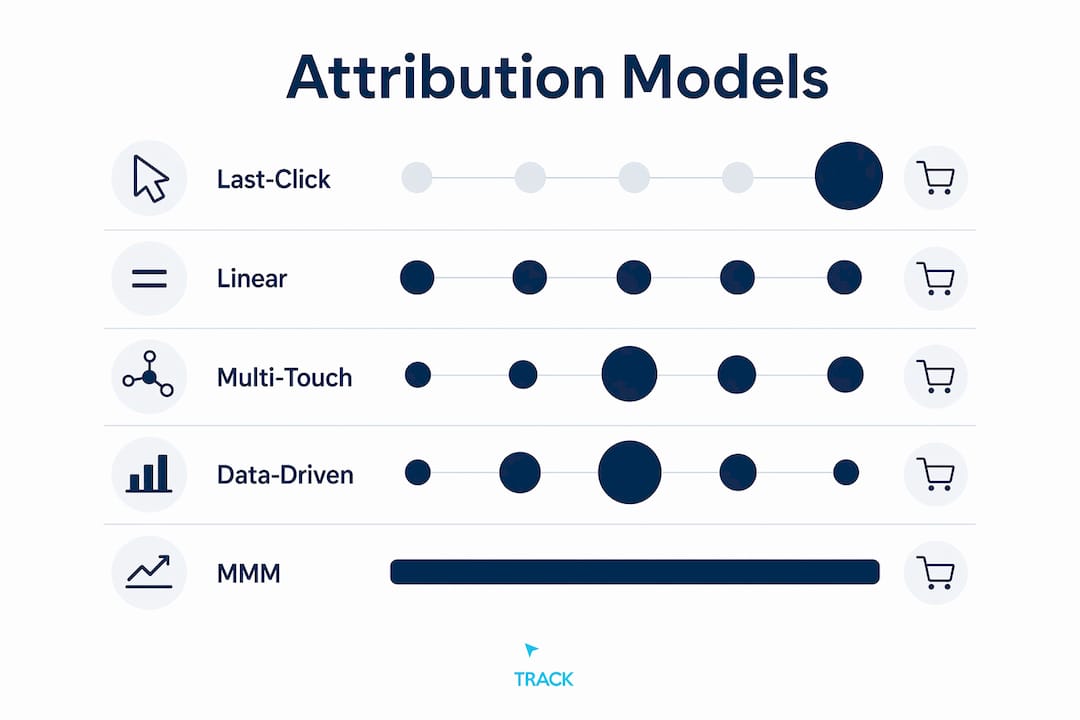
No single attribution model tells the whole story. The table below shows the most common models, their strengths, and when to use them.
| Model | How it works | Best for |
|---|---|---|
| Last-click | 100% credit to the final touchpoint | Short sales cycles, direct response |
| First-click | 100% credit to the first touchpoint | Brand awareness measurement |
| Linear | Equal credit across all touchpoints | Multi-channel campaigns |
| Time-decay | More credit to recent touchpoints | Long sales cycles |
| Multi-touch (data-driven) | Algorithmic credit across all touches | Complex funnels with sufficient data |
| Marketing Mix Modeling (MMM) | Top-down regression on aggregate spend | Strategic budget planning |
Multi-touch attribution accuracy has dropped to 30, 60% of its 2020 levels due to cookie deprecation and privacy changes. That decline means you cannot rely on multi-touch attribution alone. MMM fills the gap because it works on aggregate data without needing user-level identifiers.
Pro Tip: Start with a simple linear model to establish a baseline. Add data-driven multi-touch attribution once you have at least 90 days of clean, tagged data flowing through your CRM.
Data governance is the unglamorous part that most teams skip. You need shared definitions for what counts as a marketing-qualified lead, a sales-qualified lead, and a closed deal. Without those definitions locked in, your attribution reports will show different numbers depending on who pulls them.
How to implement marketing attribution step by step
Getting attribution right requires a specific sequence. Skipping steps creates data gaps that compound over time.
- 1Define marketing-influenced revenue. Agree across marketing, sales, and finance on what "marketing-influenced" means. Does it include deals where marketing touched the account at any point? Only deals where marketing sourced the first contact? Write it down and get sign-off from all three teams.
- 1Tag every campaign with UTM parameters. Build a UTM naming convention and enforce it. Use a shared spreadsheet or a URL builder tool so every team member follows the same format. Inconsistent naming (utm_source=google vs. utm_source=Google) creates separate data buckets that look like different channels.
- 1Confirm UTM data flows into CRM contact and deal records. Test this manually. Run a test campaign, click the link, fill out a form, and check whether the UTM values appear on the contact record in your CRM. Many teams assume this works without verifying it.
- 1Set up multi-touch attribution reporting. Use your CRM's built-in attribution reports or connect your analytics platform. Map every touchpoint from first contact to closed deal. This gives you the multi-touch attribution view that shows which channels contribute at each stage of the funnel.
- 1Integrate offline conversions. If you close deals by phone, in person, or through a sales team, feed those conversions back into your ad platforms. Offline conversion tracking improves ad platform performance by 15, 30% within 60 days because the algorithm learns which clicks actually produce revenue, not just form fills.
- 1Layer in Marketing Mix Modeling for budget planning. MMM runs a regression analysis on your historical spend and revenue data. It tells you how much revenue each channel drives at the aggregate level, without needing cookies or user identifiers. Use it quarterly to set budget allocations across channels.
| Activity | Responsible team | Primary tool |
|---|---|---|
| UTM tagging and naming convention | Marketing | URL builder, shared spreadsheet |
| CRM integration and field mapping | Marketing ops / IT | CRM platform |
| Multi-touch attribution reporting | Marketing analytics | CRM or analytics platform |
| Offline conversion upload | Marketing / Sales ops | Ad platform conversion API |
| MMM analysis | Marketing / Finance | Statistical modeling tool |
Pro Tip: Run a data audit before you launch any attribution project. Pull 90 days of CRM data and check what percentage of closed deals have a known traffic source. If it is below 70%, fix your tracking before you build reports.
What challenges make it hard to link marketing budget to sales
Attribution fails for predictable reasons. Knowing them in advance lets you build systems that avoid them.
Data silos and inconsistent tracking are the primary reasons organizations fail to connect marketing spend to revenue accurately. Your ad platform reports revenue one way, your CRM reports it another, and your finance team uses a third number. Each system is technically correct, but they do not agree because they measure different things.
The fix is a single source of truth. Pick one system as the authoritative record for revenue. Most businesses use their CRM or their accounting platform. Every other report gets reconciled against that number, not the other way around.
Privacy changes have made the problem worse. Attribution signal loss of 40, 70% since 2020 means that user-level tracking is far less reliable than it was five years ago. Relying solely on pixel-based attribution now produces systematically understated results for channels like Meta and display advertising.
“Marketing attribution often fails because of poor data governance more than software limitations. The businesses that get attribution right treat it as an operational discipline, not a reporting feature.”
Long sales cycles create a separate challenge. For B2B businesses with sales cycles of nine months or longer, pipeline velocity and MQL-to-SQL conversion rates give better revenue visibility than waiting for closed deals. Track leading indicators alongside lagging revenue metrics so you can make budget decisions without waiting nine months for results.
How to use attribution data to improve marketing ROI
Attribution data is only useful if you act on it. Reading a report and filing it away produces no return.
The right process for applying attribution insights looks like this:
- Identify your highest-revenue channels. Sort your attribution report by revenue generated, not by clicks or impressions. The channel with the most clicks is rarely the channel with the most revenue.
- Calculate marginal cost per acquisition by channel. As you increase spend on a channel, the cost to acquire each additional customer rises. Find the point where incremental spend stops producing incremental revenue.
- Triangulate across methods. Combining multi-touch attribution, MMM, and incrementality testing produces more reliable budget decisions than any single method alone. Each model has blind spots. Using all three reduces the risk of misallocating budget based on one model's limitations.
- Align with pipeline metrics. Revenue attribution looks backward. Pipeline metrics look forward. Use both together to make budget decisions that reflect current performance and future trajectory.
- Shift budget toward channels with the lowest marginal CAC. Do not wait for a quarterly review. Set a threshold and reallocate when a channel crosses it.
Directional accuracy matters more than perfect precision. You do not need to know that Channel A drove exactly $47,312 in revenue. You need to know that Channel A consistently outperforms Channel B by a meaningful margin. That directional signal is enough to make better budget decisions.
Pro Tip: Run quarterly incrementality tests on your top two or three channels. Pause spend on a small geographic segment or audience cohort for two weeks and measure the revenue difference. This gives you a ground-truth check on whether your attribution model reflects reality.
Understanding revenue-based marketing as a framework helps you apply these insights consistently. The goal is not to measure marketing activity. The goal is to measure marketing outcomes.
Key Takeaways
Tying marketing spend to revenue requires clean data, shared definitions, and a combination of attribution models because no single method captures the full picture.
| Point | Details |
|---|---|
| Attribution starts with data governance | Clean CRM data and consistent UTM tagging must come before any attribution reporting. |
| Use multiple attribution models | Combine multi-touch attribution, MMM, and incrementality tests to reduce blind spots. |
| Offline conversions close the loop | Feeding offline sales back into ad platforms improves performance by 15, 30% within 60 days. |
| Directional accuracy is the goal | You need to know which channels outperform, not exact revenue figures down to the dollar. |
| Alignment across teams is non-negotiable | Marketing, sales, and finance must agree on one revenue source of truth before attribution works. |
Attribution is a discipline, not a dashboard
I have worked with enough marketing teams to know that attribution projects almost always stall at the same point. The tools get set up. The reports get built. Then nothing changes. The budget stays the same, the channels stay the same, and the reports become something people glance at in a monthly meeting before moving on.
The problem is not the data. The problem is that attribution gets treated as a reporting exercise instead of an operational one. The businesses that actually improve their ROI from attribution are the ones that build a process around acting on the data, not just collecting it.
Operational alignment among marketing, sales, and finance is more important than the choice of attribution tool. I have seen teams with basic CRM setups outperform teams with enterprise analytics platforms because the basic-setup team had a weekly meeting where someone was accountable for moving budget based on what the data showed.
Attribution is also not a solved problem. Privacy changes, long sales cycles, and offline conversions all introduce noise that no model eliminates completely. The right expectation is directional accuracy, not perfect measurement. If your attribution tells you that paid search drives three times the revenue per dollar compared to display, that signal is reliable enough to act on, even if the exact numbers are estimates.
The teams that win treat attribution as a continuous practice. They validate their models quarterly, update their definitions when the business changes, and stay honest about what the data can and cannot tell them. That discipline, applied consistently, compounds into a real competitive advantage over time.
How Click Track Marketing closes the loop between spend and revenue
Click Track Marketing builds the attribution infrastructure that most agencies skip. PeoplePixel identifies anonymous site visitors your current setup never captures. BuyerSignals surfaces who is actively in the market right now. PeopleLytics delivers a weekly revenue attribution dashboard that shows exactly which channels and campaigns are producing customers, not just clicks. Together, these tools give you a clear answer to the question that actually matters: is the marketing making money?
If you want to see how attribution-first marketing works in practice, the free AEO checklist is a practical starting point. It covers the infrastructure decisions that determine whether your marketing is measurable and findable in AI-driven search, which is where your customers are increasingly looking.
Want to know exactly which marketing is making you money?
Get a free attribution audit — we'll show you where your leads and revenue actually come from. Answer two quick questions to start.