

Quick Answer
Marketing ROI by channel is defined as the net revenue generated by a specific marketing channel divided by the total cost of running that channel. Knowing how to track marketing ROI by channel is the difference between spending confidently and spending blindly. 69% of organizations struggle to accurately attribute value when multiple channels influence a single conversion. That number explains why so many marketing budgets get misallocated year after year. This guide covers the data requirements, attribution models, and step-by-step process you need to measure every channel accurately and act on what you find.
How to track marketing ROI by channel: data requirements first
Accurate channel-level ROI measurement starts with clean, connected data. You cannot attribute revenue correctly if your advertising platform data, CRM records, website analytics, and sales figures all live in separate systems with no common thread between them.
The core data sources you need to connect are:
- Advertising platforms (paid search, paid social, display) for spend and click data
- CRM systems for lead, pipeline, and closed revenue data
- Website analytics for session, event, and conversion data
- Offline sales records for in-store, phone, or field-generated revenue
Connecting these sources requires standardized customer identifiers. A customer who clicks a paid ad, reads an email, and then calls your sales team is one person. Without a shared ID across systems, they look like three separate interactions. Companies using unified customer identification systems gain up to 70% better cross-channel visibility. That improvement directly translates into more accurate budget decisions.
UTM parameters are the minimum standard for digital tracking. Every paid link, email campaign, and social post needs consistent UTM tagging so your analytics platform can sort sessions by source, medium, and campaign. Inconsistent tagging is the single most common cause of data gaps in channel reporting.

Standardized data collection frameworks improve customer journey tracking accuracy by up to 85%. The practical implication is that standardization is not a technical detail. It is the foundation your entire ROI measurement system rests on.
Pro Tip: Involve your sales, finance, and IT teams in the data integration process from the start. Marketing alone cannot standardize identifiers across a CRM and an ERP system. Cross-functional alignment cuts integration time significantly.
Organizations that integrate online and offline data achieve 31% higher attribution accuracy and 19% improved marketing efficiency. The businesses still running siloed data systems are leaving both accuracy and budget efficiency on the table.
Which attribution models are most effective for measuring ROI by channel?
Attribution models are the rules that determine how credit for a conversion gets distributed across the channels a customer touched. The model you choose shapes every ROI number you produce, so the choice matters.
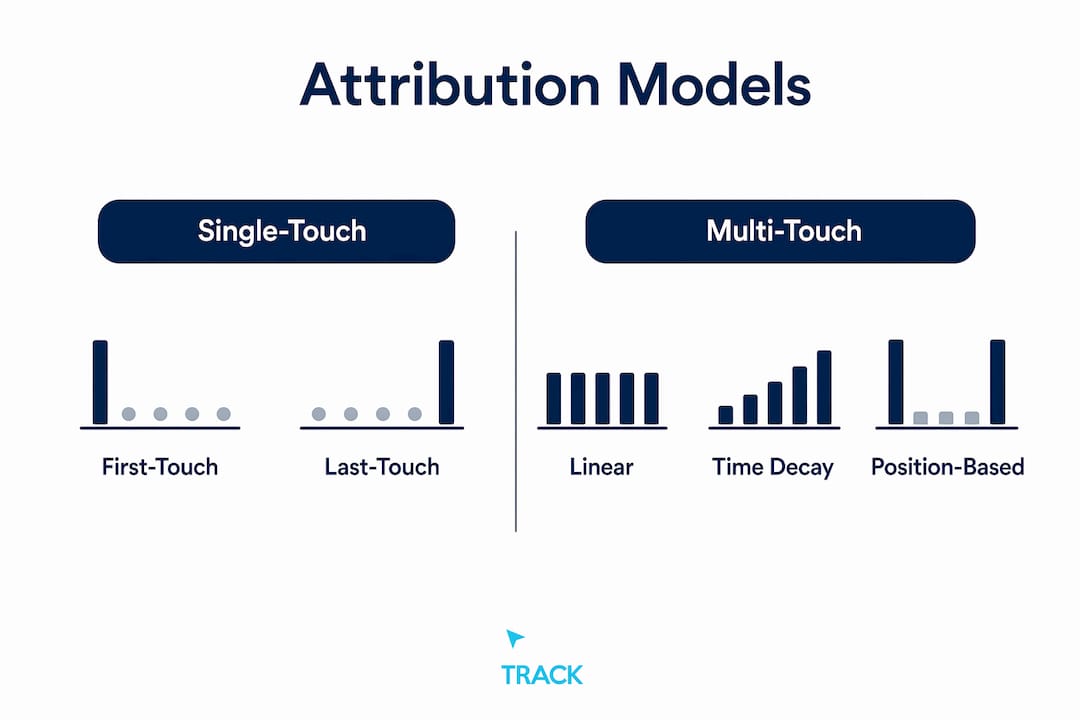
Single-touch models assign 100% of the credit to one touchpoint. First-touch gives all credit to the channel that started the relationship. Last-touch gives all credit to the channel that closed the deal. Both are simple to implement and easy to explain, but both are wrong in most real-world scenarios. A customer who saw a display ad in january, clicked a paid search ad in february, and converted through an email in march did not get there because of one channel.
Multi-touch models distribute credit across multiple touchpoints. The main types are:
- Linear: Equal credit to every touchpoint in the journey
- Time-decay: More credit to touchpoints closer to conversion
- Position-based (U-shaped): 40% to first touch, 40% to last touch, 20% split across the middle
- W-shaped: Credit weighted toward first touch, lead creation, and opportunity creation
- Data-driven: Credit assigned by a machine learning model based on actual conversion patterns
Multi-touch attribution models improve marketing ROI by 20, 30% compared to single-touch models in complex digital campaigns. The reason is straightforward: multi-touch models identify up to 40% more influential touchpoints, which means you stop underfunding channels that actually drive decisions.
| Attribution model | Best use case | Key limitation |
|---|---|---|
| First-touch | Short sales cycles, awareness focus | Ignores all post-awareness channels |
| Last-touch | Simple funnels, direct response | Ignores all pre-conversion channels |
| Linear | Even channel contribution assumed | Treats all touchpoints as equal |
| Time-decay | Long sales cycles, nurture-heavy | Undervalues top-of-funnel channels |
| Position-based | Balanced awareness and conversion focus | Requires judgment on weight distribution |
| Data-driven | High data volume, complex journeys | Requires significant historical data |
The right model depends on your sales cycle length, the number of channels you run, and how much data you have. A local service business with a two-day sales cycle and three channels can use a position-based model effectively. An e-commerce brand running eight channels with a 30-day consideration window needs a data-driven approach. Review your attribution model every quarter. Customer behavior changes, and your model should change with it.
How to implement a step-by-step process for tracking marketing ROI by channel
A repeatable process produces reliable numbers. The following seven steps take you from setup to ongoing optimization.
- 1Define your KPIs. Align every metric to a business goal. Revenue per channel, cost per acquisition by channel, and customer lifetime value by acquisition source are the metrics that connect marketing to money.
- 1Standardize your tracking parameters. Build a UTM naming convention and enforce it across every team and every platform. Define events in your analytics platform consistently so a "lead" means the same thing in every system.
- 1Integrate your data sources. Connect your advertising platforms, CRM, analytics, and sales data into one reporting environment. This is where marketing attribution works as a system rather than a collection of disconnected reports.
- 1Choose and apply your attribution model. Match the model to your sales cycle and data maturity. Start with a position-based model if you are new to multi-touch attribution. Move to data-driven once you have 12 months of clean conversion data.
- 1Build your reporting dashboard. A marketing reporting dashboard should show revenue, spend, and ROI for each channel in one view. Avoid dashboards that only show clicks and impressions. Those numbers do not tell you whether the marketing is making money.
- 1Analyze and reallocate. Channel-specific cost allocation leads to up to 25% more accurate profitability assessments. Use that accuracy to shift budget toward channels with the highest revenue return and reduce spend on channels that look active but do not convert.
- 1Set a review cadence. Review channel ROI monthly for fast-moving paid channels and quarterly for organic and content channels. Update your attribution model and KPI definitions as your business evolves.
| Step | Action | Output |
|---|---|---|
| 1. Define KPIs | Align metrics to revenue goals | KPI list tied to business outcomes |
| 2. Standardize tracking | UTM conventions, event definitions | Clean, consistent data inputs |
| 3. Integrate data | Connect all sources to one system | Unified data environment |
| 4. Apply attribution | Select and configure model | Credit assigned per channel |
| 5. Build dashboards | Visualize ROI per channel | Reporting view for decisions |
| 6. Analyze and reallocate | Shift budget to top performers | Improved ROI across channels |
| 7. Review regularly | Refine data and models | Continuously improving accuracy |
Pro Tip: Set your attribution window to match your actual sales cycle, not the platform default. Google Ads defaults to a 30-day window. If your customers typically convert in 7 days, a 30-day window inflates the credit that channel receives and distorts your ROI numbers.
What common challenges occur in marketing ROI tracking, and how do you fix them?
The most common failure in channel ROI measurement is not a technology problem. It is a process problem. 62% of marketing teams spend excessive time manually reconciling multi-channel data, and 54% struggle to prove ROI across their marketing mix. Manual reconciliation is slow, error-prone, and a signal that data integration has not been completed.
The challenges that cause the most damage are:
- Fragmented data systems that prevent a single view of the customer journey
- Inconsistent UTM tagging that makes channel data unreliable
- Overreliance on last-click attribution that systematically undercredits upper-funnel channels
- Attribution windows that do not match the sales cycle, causing revenue to be assigned to the wrong period
- No alignment between sales and marketing data, so closed revenue never connects back to the channel that sourced the lead
“Poor attribution does not just produce inaccurate reports. It produces wrong decisions. Budget misallocation from ineffective ROI measurement can reach up to 30%, meaning nearly one-third of your marketing spend may be going to channels that look productive but are not.”
The fix for most of these problems is the same: invest in data infrastructure before you invest in more channels. Accurate ROI frameworks that incorporate both direct and indirect value attribution can identify 30% more revenue influences across channels. That means channels you thought were underperforming may actually be contributing significantly to revenue you were attributing elsewhere.
Training your marketing team on attribution logic is not optional. A team that does not understand why last-click is misleading will keep optimizing for last-click metrics. Align your sales and marketing teams on shared definitions for leads, opportunities, and closed revenue. Without that alignment, your attribution model is working with incomplete data.
Which tools support tracking marketing ROI by channel?
The right tool for channel ROI tracking depends on the complexity of your marketing mix and the maturity of your data infrastructure. The features that matter most are multi-touch attribution, cross-channel data integration, real-time reporting, and the ability to connect marketing spend directly to revenue.
The main categories of solutions are:
- Marketing analytics platforms that aggregate channel data and apply attribution models
- Business intelligence tools that connect to multiple data sources and build custom dashboards
- CRM integrations that link marketing activity to pipeline and closed revenue
When evaluating any platform, prioritize these criteria:
| Feature category | Why it matters |
|---|---|
| Multi-touch attribution | Distributes credit accurately across all channels |
| Cross-channel data integration | Eliminates siloed reporting and manual reconciliation |
| Real-time analytics | Allows faster budget decisions during active campaigns |
| Revenue connection | Links spend directly to closed deals, not just leads |
| Scalability | Supports more channels and data volume as you grow |
Organizations implementing comprehensive data integration achieve 28% higher return on marketing investment compared to those with fragmented data systems. That gap is the cost of choosing a tool that cannot connect your data sources.
Click Track Marketing's PeopleLytics platform delivers revenue attribution as a weekly reporting dashboard. It shows exactly where revenue is coming from and which channels are producing it. PeoplePixel identifies anonymous site visitors, and BuyerSignals surfaces intent data so you know who is actively in the market. Together, these tools close the loop between channel spend and actual revenue, which is what measuring ROI by marketing channel requires.
Key Takeaways
Accurate channel-level ROI measurement requires unified data, the right attribution model, and a consistent review process tied directly to revenue outcomes.
| Point | Details |
|---|---|
| Unify your data first | Connect advertising, CRM, analytics, and sales data before building any attribution model. |
| Match attribution to your sales cycle | Use multi-touch models for complex journeys; single-touch only works for very simple funnels. |
| Standardize tracking parameters | Consistent UTM tagging and event definitions are the foundation of reliable channel data. |
| Review attribution models regularly | Customer behavior changes; your model should be recalibrated at least quarterly. |
| Connect spend to revenue, not clicks | ROI tracking only has value when it ties channel spend to closed revenue, not vanity metrics. |
What I've learned from years of watching attribution go wrong
I spent years inside Google working on Ads strategy, and the pattern I saw repeat itself constantly was this: businesses would invest in more channels before they had accurate data on the channels they already ran. They would add influencer marketing or connected TV because a competitor was doing it, while their paid search and email attribution was still broken.
The uncomfortable truth about measuring ROI by marketing channel is that most businesses are not ready for multi-touch attribution when they think they are. Their UTM tagging is inconsistent. Their CRM does not connect to their analytics platform. Their sales team logs revenue in a spreadsheet that nobody in marketing can access. You cannot build an accurate attribution model on top of fragmented data. The model will produce numbers, but those numbers will be wrong in ways that are hard to detect.
What actually works is starting with the simplest model your data can support accurately, then upgrading as your data infrastructure improves. A clean last-touch model with complete data is more useful than a data-driven model fed by incomplete inputs. I have seen businesses make better budget decisions from a well-structured spreadsheet than from an enterprise analytics platform they did not have the data hygiene to support.
The mindset shift that produces lasting improvement is treating attribution as infrastructure rather than a reporting exercise. When you build the data connections properly, when you standardize your tracking, and when you align sales and marketing on shared definitions, the ROI numbers start to reflect reality. That is when you can actually double down on what works.
How Click Track Marketing approaches channel ROI attribution
Click Track Marketing builds the attribution infrastructure that makes channel-level ROI measurement accurate and sustainable. The agency's approach treats data integration as the foundation, not an afterthought. PeopleLytics delivers weekly revenue attribution dashboards that show exactly which channels are producing customers and revenue. PeoplePixel and BuyerSignals add the visitor identification and intent data layers that most businesses never have access to.
If you want to understand how AI marketing works as a full-funnel attribution system, Click Track Marketing's infrastructure connects your marketing spend to real revenue outcomes. You can also book a discovery call to see how the attribution system applies to your specific channel mix and business model.
Want to know exactly which marketing is making you money?
Get a free attribution audit — we'll show you where your leads and revenue actually come from. Answer two quick questions to start.