

Quick Answer
Marketing attribution is the process of assigning credit to the marketing touchpoints that influence a customer's decision to convert or buy. Understanding how marketing attribution works tells you which channels, messages, and campaigns actually drive revenue, so you can stop guessing and start allocating your budget with confidence.
Most businesses track clicks and impressions. The ones that grow track which specific interactions produced paying customers. That distinction is the entire point of attribution in digital marketing. Tools like Google Ads, HubSpot, and platforms built around multi-touch attribution explained this shift years ago. The rest of this guide shows you how to apply it.
How marketing attribution works: models and core mechanics
Multi-touch attribution) assigns value to the key events that influence a conversion, covering models such as last touch, first touch, linear, time decay, and position-based. Each model answers a different question about your customer journey.
The six core attribution models
Last Touch (Last Click): All conversion credit goes to the final interaction before purchase. This model is simple and widely used, but it ignores every earlier touchpoint that built awareness or intent. A customer who saw three ads before clicking a Google search result would give that search result 100% of the credit.
First Touch: All credit goes to the first interaction. This model favors awareness channels like paid social or display advertising. It tells you what started the journey but nothing about what closed it.

Linear: Credit is split equally across every touchpoint in the path. A customer with five interactions gives each one 20% of the credit. This model treats all touchpoints as equally important, which is rarely accurate but provides a useful baseline.
Time Decay: More credit goes to touchpoints closer to the conversion. This model suits short sales cycles where recent interactions carry more weight. It undervalues early awareness efforts.
Position-Based (U-Shaped): 40% of credit goes to the first touch, 40% to the last touch, and the remaining 20% is split across middle interactions. This model recognizes both the channel that started the relationship and the one that closed it.
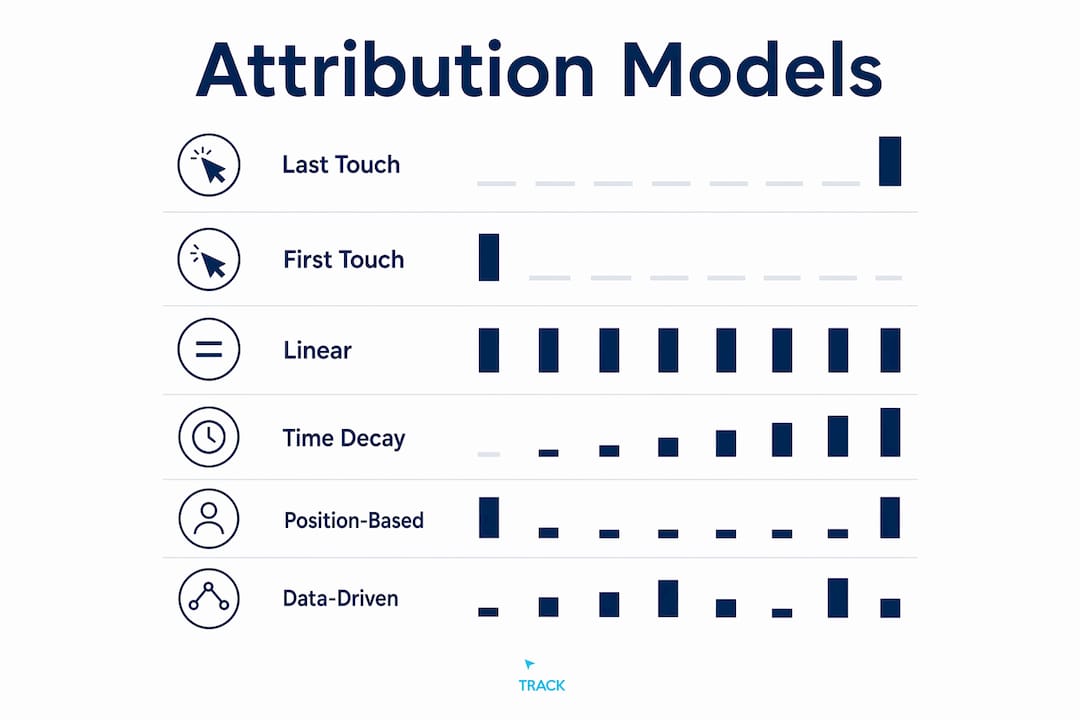
Data-Driven Attribution (DDA): Google Ads uses data-driven attribution to analyze past conversion data and distribute credit among multiple touchpoints based on their actual contribution probability. It considers both converting and non-converting paths. This is the most accurate model available for accounts with sufficient data volume.
Pro Tip: Run two models simultaneously for 30 days, such as last click alongside linear, and compare which channels gain or lose credit. The gaps reveal where your current budget decisions are based on incomplete information.
| Model | Credit Method | Best Use Case |
|---|---|---|
| Last Touch | 100% to final interaction | Short sales cycles, direct response |
| First Touch | 100% to first interaction | Brand awareness measurement |
| Linear | Equal split across all touches | Baseline comparison |
| Time Decay | More weight to recent touches | Short consideration windows |
| Position-Based | 40/40/20 split | Balanced funnel view |
| Data-Driven | Machine learning weighted | Accounts with high conversion volume |
No single model is universally correct. Comparing multiple models) reveals how each channel performs as an opener, an assist, or a closer. That context changes how you should invest.
How does revenue attribution differ from standard marketing attribution?
Revenue attribution extends beyond marketing touchpoints to include sales meetings, follow-up calls, onboarding interactions, and other post-marketing activities. NetSuite defines revenue attribution as covering the entire customer journey, including actions that happen after the first marketing contact.
Standard marketing attribution tells you which ad or channel drove a lead. Revenue attribution tells you which combination of marketing and sales activity drove a closed deal. That distinction matters enormously for budget decisions at the executive level.
The key metrics that revenue attribution produces include:
- Marketing-sourced revenue: Revenue from deals where marketing generated the first contact
- Pipeline influence: The total deal value that marketing touched at any point, even if sales closed it
- Cost per acquisition (CAC) by channel: What it actually costs to acquire a paying customer through each specific channel
The Pedowitz Group notes that these metrics align directly with the questions CFOs and CEOs ask about marketing spend. Marketing teams that report on pipeline influence and marketing-sourced revenue earn more budget authority than those reporting on clicks and impressions.
Revenue attribution also separates attribution from conversion tracking. Conversion tracking records that an event happened, such as a form fill or a purchase. Attribution assigns credit for that event to specific marketing activities. You need both, but they answer different questions. Understanding revenue-based marketing starts with recognizing that distinction.
What data and technology challenges affect attribution accuracy?
Reliable attribution requires unified data. Fragmented data across marketing, sales, and finance systems is the single most common reason attribution results are wrong. When your CRM does not talk to your ad platform, and your ad platform does not connect to your revenue data, you are measuring pieces of a journey instead of the whole thing.
Identity resolution is the technical process of connecting a single customer's interactions across multiple devices, sessions, and channels. Without it, one customer looks like three different people in your data. NetSuite identifies identity resolution as a core requirement for accurate cross-channel journey mapping.
Data-driven attribution models like Google's DDA have an additional requirement. Changes in tracking quality affect DDA outputs even when actual user behavior stays the same. If your conversion tracking breaks for a week, the model trains on corrupted data and produces skewed credit distributions. The model is only as good as the data feeding it.
Pro Tip: Before switching to a data-driven attribution model, audit your conversion tracking setup. Confirm that every conversion event fires consistently, that no duplicate conversions exist, and that your tracking covers all meaningful actions, not just purchases.
Common pitfalls that undermine attribution accuracy include:
- Inconsistent conversion definitions across teams (marketing counts a lead, sales counts a qualified opportunity, finance counts a closed deal)
- Missing UTM parameters on paid campaigns, which breaks source tracking
- Ad blockers and iOS privacy changes that prevent pixel-based tracking from capturing all touchpoints
- Offline conversions, such as phone calls and in-store visits, that never get connected back to digital campaigns
Understanding how tracking pixels work is foundational to solving most of these problems. Pixel-based data collection, when set up correctly, feeds the unified data layer that attribution models depend on.
How can you apply attribution data to improve campaign ROI?
Attribution data is only useful when it changes a decision. The goal is not to produce a report. The goal is to reallocate budget toward what works and away from what does not.
Start by identifying your top-performing channels under two different models. Run last-click and a multi-touch model side by side. Channels that appear strong under last-click but weak under multi-touch are likely closing channels that depend on other channels to warm up the audience. Cutting those assist channels to save money often causes the closing channel to underperform shortly after.
- 1Define your conversion events clearly. Decide what counts as a conversion at each stage: lead, qualified opportunity, and closed revenue. Map these definitions across your CRM, ad platforms, and analytics tools before you analyze anything.
- 2Connect marketing data to revenue data. Pull marketing-sourced pipeline and influenced revenue into a single view. This is where most businesses stall. Without a connected data layer, you are analyzing marketing in isolation from the outcomes it produces.
- 3Test model fit before committing. Run your historical data through multiple models and compare the channel rankings. If the rankings shift dramatically between models, your data is telling you that channel roles are more complex than any single model captures.
- 4Measure incrementality for your top channels. Attribution allocates credit but does not prove causation. Attribution models do not prove causation) on their own. Incrementality testing, where you run a holdout group that does not see a specific channel, shows whether that channel actually caused conversions or just happened to be present.
- 5Integrate your CRM with your ad platforms. Tools like Salesforce, HubSpot, and Google Ads all support offline conversion imports. Feeding closed revenue back into your ad platform allows bidding algorithms to optimize toward actual customers, not just leads.
Pro Tip: Set a quarterly attribution review. Pull your model comparison, identify the three channels with the largest credit discrepancy between models, and investigate each one. That process alone surfaces more useful budget insights than most monthly reporting cycles.
Applying these steps consistently is how you track marketing ROI in a way that holds up to scrutiny. The customer journey rarely follows a straight line, and your attribution practice should reflect that complexity.
Key takeaways
Accurate marketing attribution requires unified data, a model matched to your business goals, and a direct connection between marketing activity and revenue outcomes.
| Point | Details |
|---|---|
| Model selection matters | No single attribution model is correct; compare multiple models to understand each channel's full role. |
| Revenue attribution goes further | Assign dollar value to marketing and sales touchpoints together to answer real ROI questions. |
| Data quality drives accuracy | Inconsistent conversion tracking corrupts data-driven models and produces misleading credit distributions. |
| Attribution is not causation | Combine attribution with incrementality testing to confirm which channels actually drive results. |
| Unified data is non-negotiable | Fragmented systems across marketing, sales, and finance make reliable attribution nearly impossible. |
Why most attribution setups fail before they start
I have reviewed attribution setups across dozens of accounts, and the failure point is almost never the model. It is the data underneath it.
Teams spend weeks debating whether to use position-based or data-driven attribution while their conversion tracking has gaps, their CRM is not connected to their ad platforms, and their definition of a "conversion" differs between the marketing team and the sales team. You can run the most sophisticated model available and still get results that are completely wrong if the inputs are unreliable.
The second mistake I see constantly is treating last-click attribution as a temporary placeholder that will be replaced "eventually." Last-click is not just incomplete. It actively misleads budget decisions by making direct and branded search look like the primary growth drivers when they are often just the final step in a journey that other channels built. Businesses that cut paid social or content programs because they "don't convert" under last-click often see their branded search volume drop six to eight weeks later. The connection is real, but last-click made it invisible.
The future of attribution is moving toward machine learning models that incorporate offline signals, first-party data, and probabilistic identity resolution. Google's DDA is already there for accounts with sufficient volume. The businesses that will win are the ones building clean, connected data infrastructure now, before privacy changes make third-party data even harder to rely on. Attribution is not a reporting exercise. It is a competitive advantage.
See your attribution data in one place with click track marketing
Most marketing reports show you activity. Click Track Marketing's PeopleLytics platform shows you revenue. It is a weekly attribution dashboard that connects your marketing channels, your website visitors, and your actual revenue outcomes into a single view.
PeoplePixel identifies the anonymous visitors your current setup misses. BuyerSignals surfaces who is in the market right now. Together, they feed the attribution layer that makes your budget decisions defensible. If you want to know which channels are producing customers and which are producing noise, the answer starts with the right infrastructure. See how our AI marketing system works and what full-funnel attribution looks like when it is built correctly.
Want to know exactly which marketing is making you money?
Get a free attribution audit — we'll show you where your leads and revenue actually come from. Answer two quick questions to start.