

Quick Answer
Anonymous visitor tracking identifies the companies and intent signals behind site visits that never produce a form fill or login. For U.S. business owners and marketers, it closes the attribution gap between marketing spend and actual revenue by surfacing who is on your site before they raise their hand.
Identified sessions submitted forms at 3.67%, compared to 1.07% for anonymous sessions, according to data from over 1.2 million B2B sessions. This means identified sessions are about 2.4 times more likely to result in a form submission, highlighting real pipeline sitting invisible in your traffic. That gap represents real pipeline sitting invisible in your traffic. And because form conversion rates are typically low across most B2B categories, the majority of buying signals on your site leave without a trace unless you have identification in place. Under the California Consumer Privacy Act (CCPA) and a growing set of U.S. state privacy laws, how you collect and use that data matters as much as the data itself.
Table of Contents
- How anonymous visitor tracking works technically
- What business use cases does anonymous tracking actually serve?
- What accuracy limits and privacy rules should you plan for?
- What infrastructure must be in place before identification can support attribution?
- How do you turn identified visits into sales and revenue?
- How do you measure whether anonymous tracking is driving revenue?
- Which tool categories will you need?
- What does a six-step quick-start checklist look like?
- Key Takeaways
- The infrastructure gap most businesses are still ignoring
- What Click Track Marketing builds for you
- Useful sources
- FAQ
How anonymous visitor tracking works technically
The core mechanism is a layered data pipeline that runs in real time, from the moment a visitor lands on your site to the moment a company record appears in your CRM.

A lightweight JavaScript tag fires when someone loads a page. It captures the visitor's public IP address, referral source, session timestamp, and any cookies the browser will share. That data passes through reverse IP lookup, which matches the IP against commercial databases to return a company name, industry, employee count, and headquarters location. Running in parallel, an identity graph layer checks whether the visitor matches a known contact record through device IDs, hashed email signals, or a first-party cookie from a previous form fill or email click. Firmographic enrichment appends additional company attributes, and the completed record pushes into your CRM with UTM parameters stitched in for channel attribution.
The data flow in brief:
- Tracking beacon fires and captures IP, referrer, and session data
- Reverse IP lookup resolves the company behind the visit
- Identity graph matching attempts person-level resolution where signals exist
- Firmographic enrichment adds industry, size, and revenue band
- CRM push delivers the record with confidence score, pages visited, and UTM source
Pro Tip: Fix the beacon before you evaluate any vendor interface. A broken tracking beacon breaks attribution entirely, regardless of how good the software dashboard looks.
What business use cases does anonymous tracking actually serve?
The top use cases are account-based marketing, revenue attribution, lead enrichment, programmatic retargeting, and early buying-signal detection. Each one changes a team workflow in a concrete way.
- 1Account-based marketing (ABM) and sales prioritization. When you can see which target accounts are visiting your pricing or case study pages, sales can prioritize outreach by actual intent rather than guesswork. B2B buyers research solutions and visit comparison pages long before a hand-raise, so identification gives you a timing advantage over competitors waiting for a form fill.
- 1Revenue attribution for closed deals. Linking identified account visits to CRM opportunities lets you trace which channels drove the first touch, the research phase, and the conversion. This is how you connect marketing spend to revenue, not just to clicks.
- 1Lead enrichment and personalization. Firmographic data returned by identification enriches thin CRM records automatically, so your nurture sequences can reference the right industry, company size, and pain points without manual research.
- 1Programmatic retargeting. Identified company domains feed directly into ad retargeting audiences, letting you serve relevant ads to accounts that visited but did not convert.
- 1Early buying-signal detection. Repeat visits to high-intent pages (pricing, ROI calculators, comparison content) are a signal that a buying group is actively evaluating. Identification surfaces those signals days or weeks before a competitor hears from the same account.
Identification is a measurement, not an intervention. It concentrates demand that already exists. Pairing it with fast workflows is what converts signals into revenue.
What accuracy limits and privacy rules should you plan for?
The two main constraints are signal noise and legal obligations. Both require deliberate filtering and compliance checks before you route data to sales.
Accuracy considerations:
- Match rate varies by traffic source. Office network traffic resolves reliably; remote workers on residential ISPs often do not, unless a first-party cookie anchors the session.
- Confidence tiers matter. Most platforms return a high, medium, or low confidence score. Route only high-confidence matches to sales without additional review.
- Noise sources include ISP ranges, consumer VPN exit nodes, and datacenter proxies. These inflate raw visitor counts with irrelevant signals.
- False positives occur when a large ISP's IP range maps to the wrong company. Filter by ICP criteria (industry, company size, geography) before any record reaches a sales queue.
U.S. privacy checklist:
- Confirm your vendor's CCPA compliance posture and data processing agreements
- Implement consent capture for any tracking that goes beyond company-level IP resolution
- Apply data minimization: collect only what your workflows actually use
- Monitor state-level privacy laws beyond California, including Colorado, Virginia, and Texas, which have their own requirements
- Company-level IP resolution is generally lower-risk than individual tracking, but verify your vendor's specific certifications for your use case
Pro Tip: Filter your identification feed by ICP criteria and minimum confidence score before it reaches your CRM. A clean, smaller list of high-fit accounts outperforms a noisy feed every time.
What infrastructure must be in place before identification can support attribution?
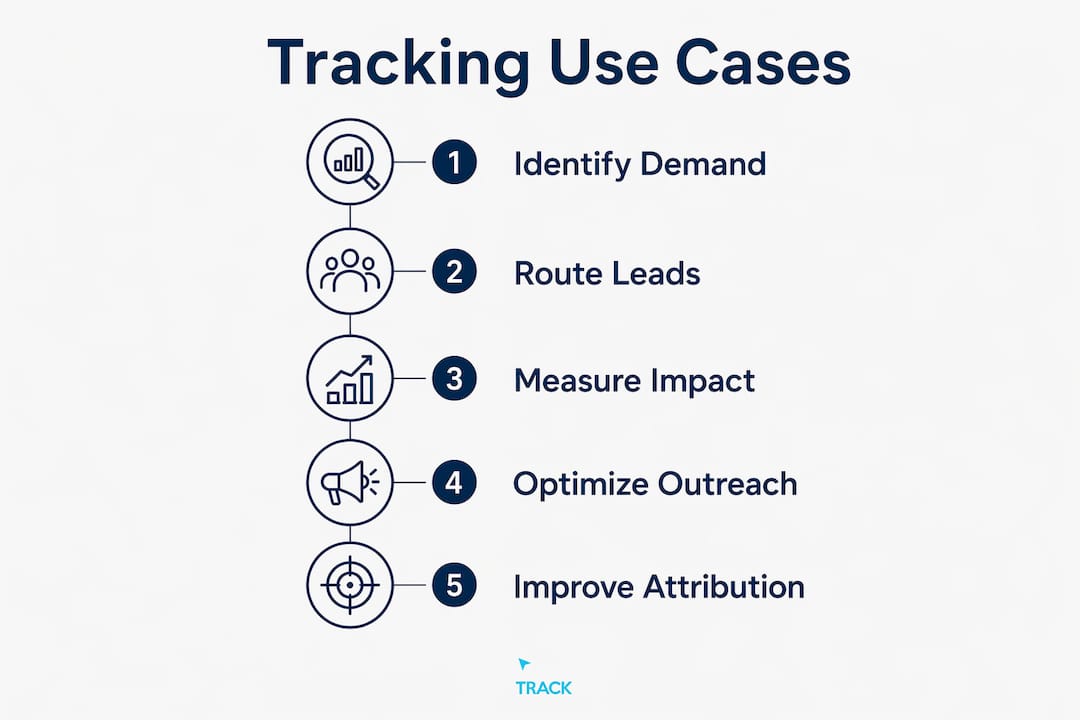
You need five things in place before identification produces usable attribution data: a correctly deployed tracking beacon, validated server-side events, clean UTM parameters, CRM account merging rules, and an enrichment subscription with confidence scoring.
Infrastructure checklist:
- Deploy the tracking beacon on every page and validate it fires on all traffic sources, including paid and direct
- Confirm server-side event collection as a fallback for browsers that block client-side scripts
- Audit UTM hygiene across all paid and organic channels so source attribution survives the CRM push
- Define CRM account merging rules so identified company records do not create duplicates
- Configure automation triggers that route high-confidence matches to the right sales owner or sequence
Most teams see usable signals within a month of a clean beacon deployment. Full attribution validation, where you can link identified accounts to closed revenue, usually takes several weeks to a few months. Tooling costs vary by vendor and traffic volume; expect a usage-based monthly fee for enrichment plus any CRM connector costs. Click Track Marketing's PeoplePixel fits into this stack as the identification and enrichment layer, pushing match confidence and firmographic attributes directly into your CRM fields.
How do you turn identified visits into sales and revenue?
The priority workflow is: detect, score, enrich, route, and engage within 24 to 48 hours. Signals decay rapidly when they sit in a dashboard without automated routing.
- 1CRM alert plus SDR follow-up. A high-confidence match triggers a CRM task and a Slack notification to the account owner within the hour. The SDR reviews the pages visited and sends a personalized outreach referencing the account's specific interest area.
- 1Targeted nurture sequence. Mid-confidence matches that fit your ICP enter an automated email sequence tailored to the content they viewed. A pricing-page visit triggers a different sequence than a blog visit.
- 1Account-based ad reengagement. Identified company domains feed an ad audience that serves relevant content to the account across channels while the SDR sequence runs in parallel.
A typical outreach window spans a couple of days: within the first hour a CRM alert fires and a task is assigned, followed by an initial personalized outreach a few hours later, automated follow-ups if no reply within a day, and a second touch or LinkedIn connection request soon after to close the window.
KPIs to track per workflow: time-to-contact, response rate, pipeline created from identified accounts, and conversion rate from identified visit to booked meeting.
How do you measure whether anonymous tracking is driving revenue?
Measure attribution by linking identified accounts to CRM revenue events, then validate with controlled tests.
| KPI | Formula | Target |
|---|---|---|
| Anonymous-to-known conversion rate | Known contacts created / total identified accounts | Improve over baseline |
| Identified session form submission rate | Form submits from identified sessions / total identified sessions | 3.67% |
| Anonymous session form submission rate | Form submits from anonymous sessions / total anonymous sessions | 1.07% |
| Identified vs. anonymous form multiple | Identified submission rate / anonymous submission rate | 2.4x |
| Assisted pipeline | Pipeline from accounts with prior identified visit | Track as % of total pipeline |
| Revenue influenced | Closed revenue where identification preceded first touch | Compare to unidentified cohort |
| Match rate | Identified sessions / total sessions | Monitor for beacon or data issues |
| Time-to-contact | Minutes from identification to first SDR touch | Under 60 minutes for high-confidence |
Validation tests: run an A/B test where one cohort of identified accounts receives routed outreach and a control cohort does not, then compare pipeline creation rates. Track time-lagged conversions for accounts that visited but did not respond immediately. Compare revenue from identified versus anonymous cohorts over a 90-day window. For a deeper look at tying channel spend to revenue, the marketing attribution guide from Click Track Marketing covers the full attribution infrastructure.
Which tool categories will you need?
You will need five categories of tools working together: reverse IP resolution, identity graph enrichment, server-side event collection, CRM connectors, and automation or sequencing platforms.
- Reverse IP and company resolution tools match IP addresses to company records and return firmographic data. Prefer vendors that expose a confidence score alongside the company match.
- Identity graph and enrichment platforms extend company-level matches to contact-level records where signals allow. Coverage is higher in North America than in regulated markets.
- Server-side event collection captures behavioral data when client-side scripts are blocked, preserving attribution for a meaningful share of traffic.
- CRM connectors push identified records into HubSpot, Salesforce, or your platform of choice. Expect webhook latencies of a few seconds and plan your data mapping before go-live to avoid field mismatches.
- Automation and sequencing platforms convert CRM records into tasks, alerts, and outreach sequences automatically. Without this layer, identified data sits unused.
For teams evaluating larger infrastructure design, Valiz offers analytics and marketing infrastructure consulting that complements identification deployments.
What does a six-step quick-start checklist look like?
Define your ICP, install the beacon, enable enrichment, map your CRM flows, set confidence thresholds, and run a 30 to 90 day pilot.
- 1Define ICP and filters. Document the company size, industry, and geography that qualify as a real prospect. These filters determine what reaches your sales team.
- 2Install and validate the beacon. Deploy the tracking tag across all pages and confirm it fires on paid, organic, and direct traffic.
- 3Enable enrichment and identity matching. Connect your reverse IP and identity graph vendor. Confirm confidence scores are included in the data payload.
- 4Map CRM flows. Define which fields receive company name, confidence score, pages visited, and UTM source. Set account merging rules before data starts flowing.
- 5Set confidence thresholds. Route high-confidence matches to sales immediately. Queue medium-confidence matches for review or automated nurture.
- 6Launch a 30 to 90 day pilot. At day 30, review match rates and beacon health. At day 60, assess pipeline from identified accounts. At day 90, compare revenue influenced to your pre-identification baseline.
Key Takeaways
Anonymous visitor tracking turns unidentified site traffic into company-level intent signals that, when routed within 24 to 48 hours, connect marketing spend directly to CRM pipeline and closed revenue.
| Point | Details |
|---|---|
| Identification is measurement | It surfaces existing demand; it does not create it. Pair it with fast workflows. |
| Beacon health is foundational | A misconfigured beacon breaks attribution before any vendor tool can help. |
| Filter before routing | Apply ICP and confidence-score filters to keep sales queues clean and actionable. |
| Act within 24 to 48 hours | Identified signals decay quickly; automated CRM routing is required, not optional. |
| Click Track Marketing infrastructure | PeoplePixel identifies visitors, BuyerSignals surfaces intent, and PeopleLytics delivers weekly attribution dashboards. |
The infrastructure gap most businesses are still ignoring
Much of the conversation around anonymous visitor tracking focuses on vendor comparisons, such as which tool offers better match rates or cleaner dashboards. That is the wrong question to start with.
The businesses that get real value from identification are the ones that fixed their measurement infrastructure first. They validated the beacon, cleaned their UTM parameters, and defined CRM routing rules before they ever signed a vendor contract. The ones that skipped those steps bought a tool, saw a noisy feed of company names, and concluded that visitor identification does not work.
Silence on your site is not lack of demand. Buying group members and early-stage researchers visit pricing pages, read case studies, and compare solutions without ever filling a form. Identification captures those signals. But the signal is only as good as the infrastructure that receives it. A clean beacon, a properly mapped CRM, and an automated routing workflow are what separate a dashboard full of company names from a pipeline with real revenue attached to it.
Small businesses rarely have the internal resources to build that infrastructure correctly on the first attempt. That is where a measurement-first approach, rather than a tool-first one, makes the difference between a pilot that produces results and one that gets canceled at 90 days.
What Click Track Marketing builds for you
Click Track Marketing helps U.S. businesses set up the full identification and attribution pipeline, from beacon deployment to weekly revenue reporting. The concrete advantage over a DIY approach is that the infrastructure is built correctly from day one, with CRM mapping, confidence scoring, and routing rules configured before the first identified record arrives.

PeoplePixel handles visitor identification and pushes enriched company records directly into your CRM. BuyerSignals layers intent data on top so you know which accounts are actively in-market right now. PeopleLytics delivers a weekly attribution dashboard that shows exactly which channels are producing revenue, not just traffic. Engagements start with a 90-day minimum retainer for bundled services, and PeoplePixel is also available on a standalone usage-based plan.
If you want to see how the full-funnel system works before committing, the AI marketing overview walks through the measurement and attribution approach in detail. Or, if you are ready to talk about your specific setup, request a consulting call to get a direct assessment of your current infrastructure gaps.
Useful sources
- Identified vs. Anonymous Website Visitors: What 1.2M B2B Sessions Show, Primary data on form submission rates across identified and anonymous sessions; source of the 2.4x match-rate figure used in this article.
- Anonymous Website Visitor Tracking Explained, Detailed breakdown of reverse IP lookup, identity graph matching, and company vs. contact-level resolution.
- How Website Visitor Identification Works, Technical walkthrough of the full identification pipeline from beacon to CRM.
- Website Visitor Tracking for B2B Teams, Practitioner guide covering filtering, CRM integration, and privacy compliance for U.S. teams.
- Website Visitor Tracking: Why You Need It for B2B Marketing, Covers beacon deployment as the foundational layer and consequences of misconfiguration.
- Anonymous Website Visitors: What You're Missing and Why It Matters, Explains early buying-signal detection and the timing advantage identification provides.
- Website Visitor Tracking: Definition, How It Works and Privacy, Covers GDPR and U.S. privacy obligations, consent, and responsible data handling practices.
- How Marketing Attribution Works: 2026 Guide, Click Track Marketing's guide to tying identified visits to closed revenue through proper attribution infrastructure.
Want to know exactly which marketing is making you money?
Get a free attribution audit — we'll show you where your leads and revenue actually come from. Answer two quick questions to start.