Quick Answer
ChatGPT ads are sponsored units that appear below a ChatGPT response for logged-in adult users on the Free and Go tiers; OpenAI began testing them in the US on 9 February 2026 and opened a self-serve Ads Manager beta on 5 May 2026. Targeting is not keyword-based — advertisers supply ad-group-level context hints, which OpenAI says are not exact-match keywords and do not guarantee delivery — and delivery is decided by a relevance-weighted second-price auction with CPM and CPC buying. Because paid ChatGPT tiers show no ads at all, the inventory reaches consumers far better than it reaches business decision-makers.
Looking for how to turn ChatGPT ads off?
Short answer, and it costs you nothing to know: ads only serve to logged-in adult users on the Free and Go tiers. Plus, Pro, Business, Enterprise and Education accounts show no ads at all, and accounts registered to users under 18 are excluded. There is no separate ad toggle to find — the tier is the setting.
The rest of this page is for the other kind of visitor: people deciding whether to buy these ads. If that is you, read on.
This is the buying platform, from the inside
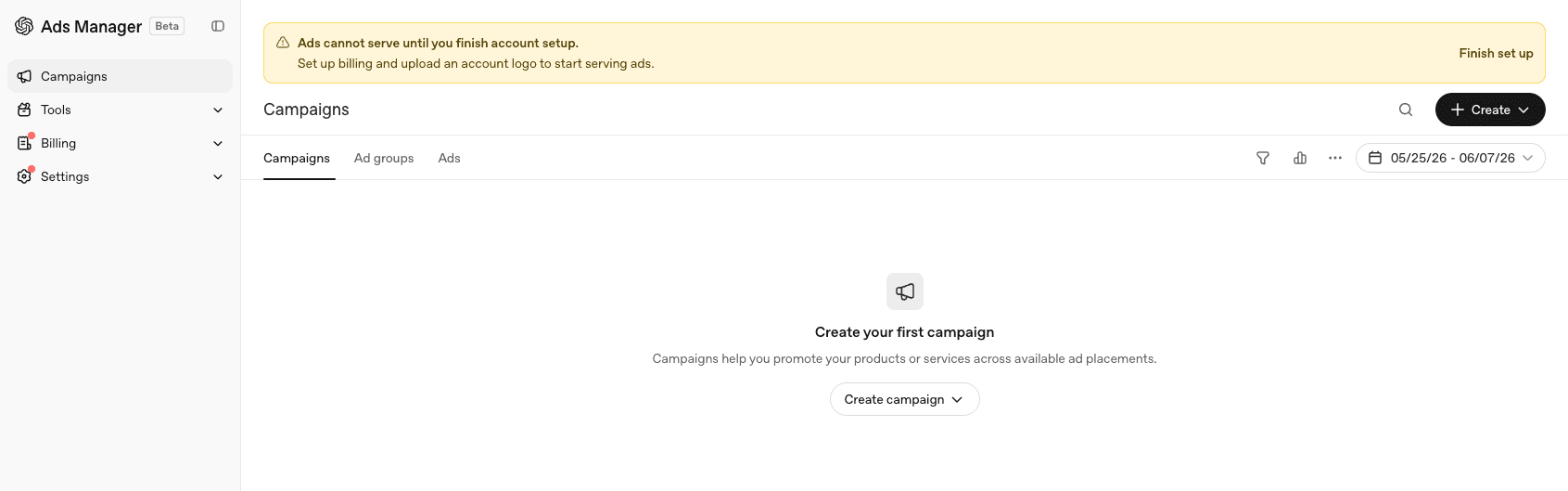
Most pages about ChatGPT ads are written from press coverage. This one is written with the Ads Manager open. OpenAI still labels it “Ads Manager Beta” in its own documentation.
How advertising on ChatGPT actually works
Six mechanics that differ enough from Google Ads and Meta that assuming otherwise will cost you money.
One unit, below the answer
Advertiser name, favicon, title, ad copy, landing page and image. Labelled “Sponsored” and visually separated from ChatGPT’s response. There is no in-answer placement and no page of competing slots.
Context hints, not keywords
Targeting is set per ad group as natural-language “context hints” describing relevant topics. OpenAI states these are not exact-match keywords and do not guarantee delivery. Geography, platform (iOS / Android / web) and custom audiences sit alongside them.
Relevance-weighted second-price auction
Delivery is decided by relevance as well as bid, and the winner pays second-price. Outbidding the market does not buy your way past a poor topical fit.
CPM and CPC buying
Reach campaigns buy on CPM, Clicks campaigns on CPC, with oCPC for product feeds since 7 August 2026. OpenAI recommends a starting maximum bid of $3–$5 per click.
Free and Go tiers only
Ads serve to logged-in adult users on Free and Go. Plus, Pro, Business, Enterprise and Education see none. That single fact determines who you can and cannot reach.
Hard content limits
Political advertising is not permitted at all, and ads are barred from serving in physical health, mental health and political contexts — which removes the most relevant conversations for several whole categories.
We will not quote you a minimum spend
The published figures contradict each other completely. Numbers as high as $200,000 and $50,000 (the latter reportedly eliminated) have circulated, alongside a $25/day figure, while OpenAI’s own documentation indicates no minimum at all. These cannot all be true, and we have no way to reconcile them from outside.
So: there is no published minimum we will stand behind. Verify the requirement in the Ads Manager signup flow for your own account and market before you plan a budget — and treat any agency that quotes a firm number as guessing.
What we can give you is OpenAI’s own bid guidance: start at a $3–$5 maximum CPC on Clicks campaigns.
The timeline, with sources
Ads in ChatGPT are months old, not years. Anyone claiming deep historical expertise is claiming something that cannot exist yet.
9 Feb 2026
Ads launch in the US
OpenAI begins testing ads in ChatGPT for logged-in adult users in the United States, on the Free and Go tiers only. Plus, Pro, Business, Enterprise and Education are excluded, as are accounts registered to under-18 users.
Source: openai.com/index/testing-ads-in-chatgpt/
26 Mar 2026
First international expansion announced
Canada, Australia and New Zealand are announced as the first markets outside the United States.
Source: OpenAI announcement
5 May 2026
Self-serve Ads Manager opens in beta
OpenAI launches the ChatGPT Ads Manager in beta with CPC bidding, a Conversions API and a measurement pixel — the point at which advertisers outside the launch holding companies could buy directly.
Source: openai.com/index/new-ways-to-buy-chatgpt-ads/
7 Aug 2026
oCPC added for product feeds
An optimized-CPC bidding option arrives in the beta for product-feed campaigns.
Source: OpenAI Ads Manager release notes
11 Aug 2026
Nine markets live
Ads are live in the US, Canada, Australia, New Zealand, the UK, Mexico, Brazil, Japan and South Korea. OpenAI's own help documentation still calls the buying platform “Ads Manager Beta.”
Source: help.openai.com — Ads in ChatGPT: the basics
Reported, not confirmed
Trade press has reported a multi-product carousel format, a roughly 1.30% click-through rate, observed CPCs around $4.42–$4.88, and expansion to 31 European countries from 24 August 2026. We have not verified any of those against an OpenAI source, so treat them as unconfirmed and do not plan a budget on them. OpenAI has separately named Dentsu, Omnicom, Publicis and WPP as launch agency partners, with Adobe, Criteo, Kargo, Pacvue and StackAdapt as technology partners.
The part most agencies will not tell you: B2B is reportedly weak
Ads serve only to Free and Go tier users. The people who sign off on software, professional services and agency retainers disproportionately sit on Plus, Pro, Business or Enterprise seats — which show no ads at all. That is not a targeting problem an agency can optimize around; it is the shape of the inventory.
Reported B2B performance has been weak, and the structural explanation above is the obvious reason. If you sell to businesses, our honest recommendation today is usually to wait — and we would rather say that here than after you have funded a quarter of testing.
Controls the beta does not have
No documented demographic targeting.
No lookalike audience building.
No site-retargeting of your own past visitors.
No documented multi-day attribution windows.
No lift studies.
No published minimum spend we are willing to quote — sources contradict each other outright.
If your acquisition model depends on retargeting warm traffic or modelled lookalikes, no agency can configure around a control the platform has not shipped.
How to run a ChatGPT ads campaign today
Five steps, in order. The first one is the one that saves the most money.
Screen whether you should advertise at all
Before anything is built we check three disqualifiers: whether your buyer plausibly sits on a Free or Go tier account, whether your market is live for ads, and whether your category runs into OpenAI's restrictions on physical health, mental health and political contexts. If any of those fail, we say so and recommend against a test rather than spending your budget to prove it.
Write context hints, not keywords
Targeting is set at the ad-group level with context hints — descriptions of the topics and situations where the ad belongs. OpenAI is explicit that these are not exact-match keywords and do not guarantee delivery. That means the craft is describing intent in natural language rather than harvesting query lists, and nobody has years of muscle memory for it yet.
Build for one unit, not a page of formats
There is one placement: advertiser name, favicon, title, copy, landing page and image, labelled Sponsored, below the response. There are no extensions, sitelinks or format tests to hide behind. Creative and landing-page relevance carry the entire campaign, which is why we treat the ad copy and destination as one artifact rather than two.
Bid into a relevance-weighted second-price auction
Delivery is decided by a relevance-weighted second-price auction across CPM (Reach) and CPC (Clicks) objectives, with oCPC available for product-feed campaigns since 7 August 2026. OpenAI recommends starting at a $3 to $5 maximum CPC. We start there, hold it, and let relevance rather than bid inflation do the work.
Measure outside the platform
We deploy the measurement pixel and the Conversions API for server-side events, then reconcile against your CRM. Because the beta has no documented multi-day attribution windows or lift studies, in-console numbers are treated as directional only. The number we report to you is the one your CRM can confirm.
What an agency can honestly do on this platform
Three things — and one of them is telling you no.
Suitability screening first
The most valuable thing we do on ChatGPT Ads is sometimes tell you not to buy. Free-and-Go-only inventory, nine live markets and health/political context exclusions disqualify a real share of businesses. We check that before a campaign is built, not after a month of spend.
Context-hint strategy and creative
Nobody has years of muscle memory for a non-keyword, single-format, relevance-weighted second-price system — the platform is months old. What transfers is disciplined intent description, one-artifact creative-plus-landing-page work, and the patience to let relevance rather than bid inflation win the auction.
Measurement that survives the beta
Pixel plus Conversions API for server-side events, oCPC where a product feed justifies it, and reconciliation against your CRM — because with no documented attribution windows or lift studies, in-console numbers are directional at best.
If you want the service version of this rather than the explainer, that lives on our ChatGPT Ads management page.
For most local businesses, organic ChatGPT citation is the bigger opportunity
Ads reach the Free and Go tiers, in a handful of markets, through a beta control set with no retargeting and no lift measurement. Being the business ChatGPT names when someone asks for a recommendation reaches every tier — including the paid ones where the decision-makers are — does not stop when the budget stops, and compounds month over month.
That work is Answer Engine Optimization. It is not a guarantee of anything: model output is non-deterministic, the same question can produce different answers on different days, and nobody can promise you a citation. What it is, for most of the local and service businesses that come to us asking about ChatGPT ads, is the better first dollar.
What working with us costs
Flat monthly fees, published up front. Websites are $297/mo on a 12-month minimum. Foundational engagements run $2,000–$3,500/mo on a 90-day minimum, and $5,000/mo adds social with Buzz Marketing Co. A standalone AEO add-on starts at $1,500. Media spend on ChatGPT Ads is separate and goes to OpenAI, not to us.
You own your website and your ad accounts, on the way in and on the way out. Founder David Esau is a former Google Partnerships and Technical Account Manager, and the agency is rated 5.0 on Google.
ChatGPT Ads: Frequently Asked Questions
Want to know exactly which marketing is making you money?
Get a free attribution audit — we'll show you where your leads and revenue actually come from. Answer two quick questions to start.
Not sure whether ChatGPT ads fit your business?
Tell us who you sell to and we'll tell you straight — including if the answer is that the inventory can't reach your buyer yet and your budget belongs somewhere else.
“They set up automation for every pipeline stage, so nothing falls through the cracks. David and his team are genuinely invested in our success.”
— Christopher Whitney · Google Review