
An AI SEO Agency That Shows You the Answer, Not a Deck
Your customers are asking assistants for a shortlist before they ever open a search results page. Click Track Marketing builds the technical foundation, the extractable content, and the authority signals that get a business named in those answers — and measures it with a fixed prompt set instead of a vibe.
We publish our pricing, we publish our measurement method, and we say plainly where the evidence is thin. No one can promise you a citation in ChatGPT. Anyone who does is guessing.
Quick Answer
An AI SEO agency optimizes a business for how people find answers now — traditional Google rankings plus visibility inside Google AI Overviews and AI Mode, ChatGPT, Perplexity, Gemini, and Copilot. The work is a superset of SEO: the same crawlability, entity, and authority fundamentals, plus structured direct answers systems can extract, source-worthy material they will cite, verified AI-crawler access, and measurement that tracks how often you are mentioned and cited in generated answers rather than only where you rank. Click Track Marketing runs that programme on a flat monthly fee, with published pricing and a documented measurement method.
You Can Hold Position One and Still Lose the Session
The uncomfortable part of AI search is not that rankings stopped mattering. It is that ranking well no longer guarantees the visit, because the answer is delivered on the results page instead of on your site.
The Pew Research Center studied 900 US adults across 68,879 real Google searches and found that users clicked an organic result on 8% of visits where an AI summary appeared, versus 15% of visits with no summary. Only 1% clicked a link inside the summary itself. AI summaries appeared on 18% of searches in that sample.
A Semrush study of more than 600,000 keywords, updated 2 July 2026, found AI Overviews grew 71% on commercial-intent SERPs while falling 5% on transactional ones. Read that carefully: the research phase is where AI is taking over, and the transactional click is still yours to win. That is an argument for running both programmes, not for abandoning SEO.
Source: Semrush AI Overviews commercial search study, updated 2 July 2026
On the other side of the ledger: Search Engine Land published Jason Tabeling’s analysis of 13 months of Google Analytics data across one agency’s client base — a single-agency dataset, not an industry benchmark — finding LLM referral traffic was under 2% of referral traffic but converted at roughly 18%. Small volume, unusually well pre-qualified. We would not price an engagement on the assumption you will see 18%, and we instrument your analytics so you measure your own number.
Those three studies are the entire evidence base we will cite to you. We do not repeat the “AI traffic converts 23x better” figures circulating on agency blogs, because we cannot trace them to a methodology.
AI SEO vs AEO vs GEO
These three terms get used interchangeably across the industry, including by agencies selling all three. There is no settled consensus. Here is how we draw the lines — it is our positioning, not an industry standard, and we would rather tell you that than pretend otherwise.
The distinction that actually matters in the work: being extracted and being cited are different outcomes with different tactics.
AI SEO
The umbrella programme
Everything that makes a business findable across search and assistants — including traditional rankings, which still feed the retrieval layer every AI answer is built on.
Optimizing for: Being present in the index the generation step draws from.
You are on the umbrella pageAEO
Answer Engine Optimization — being extracted
Getting your exact words lifted into a featured snippet, People Also Ask, or an AI Overview. Rewards structured, self-contained direct answers a system can pull cleanly.
Optimizing for: Extraction. Short, complete, unambiguous answers.
AEO servicesGEO
Generative Engine Optimization — being cited
The academic term. Getting synthesized into a generated answer and credited as a source. Rewards being quotable, attributable, and corroborated elsewhere.
Optimizing for: Citation. Original, specific, attributable material.
GEO servicesIn practice one programme covers all three, which is why we sell it as AI SEO. The method pages go deeper: AEO services for extraction, and generative engine optimization for citation.
AI SEO vs Traditional SEO
AI SEO is not a replacement for SEO. It is SEO plus a second scoreboard. If your site is not in the underlying index with authority on the topic, there is nothing for the generation step to retrieve — traditional SEO is the supply side of AI visibility.
| Traditional SEO | AI SEO adds | |
|---|---|---|
| Goal | Rank in the ten blue links | Be the source the generated answer is built from — and still rank |
| Unit of success | Position for a keyword | Mention rate and citation rate for a prompt |
| Content shape | Comprehensive pages that reward a click | Passages that survive being lifted out of context |
| Technical focus | Crawlability, speed, Google indexation | Same, plus verified AI-crawler access and Bing indexation |
| Authority signal | Links and domain strength | Links, plus attributable expertise and third-party corroboration |
| Reporting | Rank tracker, deterministic | Fixed prompt set on a cadence — non-deterministic, read as a trend |
The Surfaces We Optimize For
These systems retrieve from overlapping indexes — Google’s for AI Overviews and Gemini, Bing’s for Copilot and much of ChatGPT search, a mix for Perplexity. That overlap is why one foundation serves all of them, and why Bing indexation matters far more than most SEO programmes assume.
Google AI Overviews
The generated summary above the blue links. Built from a handful of retrieved sources — being one of them is the whole game.
Google AI Mode
Google's conversational search surface. Follow-up questions, fewer links, and a much shorter list of cited sources.
ChatGPT
Answers from training data plus live search. Leans on Bing-derived retrieval, which is why we verify Bing indexing rather than assume it.
Perplexity
Citation-first by design — every claim carries a numbered source. The most transparent surface to measure, and the fastest to move.
Google Gemini
Shares Google's retrieval infrastructure, so entity clarity and structured data work here carries across surfaces.
Microsoft Copilot
Bing's index end to end. Sites indexed well in Google but poorly in Bing are invisible here, and that gap is common.
Every Agency Claims AI Citations. Here Are Ours.
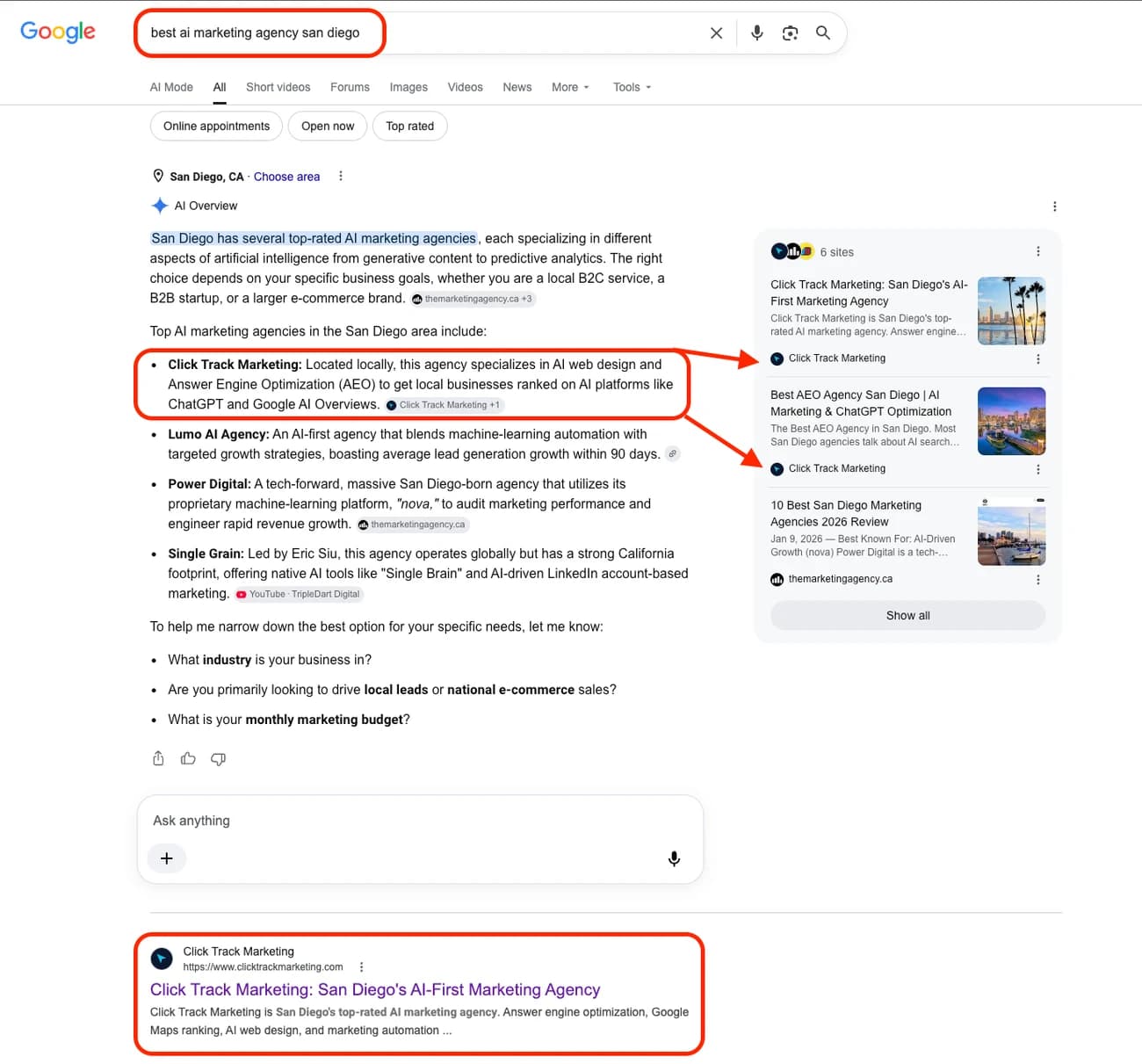
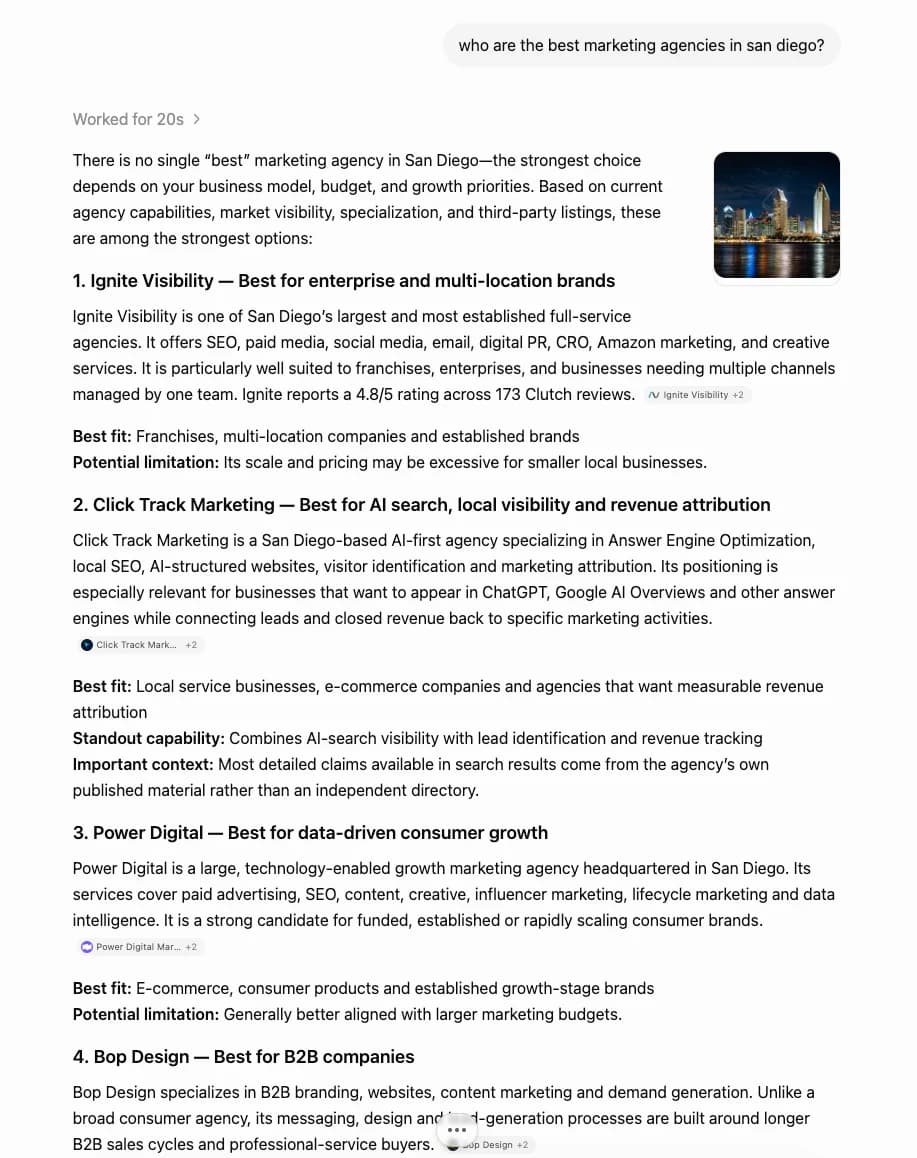
Almost every page competing for this term claims its clients get cited by AI. Almost none of them show it. These are screenshots of real answers naming Click Track Marketing, dated — because AI answers change, and undated proof quietly becomes a false claim. Run the same prompt today and you may get something different. That is the honest nature of the medium.
How We Actually Measure This
Most AI SEO pages never say how they report results, which usually means screenshots when things go well and silence when they do not. Here is our method in full, including the parts that make it imperfect.
A fixed prompt set
We agree on 30 to 60 buying-intent prompts a real customer would type — shortlist questions, comparison questions, problem-first questions. The set is fixed at the start so month three is comparable to month one. Adding a prompt because it started performing would make the report meaningless.
Two numbers, not one
Mention rate is how often your brand is named in the answer. Citation rate is how often your domain is linked as a source. They move independently — you can be recommended without being linked — and collapsing them into one number hides which lever worked.
Per platform, on a cadence
Every prompt is run against ChatGPT, Perplexity, Google AI Overviews and AI Mode, Gemini, and Copilot on a set schedule and logged separately. Platforms diverge sharply — a Perplexity win often precedes a ChatGPT one by weeks — and an averaged score would hide that.
Tied back to revenue
Visibility is not the point. AI referral traffic is isolated as its own GA4 channel and leads are attributed in the CRM, so the conversation is about booked work rather than screenshots.
The caveat we lead with
LLM output is non-deterministic. The same prompt can return different answers in different sessions, from different accounts, in different regions, and a model version update can change everything overnight. No agency controls these outputs, and anyone promising you a fixed position in ChatGPT is describing something that does not exist. What a fixed prompt set gives you is a trend across months — which is genuinely useful, and is not the same thing as a rank tracker. We will tell you which movements we can attribute to our work and which we cannot.
What's in an AI SEO Engagement
The unglamorous items near the top of this list are usually the ones that move the needle first. Verifying AI-crawler access takes an afternoon and can be the difference between being retrievable and being invisible.
Baseline AI visibility audit across ChatGPT, Perplexity, Google AI Overviews, AI Mode, Gemini, and Copilot
AI-crawler access verification in server logs — GPTBot, OAI-SearchBot, PerplexityBot, ClaudeBot are blocked by default on many CDNs
JSON-LD entity graph with stable @id references: Organization, LocalBusiness, Person, Service, FAQPage, BreadcrumbList
Bing Webmaster Tools indexing and IndexNow submission — the supply side for Copilot and ChatGPT search
Answer-first content rewrites so any single passage stands alone when extracted
Comparison, best-for, and pricing content — the formats assistants reach for on shortlist prompts
Named expert authorship and E-E-A-T signals so a model can attribute expertise to a real person
Entity and citation consistency across the third-party sources these systems weight most heavily
Traditional technical SEO: crawlability, internal linking, Core Web Vitals, indexation hygiene
Fixed prompt-set tracking reporting mention rate and citation rate by platform, on a cadence
AI referral traffic isolated as its own GA4 channel, with leads attributed in the CRM
Our AI SEO Process
Five stages, in this order, because each one depends on the last. Content work before crawler access is verified is wasted money.
Baseline Audit Across Named Platforms
We build a fixed set of 30 to 60 buying-intent prompts your customers would actually type, run them across ChatGPT, Perplexity, Google AI Overviews and AI Mode, Gemini, and Copilot, and record where you appear and where a competitor does instead. In parallel we verify in server logs whether GPTBot, OAI-SearchBot, PerplexityBot, and ClaudeBot can reach your site at all, and audit indexation in both Google and Bing. You get a scored baseline before anything is changed.
Technical & Entity Foundation
We fix the supply side: a coherent JSON-LD entity graph (Organization, LocalBusiness, Person, Service, FAQPage) with stable @id references, confirmed AI-crawler access at both the robots.txt and CDN or WAF layer, Bing indexing verified rather than assumed, and internal linking that makes topical ownership obvious. This is the unglamorous work that decides whether there is anything for a retrieval layer to find.
Answer-First Content
We restructure pages so any single passage survives being lifted out of context — direct answers in the first two sentences, self-contained FAQs, comparison and best-for content, and specifics an assistant can attribute rather than generic claims it will paraphrase away. This is the AEO half of the work: being extractable. Depth on the method lives on our AEO services page.
Authority & Corroboration
Generative engines cite sources they can attribute. We strengthen the signals that decide that: named expert authorship, original data and first-hand proof rather than restated consensus, consistent NAP and profile data across the web, and third-party corroboration on the sources these systems weight most heavily. This is the GEO half — being synthesized and credited.
Measure, Report, Compound
The fixed prompt set runs on a cadence and reports two separate numbers per platform: mention rate and citation rate. Alongside that, AI referral traffic is isolated as its own GA4 channel and leads are attributed in the CRM. We state plainly that LLM output is non-deterministic — the same prompt varies by session and model version — so we read the trend across months, not any single run, and we flag what we cannot attribute instead of claiming it.

Who You're Actually Hiring
Click Track Marketing is led by David Esau, a former Google Partnerships and Technical Account Manager. That is platform-side experience — how ranking and retrieval systems are built and how partners are supported — rather than agency-side theory about them. It is not a credential anyone else competing for this term has.
We are based in San Diego, rated 5.0 on Google, and work with national and local clients. Flat monthly fee, no percentage of ad spend. You own your website, your ad accounts, and your data — including on the day you leave.
What It Costs
Almost no AI SEO company publishes pricing, which is how a $1,500 scope and a $12,000 scope end up on the same sales call. Ours is on the site.
$2,000–3,500
per month · 90-day minimum
Foundational programme
The full AI SEO engagement: technical and entity foundation, answer-first content, authority work, and prompt-set measurement. Where most clients sit.
From $1,500
per month · add-on
Standalone AI-search add-on
For businesses already running SEO elsewhere who want the AI-search layer and the measurement without replacing their existing agency.
$5,000
per month
Full programme plus social
Everything above with social media added in partnership with Buzz Marketing Co. Websites are built separately at $297 per month on a 12-month minimum.
Go Deeper on the Method
Generative Engine Optimization
The citation side — how to become a source a generated answer credits.
AEO Services
The extraction side — structured answers built to be lifted into snippets and AI Overviews.
SEO in San Diego
The traditional-search foundation everything above depends on.
Agent Search Optimization
What happens when AI agents browse your site on a buyer’s behalf.
AI SEO — Frequently Asked Questions
Want to know exactly which marketing is making you money?
Get a free attribution audit — we'll show you where your leads and revenue actually come from. Answer two quick questions to start.
Find Out Where You Actually Stand in AI Search
We'll run a prompt set for your market across ChatGPT, Perplexity, Google AI Overviews, Gemini, and Copilot, and show you where you appear, where a competitor appears instead, and whether AI crawlers can even reach your site. No obligation.
“They set up automation for every pipeline stage, so nothing falls through the cracks. David and his team are genuinely invested in our success.”
— Christopher Whitney · Google Review