
How to Rank Higher on Google Maps
Quick Answer
To rank higher on Google Maps, optimize your Google Business Profile (categories, services, photos, and posts), earn a steady stream of genuine reviews, keep your name, address, and phone consistent everywhere online, and reinforce it all with local content on your website. Google ranks the map pack on three things — proximity, relevance, and prominence — and most businesses can move relevance and prominence within 60 to 90 days.
When a customer looks for what you sell nearby, Google shows three businesses on the map. Those three get the calls. Here is exactly how to become one of them, step by step, and how the game changed in 2026.
Why the Map Pack Is the Whole Ballgame
Nearly half of all Google searches have local intent, and the local 3-pack sits above everything else. Those three listings capture the vast majority of clicks and calls.
When someone searches for a service "near me," the map pack appears first — above the ads and above the organic links. Most people choose from those three without scrolling further.
For service-area businesses like contractors, plumbers, and cleaners, the map pack is where almost every new lead starts. If you're not in the top three, many customers never learn you exist.
Even if your website ranks well organically, the map sits above it. A ready-to-buy customer will call the business in the top three Maps results before they scroll down to your blue link.
The 3 Things Google Ranks the Map Pack On
Every tactic below ladders up to one of these. You can't change proximity, but relevance and prominence are yours to win.
Proximity
How close you are to the person searching. You can't move your building, but you can widen your reach with accurate service areas and local relevance so you show up across more of your market.
Relevance
How well your profile and website match what the searcher wants. Your primary category, services, descriptions, and on-site content all tell Google exactly what you do.
Prominence
How well-known and trusted your business is. Reviews, citations, links, and an active profile are the levers here — and it's where most businesses win or lose the map pack.
How to Rank Higher on Google Maps, Step by Step
Eight moves, in order. The first six you can start today; the last two are where established businesses pull ahead.
Claim and verify your Google Business Profile
Create or claim your free Google Business Profile and finish Google's verification. An unclaimed or unverified profile can't rank in the map pack, no matter how good your business is.
Pick the most specific primary category
Your primary category is the single biggest on-profile ranking lever. Choose the most specific one that matches your core service ("emergency plumber," not just "plumber"), then add relevant secondary categories.
Complete every field
Fill in your services with real descriptions, service areas, hours, attributes, and products. Google rewards complete, accurate profiles. Every empty field is a ranking and a customer you leave on the table.
Add real photos and post regularly
Upload genuine photos of your work, team, and location on an ongoing basis. Publish Google Posts and answer questions in the Q&A. Consistent activity signals a live, real business Google can trust.
Build a steady review engine
Ask every happy customer for a Google review by text and email. Count, recency, rating, and your responses are the strongest prominence signal there is. Reply to every review, good and bad.
Fix your NAP and clean up citations
Make your business Name, Address, and Phone identical everywhere online — directories, social profiles, and your website. Inconsistent listings create doubt, and doubt is why Google leaves you out.
Add local content and schema to your website
Publish service and location pages and add LocalBusiness schema so Google connects your website to your profile and your service area. Your site and your profile should reinforce each other.
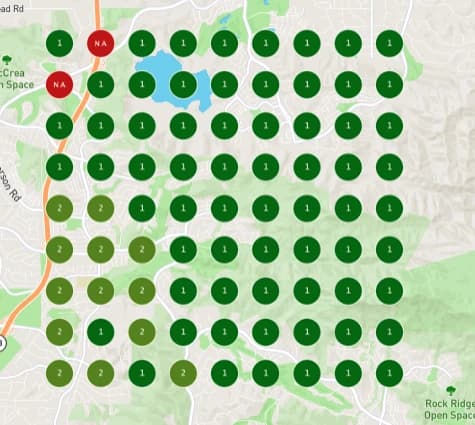
Track your rank as a geo-grid
Your map rank changes block by block. Track it across a grid of points in your service area, not one search from your office, so you can see where you actually win and where you're losing customers.
Get the Complete Guide as a Free PDF
The full 15-page Local Search Simplified guide — Google Maps, AI search, reviews, and how to finally know what your marketing actually makes you. Tell us where to send it.
- The 8-step Google Maps ranking playbook
- How to get recommended by ChatGPT and AI Overviews
- A 90-day local domination plan
Free PDF · takes 10 seconds.
“We rank #3” is a myth. You rank differently on every block.
Because proximity is a ranking factor, your Google Maps position changes with the searcher's exact location. A business can be number one at its front door and invisible three miles away. Checking your rank with one search from your office tells you almost nothing.
The businesses that win track their rank as a geo-grid — their position for each keyword across dozens of points spread over the service area. That's the only way to see where you truly win, where you're losing customers, and where to focus next.
The Map Pack Isn't the Only Place Customers Decide Anymore
Ranking on Google Maps is still essential, but it's no longer the whole story. A fast-growing share of customers now ask an AI engine — ChatGPT, Google's AI Overviews, Perplexity — “who's the best [service] near me?” and act on the single recommendation it gives back.
The good news: the work that wins the map pack also wins AI search. AI engines read the same signals — your Business Profile, your reviews, your reputation, and the content on your site — to decide who to name. Optimizing for one strengthens the other. The businesses that show up in AI answers today will be very hard to displace tomorrow, and almost no one is optimizing for it yet.
Want the full picture? Read our guide on how to rank in AI search results, or see how we approach Answer Engine Optimization.
The Question That Actually Matters: Is It Making You Money?
Ranking is the means, not the end. The point of the map pack is calls, booked jobs, and revenue — and most businesses can't tell which of their marketing actually produced it. Leads arrive with no source attached, and standard analytics quietly mislabel where customers came from (visitors from AI engines often get dumped into “referral,” and Maps traffic disappears into the pile).
The fix is proper attribution: sort every visit into clean channels — Organic, Google Maps, Paid, and AI Search as its own channel — then tie each one to the calls, forms, and dollars it drives. That's how “I think it's working” becomes “this channel returned this much.”
It's exactly what our revenue intelligence platform does — see it at clicktrackanalytics.com.
Common Google Maps Ranking Mistakes
- Stuffing keywords into your business name — a Google guideline violation that can get your profile suspended.
- Buying fake reviews. Google detects and removes them, and it can cost you the whole profile.
- Letting your NAP drift out of sync across directories after a move or phone change.
- Choosing a broad primary category when a specific one would win.
- Ignoring reviews — never asking, and never responding.
- Judging your rank from a single search at your desk instead of across your service area.
This Is What It Looks Like When It Works
We run this exact playbook for our clients — and on ourselves.
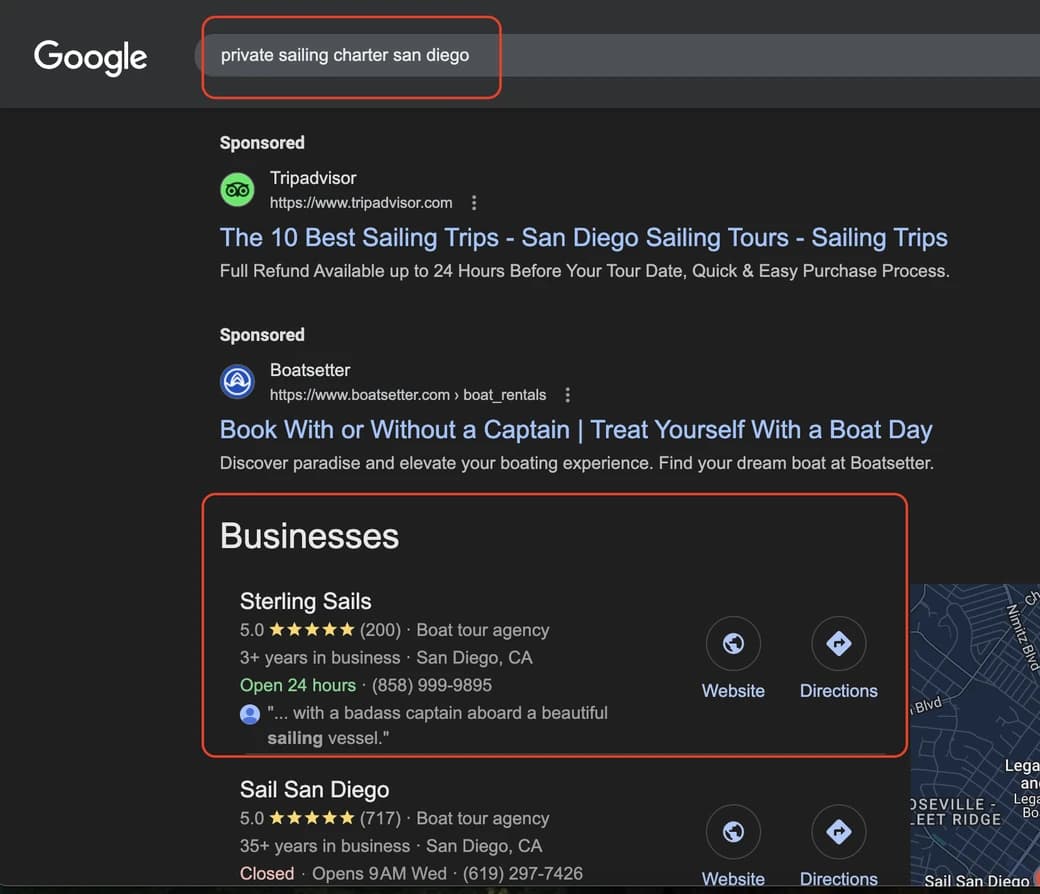
Client ranked #1 in the map pack
Sterling Sails owns the top spot for “private sailing charter san diego” — 5.0 stars, 200 reviews.
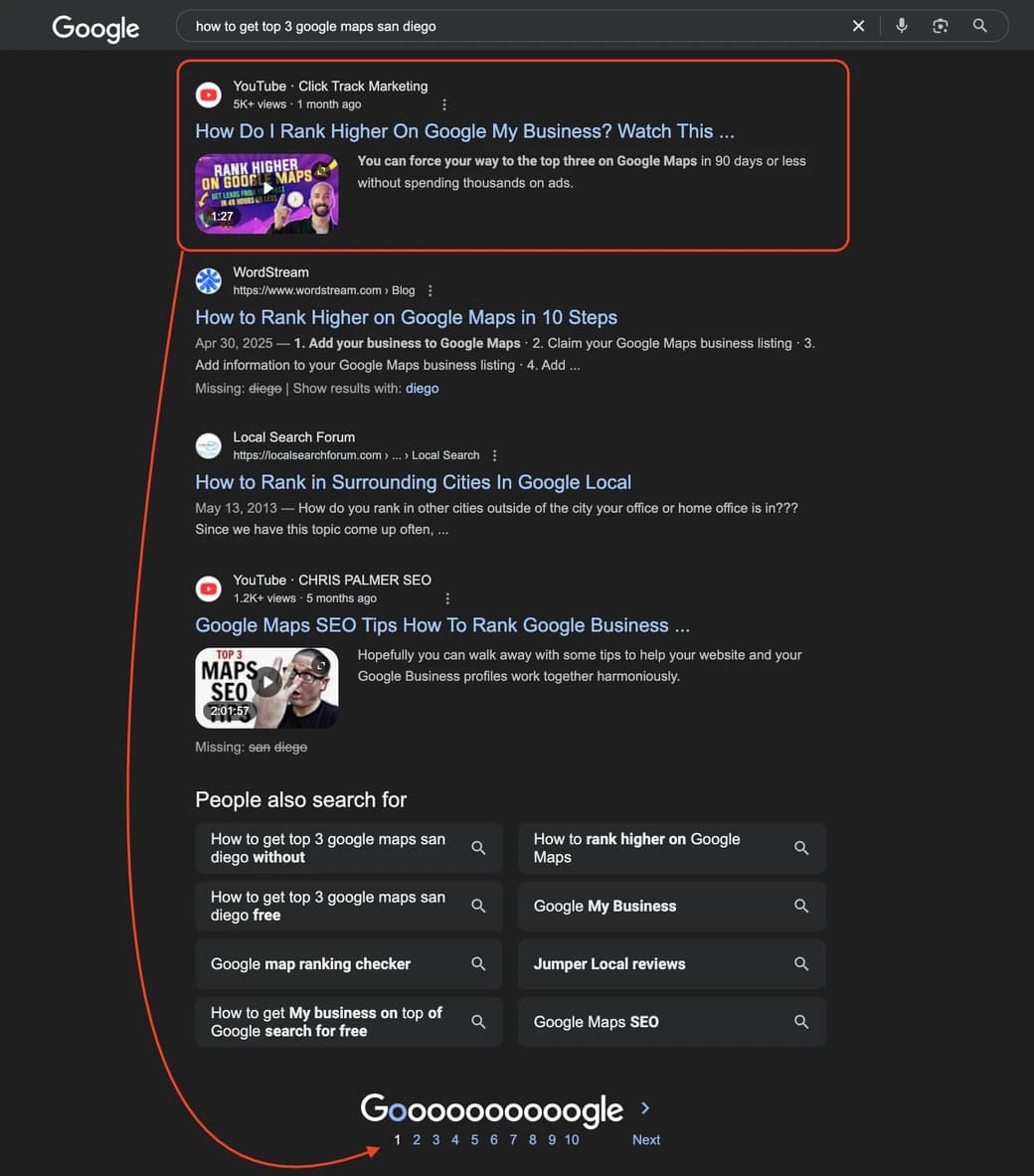
We rank #1 for this exact topic
Our own video sits at the top of Google for “how to get top 3 google maps san diego.” We practice what we teach.

One 45-day test → six more locations
After a 45-day test on a single location, this client is ready to roll it out to six more. (Name redacted.)
Rather Have It Done for You?
This guide is everything you need to do it yourself. If you'd rather run your business than run its local SEO, we handle the whole system — profile, reviews, citations, content, and geo-grid tracking — for a flat monthly fee, and we tie it to real revenue.
Google Maps Ranking: Frequently Asked Questions
See Where You Rank on Google Maps Right Now
Get a free visibility scan across Google, the map pack, and AI search — where you stand today and the fastest way to the top 3. No cost, no commitment.
Verified by third parties

Stop Losing Calls to the Business Listed Above You
Get a free local SEO audit that shows exactly where you rank on Google Maps today, what your competitors are doing, and the steps to reach the top 3.
“We went from page two to the top three on Google Maps in eight weeks. Our calls doubled.”
— Luis R., San Diego Painting Company