
AEO Services — Be the Answer, Not the Tenth Blue Link
Answer engines do not send traffic for ranking. They send it for being quotable. Our AEO services make your pages structurally easy to extract — into featured snippets, People Also Ask, Google AI Overviews, and the citations inside ChatGPT and Perplexity answers.
Run by Click Track Marketing, San Diego. Founded by David Esau, a former Google Partnerships and Technical Account Manager. Flat monthly fee, you own your site and accounts, and we tell you what we cannot prove.
Quick Answer
AEO services are the technical and editorial work that makes a website easy for an answer engine to extract a direct answer from — structured data, entity disambiguation, answer-first content, AI-crawler access, and third-party corroboration. The goal is to appear inside featured snippets, People Also Ask, Google AI Overviews, and the citations of ChatGPT and Perplexity answers, rather than merely to rank beneath them. Because model output is non-deterministic, AEO is measured as appearance frequency across repeated prompts, not as a fixed position.
What AEO Actually Optimizes For
The word that matters is extracted. An answer engine takes a passage from a page and presents it as the answer — in a featured snippet, a People Also Ask panel, or an AI Overview. AEO is the discipline of making sure that passage is yours: structured, self-contained, and unambiguous about who wrote it and what it refers to.
That is a different job from being synthesized — paraphrased across several sources inside a generated answer and cited alongside them. That is generative engine optimization, and it has its own research base and its own tactics. We cover it separately on our generative engine optimization page. The two overlap heavily and most engagements run both; they are not the same objective.
If you want the full taxonomy — how AEO, GEO and AI SEO relate, and which one your situation calls for — start at our AI SEO agency hub. This page is the deep version of the AEO half: methodology, deliverables, measurement, and proof.
AEO vs SEO
AEO is not a replacement for SEO — it sits on top of it. An engine still has to crawl, index and trust a page before it can quote one. What changes is the unit of success.
| SEO | AEO | |
|---|---|---|
| What you win | A ranked position in a list of links | An extraction or a citation inside the answer itself |
| Unit of content | The page | The quotable passage |
| Primary lever | Relevance, authority, links | Extractability, structure, corroboration |
| Measured by | Rank, impressions, clicks | Appearance frequency across repeated prompts, citations, AI referral sessions |
| Result stability | Deterministic enough to track daily | Non-deterministic — varies by user, session and model version |
Why the Click Is Disappearing
There is a great deal of unsourced statistics in this market. Here is one measurement we are willing to stand behind, because the methodology is published. Pew Research Center tracked 900 US adults across 68,879 searches in March 2025:
8% vs 15%
Clicked an organic result with an AI summary present, versus without one
1%
Clicked a link inside the AI summary itself
26% vs 16%
Sessions that ended entirely with a summary present, versus without
18% / 88%
Of searches produced an AI summary; 88% of those cited three or more sources
Read those last two together, because that is the whole argument for AEO. Clicks fall sharply when a summary appears — but the summaries overwhelmingly cite multiple sources. The visibility does not vanish; it moves inside the answer. Being one of the three or more cited sources is the position worth competing for.
Source: Pew Research Center, 22 July 2025 — 900 US adults, 68,879 searches, March 2025 data.
The Engines We Work Against
These are not interchangeable. They differ in whether they retrieve live pages, whose index they borrow, and whether they cite at all — which changes both the tactics and what can honestly be measured.
ChatGPT
Both the model’s own knowledge and ChatGPT search, which retrieves live pages and cites them. Its web results lean partly on Bing’s index.
Perplexity
Retrieval-first by design and always shows numbered sources. The cleanest engine to measure against, because every answer names the URLs it used.
Google AI Overviews & AI Mode
The highest-volume answer surface there is, and the one where extraction — being lifted directly from a page — matters most.
Google Gemini
Shares Google’s grounding infrastructure, so work that earns AI Overview citations tends to carry over.
Microsoft Copilot
Built on Bing’s index. If you are not indexed in Bing, you are structurally invisible here — which is why Bing indexing is a deliverable, not an afterthought.
Our AEO Process
Six stages, in order. Stage one exists because a meaningful share of the sites that ask us why they are invisible in AI answers turn out to be blocking the crawlers outright.
Extraction Audit
We run your actual buying questions against ChatGPT, Perplexity, Google AI Overviews, Gemini and Copilot, and log what comes back — who is named, which URLs are cited, and where you are absent. In parallel we audit whether GPTBot, OAI-SearchBot, PerplexityBot and ClaudeBot can reach your site at all, validate every schema type, and check Bing indexing coverage. You get a scored baseline and the raw prompt log before any work starts.
Access & Entity Foundation
We clear whatever is blocking AI crawlers in robots.txt or at the CDN, then build the machine-readable layer: Organization, Product, Service, FAQPage, HowTo and Article schema with a linked @id graph, sameAs references to your authoritative profiles, Wikidata alignment where it applies, and consistent name, address and phone data everywhere it appears. This is what lets an engine tell your business apart from every similarly named entity.
Answer-First Restructuring
We rewrite the pages that matter so the answer comes first: a direct two-to-three sentence response under a question-shaped heading, then the supporting detail. Comparison tables, definitions, and self-contained FAQ entries give engines clean, quotable units. The test we apply is simple — can a passage be lifted out of context and still be correct and attributable?
Corroboration & Citations
Engines rarely rely on your own claims about you. We pursue third-party coverage on the sources these models actually retrieve — industry publications, review platforms, structured directories, community discussion — and pursue Bing rankings deliberately, since Bing's index feeds Copilot and part of ChatGPT search. Original data and named expert attribution do more here than volume of links.
Measurement & Attribution
We track a fixed prompt set on a schedule with AI search monitoring tools, keeping AI search results (retrieved, cited) separate from LLM knowledge probes (uncited). GA4 is segmented so chatgpt.com, perplexity.ai, gemini.google.com and copilot.microsoft.com referrals are isolated rather than lost in Direct, and lead attribution ties AI-sourced sessions to booked revenue. Bing Webmaster Tools indexing serves as the leading indicator.
Iterate on Evidence
Every month we rerun the prompt set, compare appearance frequency against baseline, and reallocate effort toward the questions and pages where movement is real. Because model output varies by session and version, we judge on trend across repeated probes rather than on any single screenshot — including our own.
What You Actually Get
Six work streams. Every one of them is verifiable — you can open the page source, read the robots file, check the server log, or rerun the prompt yourself.
Structured data implementation
FAQPage, Organization, Product, Service, HowTo, Article and BreadcrumbList markup, built as a linked @id graph rather than isolated blobs. Validated on deploy and monitored afterwards — schema quietly breaking during a redesign is one of the most common regressions we find.
Entity disambiguation & consistency
sameAs references to your authoritative profiles, Wikidata alignment where it applies, and identical name, address and phone data everywhere it appears. This is how an engine tells your business apart from every other company sharing your name.
Answer-first content restructuring
Question-shaped headings, a direct two-to-three sentence answer before the supporting detail, comparison tables, and self-contained FAQ entries. The test: can a passage be lifted out of context and still be correct and attributable to you?
AI-crawler access audit
Verifying GPTBot, OAI-SearchBot, PerplexityBot and ClaudeBot are not blocked in robots.txt or by a bot-mitigation rule at your CDN or WAF. A real, checkable failure — confirmed in server and edge logs, not guessed at — and usually cheap to fix.
Digital PR & third-party citations
Coverage on the sources these models actually retrieve: industry publications, review platforms, structured directories, and community discussion. Engines rarely take your word about you; corroboration is what makes a claim usable.
Bing indexing & ranking
Bing feeds Copilot and part of ChatGPT search. We treat Bing Webmaster Tools coverage as a first-class deliverable and a leading indicator — pages get indexed in Bing before they show up in AI answers.
Proof, With the Caveats Attached
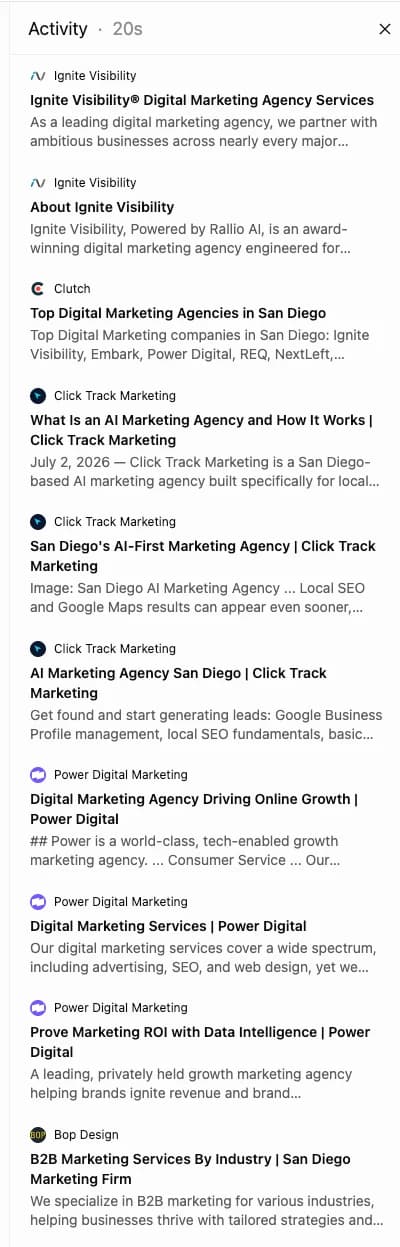
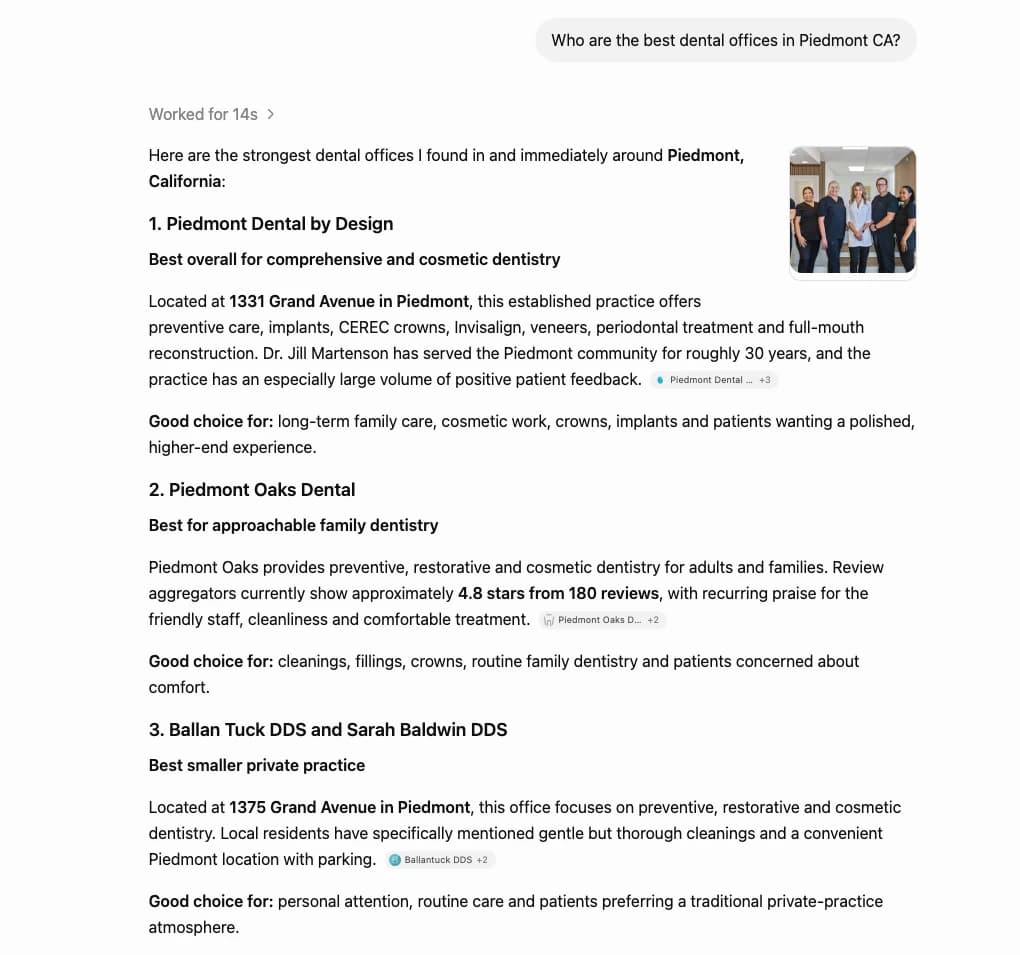
Most pages selling AEO show a dashboard reading something like “Citation Rate 73%” with no client named, no prompt shown, and no methodology. That number is unfalsifiable and therefore worthless. Here are two captures with the date and the prompt attached, so you can rerun them.
The necessary caveat: large language model output is non-deterministic. Rerunning these prompts may not reproduce these exact answers — results vary by user, session, personalization and model version. A screenshot is evidence that something happened once, not a guarantee that it happens every time. That is precisely why we report appearance frequency across repeated probes rather than trophies.
What Does Not Work — and What We Stopped Selling
A shortlist of things routinely sold as AEO that we do not sell, with the reason. If a competing proposal contains one of these, it is a fair question to raise.
llms.txt
Google’s John Mueller has said publicly that none of the AI services report using llms.txt, and that server logs show their crawlers do not even request it — he compared it to the keywords meta tag. Ahrefs analysed 137,210 domains in June 2026 and found that of the roughly 38,000 carrying a valid llms.txt, only about 1,100 received a single request — and AI retrieval bots accounted for about 1 percent of those.txt files are never fetched. We removed it from our own site and from everything we sell. If an agency lists it as a core deliverable, ask them for a server log.
“Voice search optimization”
Recycled 2018 positioning with little current evidence behind it as a distinct discipline. The work that genuinely helps — concise direct answers, question-shaped headings, valid schema, accurate local data — is already in the AEO list above. Paying for it twice under a second name does not double the outcome.
A guaranteed ChatGPT mention
Nobody can deliver this. Model output is non-deterministic: the same prompt returns different brands to different users, in different sessions, and across model versions, and personalization shifts it further. What is real is appearance frequency measured across repeated probes. Anyone selling a guarantee is selling a screenshot.
“Results in 60–90 days”
You will see this on nearly every agency page in this market, almost always with no basis behind it. Ours comes from our own client base rather than a published study, and it is an average, not a promise. Mechanical fixes — unblocking a crawler, repairing schema — can shift indexing behavior within days; citation and authority work compounds over months. We report from month one so you watch a trend instead of waiting on a number.
How AEO Gets Measured
There is no rank tracker for an answer. What there is: repeated prompts logged over time, first-party analytics, and indexing signals that lead the rest.
AI search monitoring is not LLM monitoring
AI search monitoring probes an engine that retrieves live web results — ChatGPT search, Perplexity, AI Overviews. The answer comes back with citations, so you can see exactly which URL was used and fix the page that was not.
LLM monitoring probes the model’s training knowledge with retrieval off. It tells you what the model absorbed during training, and returns no citations at all. Both are legitimate. Reporting that blends them — or presents an uncited brand mention as a citation — is measuring something you cannot act on.
Third-party visibility tools
Profound
Enterprise-scale prompt monitoring and share-of-answer reporting.
Peec AI
Prompt tracking with competitor comparison across engines.
Otterly.ai
Lightweight prompt and link-citation monitoring.
Semrush AI Toolkit
AI visibility layered onto an existing SEO data set.
Ahrefs Brand Radar
Brand mention and citation tracking across AI answers.
Nightwatch
Rank tracking extended to AI answer surfaces.
First-party signals we insist on
GA4 referral segmentation. A custom channel that isolates chatgpt.com, perplexity.ai, gemini.google.com and copilot.microsoft.com. Left unsegmented, AI-sourced sessions land in Referral or Direct and the entire channel looks like it produced nothing.
Bing Webmaster Tools indexing coverage. The leading indicator. Because Bing’s index feeds Copilot and part of ChatGPT search, pages get indexed there before they can be cited — coverage moving is the earliest honest sign the work is landing.
Lead attribution through to revenue. AI-referred sessions tied to booked leads in the CRM, so the question stops being “did we get mentioned” and becomes “did the mention produce a customer”.
Who AEO Services Are For
A good fit
- You have an existing site with some search authority to build on
- Your buyers research before they purchase — professional services, healthcare and dental, home services, B2B software, considered local services
- You already do competent SEO and want the traffic it earns to keep producing
- You want reporting you can rerun yourself, not a curated screenshot
Not a fit
- There is no site yet — build the foundation first
- The purchase is impulsive and nobody researches it
- You need a guaranteed ChatGPT mention by a fixed date
- You want results without changing any content or technical implementation
What AEO Services Cost
Flat monthly fees, published. No percentage of ad spend, and you own your website, analytics and advertising accounts — including when you leave.
From $1,500/mo
Standalone AEO as an add-on to an existing engagement or an existing site.
$2,000–$3,500/mo
Foundational marketing — AEO alongside SEO, local search, and reporting. 90-day minimum.
$5,000/mo
Everything foundational, plus social media through Buzz Marketing Co.
$297/mo
Website, built to be extractable from day one. 12-month minimum.
AEO in San Diego
Local-intent AEO — Google Business Profile, map pack, and geographic prompts.
Generative Engine Optimization
The synthesis-and-citation half, and the research it comes from.
AI SEO Agency
The umbrella hub — how AEO, GEO and AI SEO fit together.
Agent Search Optimization
What happens when the AI stops answering and starts transacting.
Click Track Marketing is led by David Esau, a former Google Partnerships and Technical Account Manager. We are rated 5.0 on Google, we do not white-label the work, and every client keeps ownership of their site, analytics and ad accounts on exit.
AEO Services — Frequently Asked Questions
Want to know exactly which marketing is making you money?
Get a free attribution audit — we'll show you where your leads and revenue actually come from. Answer two quick questions to start.
Find out where you actually appear
We will run your real buying questions against ChatGPT, Perplexity, Google AI Overviews, Gemini and Copilot, check whether the AI crawlers can reach your site at all, and send you the raw prompt log — appearances, absences and all.
“They set up automation for every pipeline stage, so nothing falls through the cracks. David and his team are genuinely invested in our success.”
— Christopher Whitney · Google Review