
Quick Answer
Generative engine optimization services are the ongoing work of making a business the source that AI engines quote and cite when they generate an answer — across ChatGPT, Perplexity, Google AI Overviews and AI Mode, Copilot and Gemini. The work is structured data and entity consistency, answer-first page structure, quotable evidence (quotations, statistics, cited sources), earned mentions on the third-party sources those engines pull from, and verified AI-crawler access. It is measured by citation share across a tracked prompt set, not by keyword rankings — and because model output is non-deterministic, no honest provider can guarantee a specific citation.
GEO sits inside a family of overlapping terms. If you want the taxonomy — GEO versus AEO versus AI SEO, and which one your business actually needs — that is laid out on our AI SEO agency hub. This page is the deep end on GEO specifically: where the term came from, what the research actually measured, and what the work looks like week to week.
GEO is not a marketing coinage. It came out of a lab.
The term “generative engine optimization” was introduced in a paper by Pranjal Aggarwal, Vishvak Murahari, Tanmay Rajpurohit, Ashwin Kalyan, Karthik Narasimhan and Ameet Deshpande — researchers at Princeton, Georgia Tech, the Allen Institute for AI and IIT Delhi. It was submitted on 16 November 2023, revised to v3 on 28 June 2024, and published at KDD 2024.
That matters because it means GEO has a definition someone had to defend. The paper defines a generative engine as a search system that synthesises an answer from retrieved sources instead of returning a ranked list, and defines GEO as optimising content so it is selected, quoted and attributed inside that synthesised answer. To test it, the authors built GEO-BENCH: 10,000 queries across multiple domains, with visibility scored as position-adjusted word count — how much of the generated answer comes from your source, weighted by where in the answer it appears. An unoptimised baseline scores 19.3.
Read the paper: “GEO: Generative Engine Optimization” (arXiv:2311.09735)The table everyone quotes and nobody prints
You will see “up to 40%” on a hundred agency pages. Here is what it is 40% of, and what the other eight tactics did. Nine content strategies, scored on GEO-BENCH against a 19.3 baseline.
| Tactic | Score | vs baseline |
|---|---|---|
| Quotation Addition | 27.2 | +41% |
| Statistics Addition | 25.2 | +31% |
| Fluency Optimization | 24.7 | +28% |
| Cite Sources | 24.6 | +27% |
| Technical Terms | 22.7 | +18% |
| Easy-to-Understand | 22 | +14% |
| Authoritative | 21.3 | +10% |
| Unique Words | 20.5 | +6% |
| Keyword Stuffing | 17.7 | −8% |
Source: Aggarwal, Murahari, Rajpurohit, Kalyan, Narasimhan & Deshpande, “GEO: Generative Engine Optimization”, KDD 2024. Metric: position-adjusted word count. Unoptimised baseline = 19.3.
The oldest SEO reflex made things worse
Keyword stuffing scored 17.7 against the 19.3 baseline — about 8% worse than doing nothing at all. On the live Perplexity.ai test it came out roughly 10% below baseline. Repeating the target phrase did not just fail to help; it cost visibility.
This is the single most useful line in the paper for anyone buying these services, because it kills the cheapest version of the pitch. If a provider’s GEO deliverable is “we’ll add your keyword to more places on the page”, the measured effect of that work is negative. A generative engine is not counting term frequency. It is deciding whether a passage is worth quoting.
The tactics that won — quotations, statistics, citing sources, fluency — are all versions of the same thing: give the model something specific and attributable to lift.
It favours the underdog — and that is measured, not asserted
This is the finding that should decide whether a smaller business invests here. When the authors applied the cite-sources tactic, visibility for websites ranked 5th rose 115.1%, while top-ranked websites’ visibility fell 30.3%. The authors frame generative engines as having a democratising effect on visibility.
+115.1%
Visibility change for 5th-ranked sites applying Cite Sources
−30.3%
Visibility change for top-ranked sites in the same test
Think about what position five means in each system. On a results page it is below the fold and effectively invisible. Inside a synthesised answer there is no page — there is a paragraph, assembled from whichever sources had the most quotable material. A well-structured fifth-place source can supply more of that paragraph than the site ranked above it. That is the first time in twenty years of search that a business without the biggest link budget has had a structural opening. It is also why we would rather do this work for you now than in three years.
Validated on a live engine, not just a simulation
A benchmark can be gamed by its own construction, so the authors also ran 200 test samples against Perplexity.ai — a production generative engine with its own retrieval stack. Quotation addition produced roughly a 22% lift there, and keyword stuffing again underperformed baseline. Directionally, the benchmark held up in the wild.
The paper also reports that tactic efficacy is domain-dependent: statistics addition performed strongest in Law & Government, while an authoritative tone performed strongest on debate-style queries. That single result is the argument against buying a generic GEO checklist. A personal injury firm and an HVAC contractor should not get the same content treatment, because the engines do not weigh evidence the same way across those query types. Per-industry work is not upselling — it is what the data says.
What it looks like when it works
Two of our clients, in a generated answer. These are dated screenshots, not claims — and because engine output changes, they are a record of a moment rather than a promise about yours.
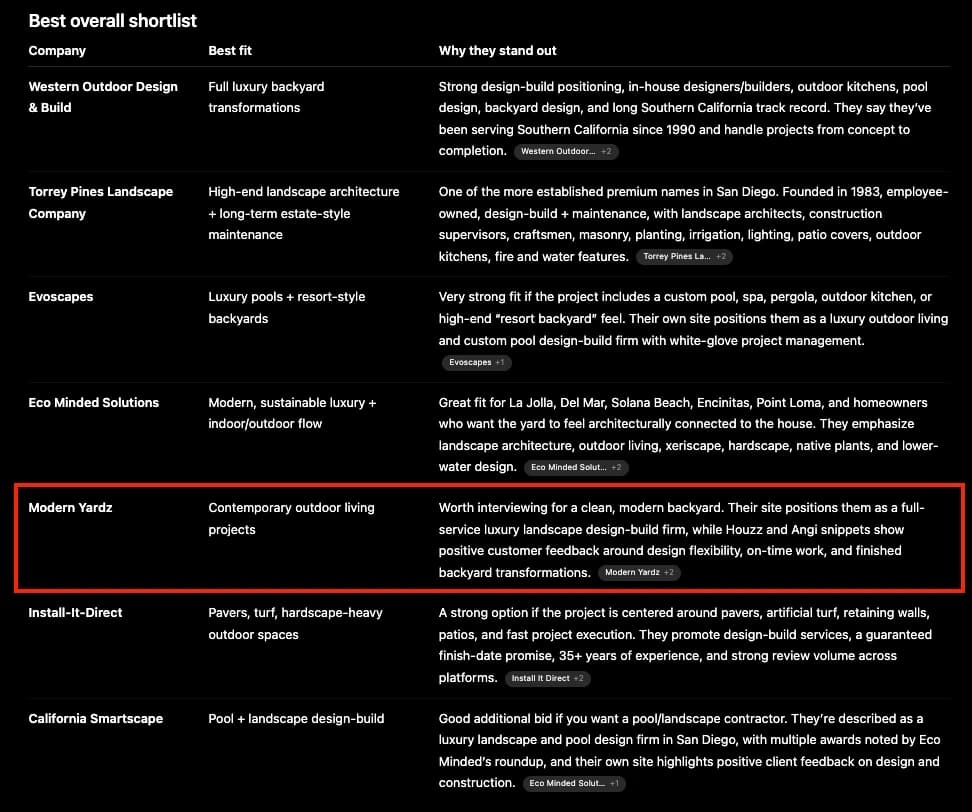
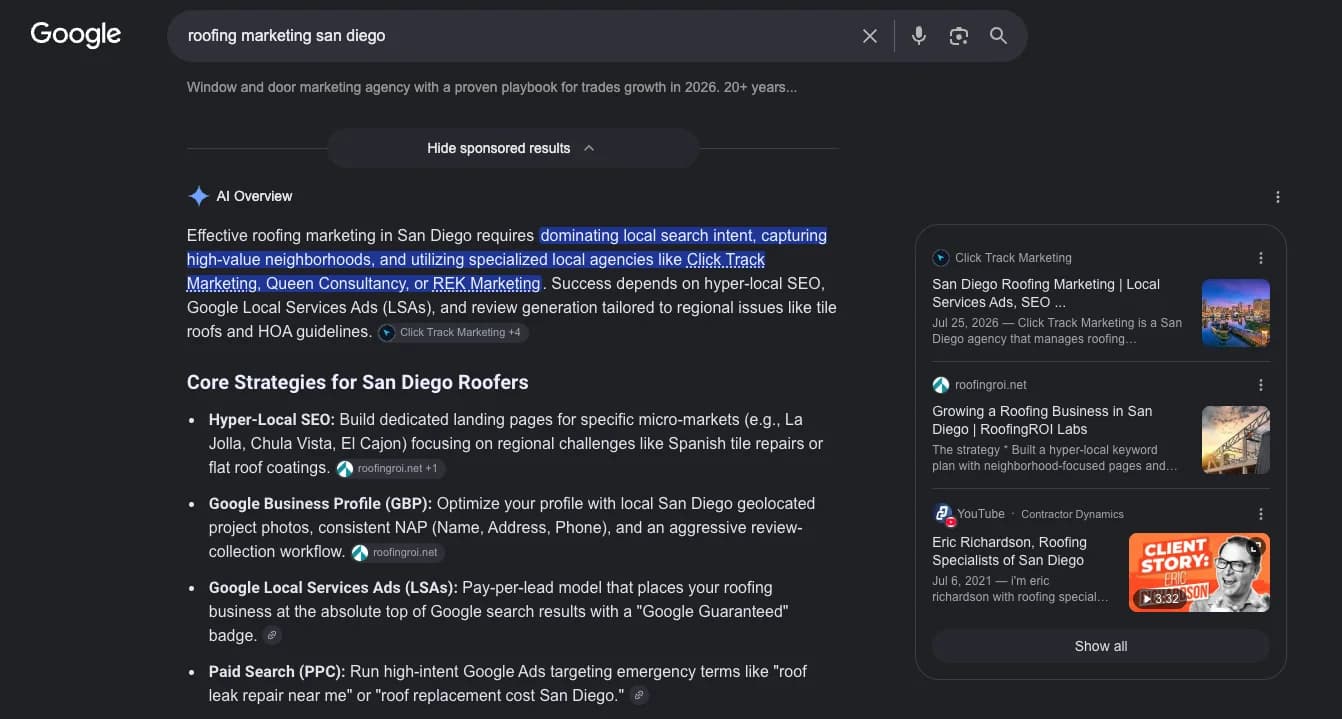
Generative engines are non-deterministic: the same prompt can return different sources on consecutive runs. That is exactly why we measure citation share across a tracked prompt set over months rather than hand you a screenshot and call it a result.
Why we will not build your strategy on one engine’s current habits
Semrush published a most-cited-domains study on 10 November 2025 covering more than 230,000 prompts and 100 million citations across ChatGPT Search, Google AI Mode and Perplexity over thirteen weeks. Reddit and Wikipedia are ChatGPT’s most-cited domains. Both fell off a cliff in September — Reddit from around 60% of prompts to roughly 10%, Wikipedia from around 55% to under 20%.
If the two most-cited domains on the largest engine can shed most of their citation share inside a single month, any tactic tuned to what that engine likes today has a short half-life.
So we do not chase the platform of the month. We build the things that survive a retrieval change: an unambiguous entity, clean structured data, self-contained answers, real evidence with real attribution, and genuine third-party corroboration. Those inputs are what every engine is reaching for, whatever weighting it happens to apply this quarter.
Semrush: most-cited domains in AI search (10 Nov 2025)What generative engine optimization services actually involve
Six workstreams. None of them is “write more blog posts”.
Structured data & entity consistency
Organization, LocalBusiness, Service, FAQPage and Person schema wired into an @id graph, with name, address, phone and description matched across the site, the Google Business Profile and the directories. An engine that cannot resolve who you are will not attribute anything to you.
Answer-first restructuring
Every answer made self-contained: claim first, evidence beneath, no dependency on context three screens up. A generative engine lifts a passage, not a page. If the passage only makes sense in situ, it does not get lifted.
Quotable evidence
Named-expert quotations, real statistics with dates and attributable origins, and outbound citations to primary sources — the three highest-scoring tactics in the GEO benchmark, applied literally rather than gestured at.
Digital PR on the sources engines pull from
We read the citation lists your prompt set actually returns and pursue mentions on those specific directories, trade titles, review platforms and communities — rather than assuming which sources matter and buying links into the void.
AI-crawler access
GPTBot, OAI-SearchBot, PerplexityBot and ClaudeBot are blocked by default on a great many hosts, CDNs and inherited robots.txt files. We verify in server logs that they are fetching real pages and getting 200s. This failure is silent and it invalidates everything downstream.
Per-engine measurement
A tracked prompt set re-run monthly: cited, mentioned, or absent, per engine, with the competitor sources that appeared instead. Plus AI referral traffic isolated as its own analytics channel so AI-sourced leads are attributable to revenue.
Our GEO process
Six stages, run in this order for a reason: there is no point writing quotable content for a site the crawlers cannot read.
Baseline: prompts, citations and crawler access
We build a prompt set that mirrors how your buyers ask, then record for each engine whether you are cited, mentioned or absent — and which sources win instead. In parallel we check server logs to confirm GPTBot, OAI-SearchBot, PerplexityBot and ClaudeBot can actually reach your pages, because a blocked crawler makes every later step pointless and reports no error to anyone.
Entity and schema foundation
We make the business unambiguous to a machine: complete JSON-LD (Organization, LocalBusiness, Service, FAQPage, Person for named authors), an @id graph that links those entities together, and consistent name, address, phone and description across the site, the Google Business Profile and the major directories. Engines resolve entities before they cite them.
Answer-first restructuring
We rewrite pages so each answer is self-contained and liftable — the claim in the first sentence, the supporting detail beneath it, no dependency on the paragraph three screens up. This maps directly to the paper's fluency optimisation and easy-to-understand tactics, which scored 24.7 and 22.0 against a 19.3 baseline.
Evidence: quotations, statistics and cited sources
The three highest-scoring tactics in GEO-BENCH were quotation addition, statistics addition and citing sources. We apply them literally: named-expert quotes, real figures with a date and an attributable origin, and outbound citations to primary sources. Efficacy is domain-dependent, so the mix is set per industry rather than run as one checklist.
Digital PR on the sources engines actually pull from
Citations are earned off-site as much as on it. We pursue mentions on the directories, trade publications, review platforms and community sources that show up in your prompt set's citation lists — and we watch that list rather than assume it, since the Semrush data shows even the most-cited domains can lose most of their share within a month.
Measure, report, compound
Monthly, we re-run the prompt set, report citation and mention share per engine, and track AI referral traffic as its own channel in analytics so AI-sourced leads are attributable. Where the share moved we double down; where it did not we say so. No guarantees, no cherry-picked screenshots.
What we will not promise you
We cannot guarantee a citation. Nobody can. Large language model output is non-deterministic — run the same prompt twice and the source list can differ — and the engines change retrieval behaviour without announcing it. Any provider selling a guaranteed ChatGPT ranking is selling you a screenshot they got lucky on.
What we control is the input side: the schema, the entity, the structure, the evidence, the crawler access, the earned mentions — and honest month-over-month reporting of citation share so you can see the trend and judge us on it. That is the whole offer, and we think it reads better than a guarantee.
What it costs
- —$2,000–$3,500/mo foundational engagement (90-day minimum) — GEO and AEO run alongside SEO, which is how it works best.
- —From $1,500/mo for a standalone AEO/GEO add-on if another agency already handles the rest.
- —$297/mo website (12-month minimum) if the site itself needs rebuilding for AI search.
- —$5,000/mo adds social media through our partner Buzz Marketing Co.
Flat monthly fees, never a percentage of ad spend. You own your website and every account we touch, including on the way out. Founder David Esau is a former Google Partnerships & Technical Account Manager, and Click Track Marketing is rated 5.0 on Google.
Full pricing detailWhere GEO sits in the rest of the work
AI SEO Agency
The hub: how AI SEO, AEO and GEO differ, and which one your business actually needs first.
AEO Services
The answer-engine side: being the answer to a direct question, not just a cited source.
AEO in San Diego
We do this work from San Diego, and it is where our own citations were earned first — including being named first in Google’s AI Overview for “best ai marketing agency san diego”.
Agent Search Optimization
What happens after the citation, when an AI agent browses your site on a buyer’s behalf.
Case Studies
Documented client outcomes across AI search, local search and paid.
Generative Engine Optimization FAQs
Want to know exactly which marketing is making you money?
Get a free attribution audit — we'll show you where your leads and revenue actually come from. Answer two quick questions to start.
Find out what the engines say about you today
We'll run a prompt set across ChatGPT, Perplexity and Google AI Overviews, check whether the AI crawlers can even reach your site, and show you which sources are being cited instead of you. No guarantees — just the baseline, in writing.
“They set up automation for every pipeline stage, so nothing falls through the cracks. David and his team are genuinely invested in our success.”
— Christopher Whitney · Google Review