

Quick Answer
Focus on three things: practice area authority built by named attorneys, a locked down local presence, and attribution that proves which leads become signed matters. Firms that build attorney-authored practice-area hubs, secure their Google Business Profile and directory listings, and connect call tracking to their CRM outperform firms chasing rankings alone. The reason is simple: search engines and AI answer tools both now filter legal content through trust signals like schema markup and verified authorship before they will cite it.
“**TL;DR:** - Securing verified attorney authorship, schema markup, and complete directory profiles are essential to ensure your firm appears in AI citation sources and answer engines. - Technical SEO elements like mobile performance, structured data, and fixing orphaned pages are critical for visibility and should be audited regularly. - Building a pillar and cluster content structure with attorney bios enhances topical authority and improves likelihood of AI systems citing your firm. - Consistent local citations, reviews, and a fully optimized Google Business Profile increase your chances of appearing in the local map pack and AI-generated answers. - A 90-day SEO plan focused on technical fixes, content publishing, and attribution infrastructure can lead to measurable leads, not just improved rankings.”
Table of Contents
- What Makes SEO for Law Firms Different From Other Industries?
- What Technical SEO Elements Do Law Firm Websites Need?
- How Should Law Firms Structure Practice Area Content?
- How Do You Win the Local Map Pack for a Law Firm?
- How Do Law Firms Build Authority Through Directories and Press?
- How Do You Prove SEO Is Generating Signed Matters?
- How Do You Get a Law Firm Cited in AI Answers?
- What Does a 90-Day SEO Launch Plan Look Like for a Law Firm?
- What Ethical Rules Apply to Law Firm Content Marketing?
- How Do You Research Keywords for a Law Firm?
- What Backlink Strategies Actually Work for Law Firms?
- How Do You Build Content Around Your Ideal Client?
- How Do You Build Local Trust Beyond Google Business Profile?
- The Infrastructure Perspective on Law Firm SEO
- Get Cited by AI Answer Engines, Not Just Ranked by Search
- Sources
- FAQ
What Makes SEO for Law Firms Different From Other Industries?
Legal content falls into a category Google calls Your Money or Your Life, or YMYL. That means the stakes of bad information are high (someone could make a costly legal decision based on it), so Google's quality systems demand more proof of expertise, experience, authority, and trust, known as E-E-A-T, before ranking or citing a page. A blog post about the best hiking boots does not face this scrutiny. A blog post about whether you need a lawyer after a car accident does.
This is not a new rule, but it has gotten sharper. Legal category guidance and industry analysis show E-E-A-T functions as a gate for legal content, not a ranking bonus you can skip and still compete on authority instead of tactics. Thin pages with no named author, no bar credentials, and no case context tend to underperform even when the keyword targeting is technically correct.
The bigger shift is what happens after a page ranks. Clients increasingly ask ChatGPT, Google's AI Overviews, or Perplexity questions like "do I need a personal injury lawyer" before they ever open a search results page. Answer Engine Optimization, or AEO, is the discipline of structuring content so those engines can extract and cite your firm as the answer. That means:
- Named attorney authorship with verifiable credentials, not anonymous "staff" bylines
- Structured data (schema markup) that tells machines who wrote the page and what firm stands behind it
- Directory completeness, since directories are the first cited source in a large majority of AI answers for legal queries, according to research on AI search strategy for law firms
The order of operations matters. Get the local foundation right first, since that is where most client searches start. Then build topical authority through practice-area content. Only after both are in place does measurement tell you what is actually working.
Statistic Callout: Directories capture a substantial share of citations in AI-generated answers for legal queries, and they're often the first source cited, according to the same 2026 AI search strategy research. A firm with an incomplete Avvo or Justia profile is invisible in exactly the moment a prospective client is asking an AI engine for a recommendation.
What Technical SEO Elements Do Law Firm Websites Need?
A law firm site can have brilliant content and still be invisible if the technical layer is broken. Here is the checklist that matters most:
- 1Mobile performance first. Most legal searches happen on a phone, often after an accident or an arrest. Test load times with Google's PageSpeed Insights and aim for a Largest Contentful Paint under 2.5 seconds.
- 2LegalService schema on every practice area page. This structured data tells search engines and AI crawlers what kind of legal service you offer, where, and under what business entity.
- 3Person schema for every attorney, connected with
hasCredentialandworksForproperties so machines can tie a named lawyer to their bar admission and their firm. This pairing materially improves how well AI systems identify attorneys and their organization. - 4FAQPage schema on any page with a genuine question and answer format, which increases the odds an AI engine lifts your answer directly.
- 5Clean sitemaps and robots.txt. Submit an XML sitemap through Google Search Console and confirm crawlers are not blocked from practice area pages. Sitemaps have been a foundational part of how search engines discover pages since the format was introduced, and they remain relevant for AI crawlers too.
- 6An llms.txt file at your site root. This emerging standard gives AI crawlers a plain-language map of your most important content, similar to how robots.txt works for traditional search bots.
- 7Fix orphaned 404s and duplicate URLs. Canonicalize any page that exists at more than one URL, since duplicate content splits authority instead of consolidating it.
Validate your schema with Google's Rich Results Test before you consider it done. A typo in your JSON-LD markup means the schema does nothing.
Pro Tip: Run your top five practice area pages through the Rich Results Test quarterly. Schema markup breaks silently when developers update a site theme, and you won't notice until your rich results disappear.
How Should Law Firms Structure Practice Area Content?
The architecture that works best is a pillar and cluster model. A pillar page covers a broad practice area, such as personal injury or family law, in full depth, usually 1,500 to 2,500 words. Cluster pages branch off it to cover specific questions, like "what happens if the other driver has no insurance" or "how is child support calculated in a contested divorce," typically running 800 to 1,200 words each. Every cluster links back to its pillar, and the pillar links out to each cluster, building a web of topical depth that both readers and AI crawlers can follow.
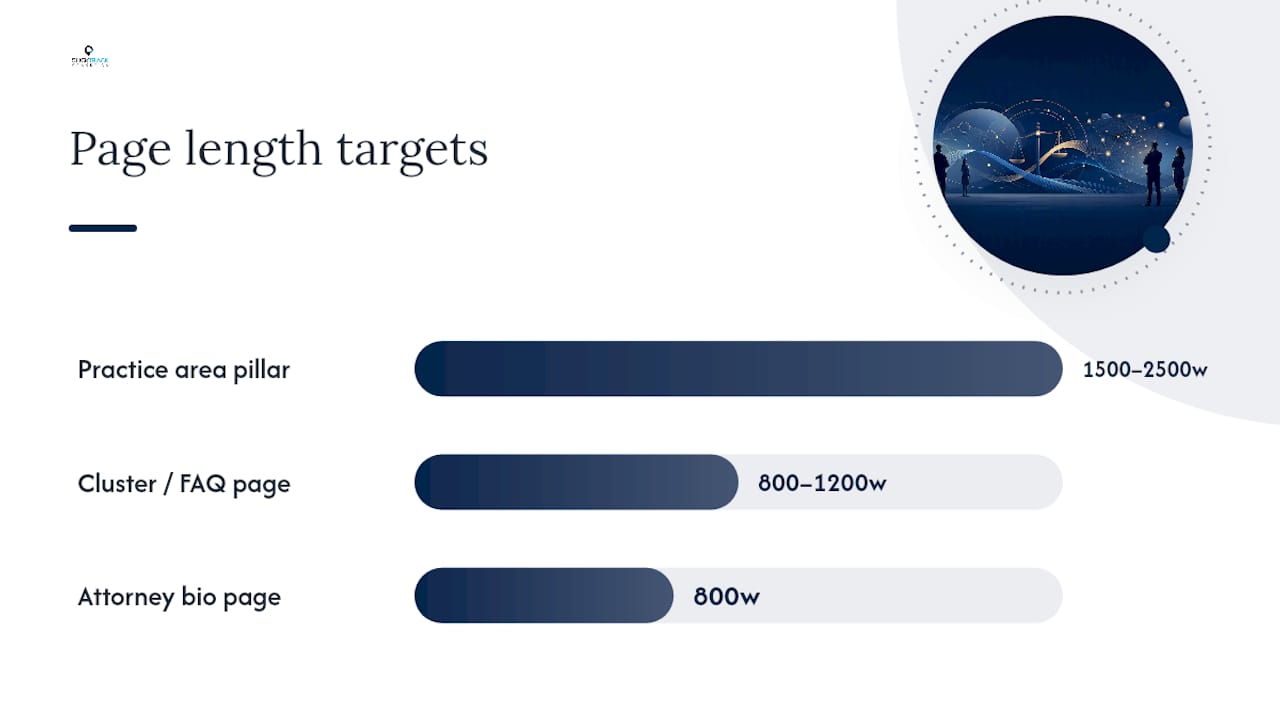
This structure is not a suggestion; it is what the research supports. Pillar and cluster models built around attorney-byline content and FAQ blocks are the recommended architecture for improving how often AI engines extract and cite legal content.
Every page needs a named attorney author, not a marketing department byline. The bio attached to that author should include:
- Bar admission state and year
- Law school and any relevant certifications
- Representative matters or case types handled, described in general terms that comply with advertising rules
- Years in practice and any recognitions from bar associations
Detailed attorney bios and named authorship materially increase the odds a page is cited by AI answer engines, because they give the machine something concrete to verify.
Every page should also follow a lead-with-answer rule. The first 40 to 60 words under any question-style heading should directly answer that question, with supporting detail following after. This is exactly how featured snippets and AI-generated answers pull content, so writing the answer first is not optional if extraction is the goal.
| Content type | Length target | Author requirement | Primary purpose |
|---|---|---|---|
| Practice area pillar | 1,500 to 2,500 words | Named attorney, full bio | Establish topical authority |
| Cluster/FAQ page | 800 to 1,200 words | Named attorney or reviewed by one | Answer specific client questions |
| Attorney bio page | 800 words | Self-authored or firm-verified | Support E-E-A-T signals sitewide |
FAQ blocks belong on nearly every cluster page, formatted as a genuine question followed by a 40 to 80 word answer marked up with FAQPage schema. Skip questions that exist only to stuff keywords in. Answer the ones real clients actually type into Google at 11 p.m.
How Do You Win the Local Map Pack for a Law Firm?
Local visibility starts with your Google Business Profile, and most firms leave it half finished. Here is the operational sequence:
- 1Claim and completely fill out your profile. Choose the most specific primary category available, such as "Personal Injury Attorney" rather than the generic "Lawyer," since specificity affects which searches trigger your listing.
- 2Add every service, business hour, and photo field. An incomplete profile signals lower trust to Google's ranking systems, and completeness itself is treated as low-hanging fruit with outsized impact on how often AI engines cite your firm.
- 3Keep your name, address, and phone number byte-identical everywhere. If your Google Business Profile lists "Suite 200" and your Avvo profile says "Ste. 200," that inconsistency erodes the trust signal directories are supposed to provide.
- 4Claim the legal directories that actually carry weight, including Justia, Avvo, and Martindale-Hubbell. These sites are cited constantly in AI-generated answers, and an unclaimed or sparse profile there is a missed opportunity, not a neutral non-event.
- 5Build a review generation process, not a review request afterthought. Ask satisfied clients for reviews at the natural end of a matter, respond to every review professionally, and never offer anything of value in exchange for a review, which violates most platform policies and raises ethical concerns under attorney advertising rules.
Review velocity matters more than review volume in isolation. A firm with steady reviews trickling in over months looks more credible to both Google's algorithm and to a prospective client scrolling through your profile than a firm with fifty reviews all posted the same week.
How Do Law Firms Build Authority Through Directories and Press?
Authority signals tell search engines and AI systems that entities other than your own website vouch for your firm. For law firms, the highest value targets are:
- Legal directories: Justia, Avvo, and Martindale-Hubbell, since these platforms are the first cited source in most AI-generated answers to legal questions
- Local press and business journals covering settlements, verdicts, or community involvement (where ethically permissible to discuss)
- Bar association publications and committee involvement, which double as credibility signals and networking
- Legal trade publications open to bylined articles from practicing attorneys
The best way to earn these mentions is to make yourself genuinely quotable. Journalists and editors want a specific, named attorney with a clear credential, not a generic firm inquiry. When you pitch a byline or a quote, lead with the attorney's bar admission and relevant case experience, and make the piece about the legal question, not about promoting the firm.
Avoid anything that looks like a paid link scheme. Google's algorithms and AI crawlers both discount or penalize link networks built through payment rather than earned relevance, and the American Bar Association's guidance on attorney advertising and communication adds another layer of risk if a paid placement implies an outcome guarantee.
Pro Tip: Skip exact-match anchor text like "best divorce lawyer near me" in guest content. A handful of natural mentions of your firm name and attorney name will outperform a keyword-stuffed anchor every time, and it reads as more trustworthy to both readers and algorithms.
How Do You Prove SEO Is Generating Signed Matters?
Rankings and traffic tell you almost nothing about revenue on their own. What matters is the path from a first search to a signed retainer, and that path has to be instrumented at every step or you are guessing.
Start by mapping the conversion sequence: a person searches, lands on a practice area page, calls or fills out a form, gets contacted by intake, and eventually signs a retainer. Each of those steps needs a tracking point. Assign unique tracking phone numbers to your website, your Google Business Profile, and each paid campaign so you know exactly which source generated the call. Apply consistent UTM parameters to every link you control, and integrate that call and form data directly into your CRM or case management system.
Firms that do this well can identify precisely which channel produced a qualified call versus a wrong number or a case they had to decline, turning what was previously expensive guesswork into measurable ROI. Combining unique tracking numbers with CRM integration also reduces wasted ad spend, since firms can see fast which channels are producing signed matters and scale confidence in those channels specifically.
Statistic Callout: The value of attribution is not the tracking itself, it's the decision it enables. A firm that knows its cost per signed matter by channel can shift budget toward what works within weeks instead of guessing for a quarter.
When you report to partners, skip impressions and click counts. The metrics that matter are:
- Cost per signed matter, broken out by channel
- Call to signed retainer conversion rate
- Attribution window (how long from first touch to signature, which varies significantly by practice area)
- Channel lift when you pause or increase spend on a specific source
This is the difference between marketing you can defend in a partner meeting and marketing you can only describe in adjectives.
How Do You Get a Law Firm Cited in AI Answers?
Getting cited by ChatGPT, Google's AI Overviews, or Perplexity requires formatting content so it can be lifted cleanly, not just written well. The specific steps:
- 1Lead every page and section with a direct answer, 40 to 60 words, before adding context or nuance. AI engines extract the clearest, most self-contained statement they can find.
- 2Use question-style headers that mirror how people actually phrase queries to voice assistants and chat interfaces, not keyword phrases strung together.
- 3Format FAQ answers at 40 to 80 words, direct and complete enough to stand alone if lifted out of context entirely.
- 4Implement LegalService and Person schema across every practice area and attorney page, then validate every implementation with Google's Rich Results Test.
- 5Run an AI citation diagnostic. Ask ChatGPT, Google AI Overviews, and Perplexity the exact questions your prospective clients would ask, such as "who is the best car accident lawyer in [your city]," and record whether your firm appears, whether a directory appears instead, and whether a competitor is cited by name.
This diagnostic is how you find your citation gaps, the specific queries where directories or competitor firms are cited and you are not, which is a practical way to prioritize which pages need schema fixes or rewritten lead answers.
Pro Tip: Run the same five to ten diagnostic queries monthly and log the results in a spreadsheet. AI citation patterns shift as engines update their models, and a query where you were cited last quarter can quietly drop off.
Firms that treat this as technical infrastructure, meaning schema, llms.txt, and structured answers, consistently outperform firms treating marketing as a series of creative campaigns with no underlying architecture.
What Does a 90-Day SEO Launch Plan Look Like for a Law Firm?
You do not need to do everything at once, and trying to will slow you down. A sequenced 90-day plan:
- 1Weeks 1 to 4: Complete your Google Business Profile, fix NAP inconsistencies across directories, resolve major site speed issues, and pilot call tracking on your top two lead sources.
- 2Weeks 5 to 8: Publish your first practice area pillar page and two to three supporting cluster pages, each with named attorney authorship and FAQPage schema. Claim and complete your profiles on Justia, Avvo, and Martindale-Hubbell.
- 3Weeks 9 to 12: Begin outreach for press mentions and bylined articles, fully integrate call tracking data into your CRM, and review early metrics like cost per qualified call. Revise underperforming pages and schema based on what the data shows.
This sequence front-loads the fixes with the fastest payoff, local completeness and technical health, before asking content to carry the weight.
What Ethical Rules Apply to Law Firm Content Marketing?
Legal marketing operates under advertising rules that other industries never have to think about. The American Bar Association's Model Rules place real limits on how firms describe outcomes, and most state bars layer additional restrictions on top of that.
The most common mistakes are avoidable. Never state or imply a guaranteed outcome, since past results do not predict future cases and most bar rules explicitly prohibit language that suggests otherwise. Case results and testimonials need careful disclaimers in most jurisdictions, often requiring language clarifying that results vary by case and jurisdiction.
Attorney bios need to be accurate and current. Listing a bar admission you no longer hold, or describing a certification that has lapsed, is not just a marketing problem, it is a professional responsibility issue tied to the ABA's rules on communication and advertising.
Content discussing specific case types should stay general enough to avoid creating an attorney-client relationship inadvertently, and most firms add a disclaimer clarifying that reading the content does not constitute legal advice. This is not boilerplate for its own sake. State bars have disciplined firms for content that blurred that line.
The safest approach is to have a licensed attorney at the firm review any content describing case outcomes, statistics about verdicts or settlements, or comparative claims like "the top-rated firm in [city]" before publication. A marketing team writing in a vacuum, without that review step, is the most common source of compliance problems in legal content.
How Do You Research Keywords for a Law Firm?
Legal keyword research differs from most industries because search intent splits sharply between informational and transactional queries, and the commercial value gap between them is enormous. Someone searching "what to do after a car accident" wants information. Someone searching "car accident lawyer near me" is ready to call. Both deserve content, but they need different pages and different calls to action.
Start by mapping keywords to the client journey stage. Broad, informational terms feed your cluster content. Specific, high-intent terms with local modifiers, like "[practice area] attorney [city]," should map directly to your practice area pillar pages and your Google Business Profile category selection.
Competitor analysis matters more here than in most industries because law firm SEO is hyperlocal and hypercompetitive in major metros. Look at which firms rank and get cited for your target queries, then examine their content structure specifically: do they have named attorney authors, how deep is their FAQ coverage, and are they claiming the directory profiles that are getting cited in AI answers. A gap in their content, a question they leave unanswered or a sub-topic they ignore, is often your fastest opportunity.
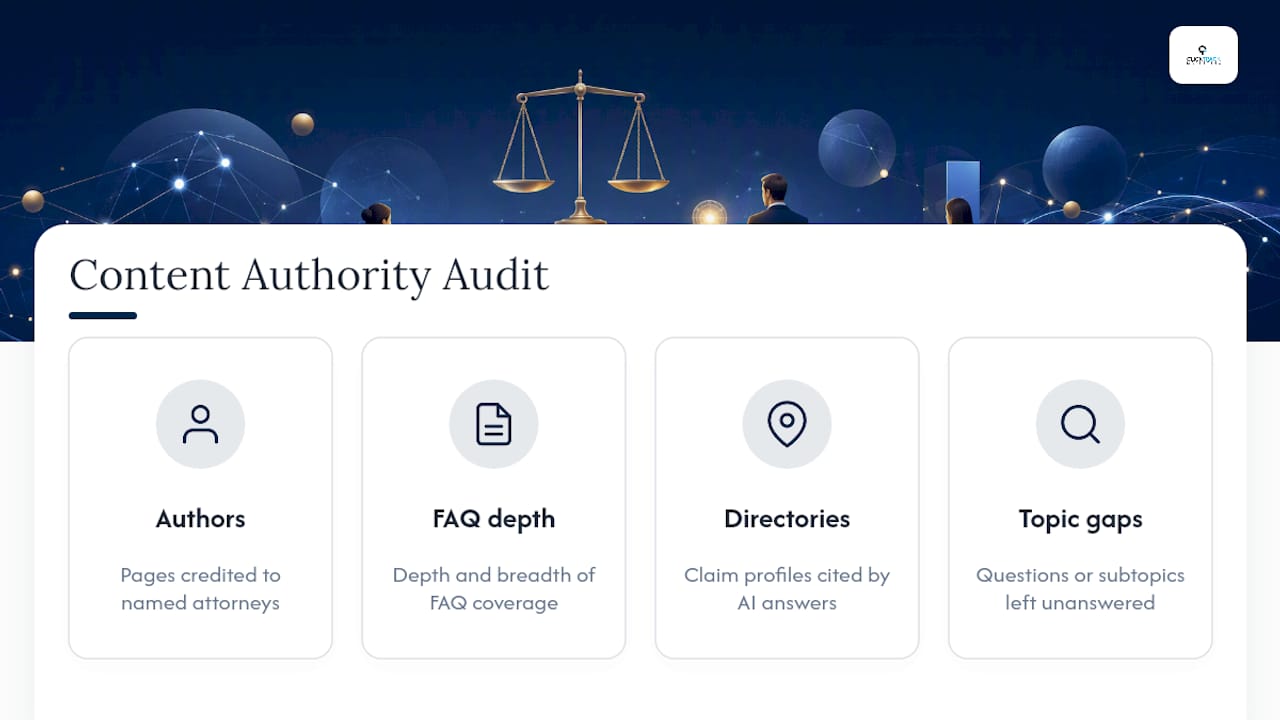
Long-tail, question-based keywords deserve more weight in a legal keyword strategy than they get in most industries, since these map directly to the extractable answer format that both featured snippets and AI engines favor.
What Backlink Strategies Actually Work for Law Firms?
Link building for law firms works best when it grows out of genuine authority rather than manufactured placements. The strongest links come from sources that would exist whether or not you asked for a link.
Bar association websites, local chambers of commerce, and alumni pages from your law school are often overlooked but carry real trust because they verify something true about you rather than simply hosting a paid mention. Sponsorship of local community events, when relevant and genuine, frequently earns a natural link from the event page or local news coverage.
Guest contributions to legal trade publications work well specifically because they pair a link with the E-E-A-T signal of a named attorney publishing expert analysis. This is a two-for-one: you get a citation-worthy mention and a demonstrable expertise signal in the same placement.
Avoid link networks, paid placements that disclose nothing, and reciprocal link schemes where firms trade links purely to inflate authority metrics. These tend to get discounted by search algorithms and can create disclosure problems under advertising rules. Over-optimized anchor text, where every link uses the exact phrase "best [practice area] lawyer," also reads as manipulative to modern ranking systems and does more harm than a handful of natural, varied mentions.
How Do You Build Content Around Your Ideal Client?
Generic practice area content written for "anyone who needs a lawyer" underperforms content built around a specific, well-understood client persona. A firm handling both high-net-worth divorce and straightforward uncontested divorce is really serving two different people with different fears, different budgets, and different questions.
Start by identifying two or three core personas per practice area based on real client patterns your intake team already recognizes. A car accident client searching at 2 a.m. after a crash has a different urgency and different questions than someone researching a slip-and-fall claim from six months ago. Content written for the former should lead with immediate next steps and insurance company tactics to avoid. Content for the latter can go deeper into legal standards for premises liability.
Map each persona to specific content: what they search for, what objections they carry into a consultation, and what proof points (case results, credentials, reviews) actually move them toward calling. This is where attorney bios and representative matter summaries earn their keep, since a persona-matched case example builds trust faster than generic credentials ever will.
Revisit personas periodically using actual call and intake data, not assumptions made in a single planning meeting years ago. Client search behavior shifts, and content built around outdated personas quietly stops converting even while it keeps ranking.
How Do You Build Local Trust Beyond Google Business Profile?
Google Business Profile is the foundation, but it is not the whole local strategy. Local citations across smaller directories, including your state bar's own directory, local chamber of commerce listings, and city-specific business directories, reinforce the same NAP consistency signal that Google rewards.
Local reviews carry weight beyond Google itself. Reviews on Avvo and Martindale-Hubbell function both as trust signals for prospective clients researching a firm and as content that AI engines can pull from when answering local legal queries. A firm with strong reviews concentrated only on Google and nowhere else has a thinner trust footprint than one with consistent reviews spread across two or three platforms.
Local link signals matter too. A mention from a local news outlet covering a case outcome, a quote in a community publication, or a sponsorship listing on a local nonprofit's site all reinforce that your firm is a real, established presence in a specific geography, not a national campaign renting a local phone number.
Consistency across every one of these touchpoints, same firm name, same address format, same phone number, is what turns a scattered collection of listings into a coherent trust signal that both search engines and AI systems can verify.
The Infrastructure Perspective on Law Firm SEO
Most law firm marketing still gets evaluated on rankings and traffic, and that is the wrong lens now. The firms winning client leads in 2026 are the ones treating their web presence as infrastructure, meaning attorney-authored content connected to schema markup, directory profiles that AI engines actually pull from, and attribution systems that trace a click back to a signed retainer.
Click Track Marketing builds that infrastructure directly: Answer Engine Optimization work that structures practice-area content and schema for AI citation, paired with tools like PeoplePixel to identify who is actually visiting your site, and PeopleLytics to attribute that traffic to real revenue. This shifts the conversation from "are we ranking" to "which channel produced this signed matter and what did it cost us." A typical engagement starts with a technical and directory audit, then builds out pillar content and attribution in parallel, so visibility and measurement improve together instead of visibility arriving first with no way to prove it worked, following the AI Content Optimization Guide for Legal Marketers.
Get Cited by AI Answer Engines, Not Just Ranked by Search
Everything in this article points to the same conclusion: a beautiful law firm website that AI engines cannot read, and that you cannot trace to a signed matter, is not doing its job. Click Track Marketing builds the infrastructure underneath your firm's online presence, from AEO work that structures your practice area content for AI citation, to attribution systems like PeoplePixel that show you who is actually visiting your site and whether that traffic turns into revenue.

If your firm's content is not showing up when prospective clients ask ChatGPT or Google's AI Overviews who to call, that is a fixable, specific problem, not a reason to start over. Download the free AEO checklist to see exactly where your site stands, or book an application call to talk through what a locked local foundation, attorney-authored content, and real attribution would look like for your practice.
This article is general information, not a substitute for advice from a qualified lawyer. Consult a qualified legal professional about your own circumstances before acting on anything here.
Sources
- A Practical Framework For Optimizing Your Firm's Content For AI Answer Engines
- How to optimize your law firm’s content for AI answer engines
- Law firm SEO 2026: why authority beats tactics
Want to know exactly which marketing is making you money?
Get a free attribution audit — we'll show you where your leads and revenue actually come from. Answer two quick questions to start.