

Quick Answer
Last-click attribution is a marketing measurement model that assigns 100% of the conversion credit to the final touchpoint a customer interacts with before completing a purchase or action. It is the default model in platforms like Google Analytics, Google Ads, and Facebook Attribution, which makes it the most widely used attribution approach in digital marketing today. Understanding what is last-click attribution, and where it falls short, is the difference between budget decisions grounded in evidence and ones built on a partial picture.
What is last-click attribution and how does it work?
Last-click attribution assigns all conversion credit to the last marketing touchpoint before the customer takes action. Every prior interaction, whether a display ad, a blog post, or an email, receives zero credit. The model is also called last-interaction attribution in some platforms, but the mechanics are identical.

The mechanics behind the model
Platforms track the final interaction using UTM parameters and tracking pixels embedded in your ads and pages. When a customer converts, the platform reads the last recorded UTM source and assigns the sale to that channel. Pixel tracking technology is what makes this possible at scale across paid and organic channels.
A practical example makes this concrete. A customer sees a Facebook awareness ad on monday, reads a blog post on wednesday, clicks a Google retargeting ad on friday, and then converts. Under last-click, the Google retargeting ad gets 100% of the credit. The Facebook ad and the blog post get nothing, even though they moved the customer through the consideration phase.
This structure naturally favors closing channels. Branded search and retargeting ads appear at the bottom of the funnel, so they consistently win credit under this model. Awareness channels like display, social, and content marketing are systematically undercredited.
Pro Tip: Set up consistent UTM parameters across every campaign before you rely on last-click data. Inconsistent UTM tagging causes misattribution that makes your channel reports unreliable from the start.
How Google Analytics handles last-click by default
Google Analytics uses a specific variation called last non-direct click attribution. It ignores direct traffic when another channel was involved in the journey, giving credit to the last identifiable source instead. This prevents direct traffic from absorbing credit that belongs to a paid or organic channel, but it still leaves all prior touchpoints invisible.
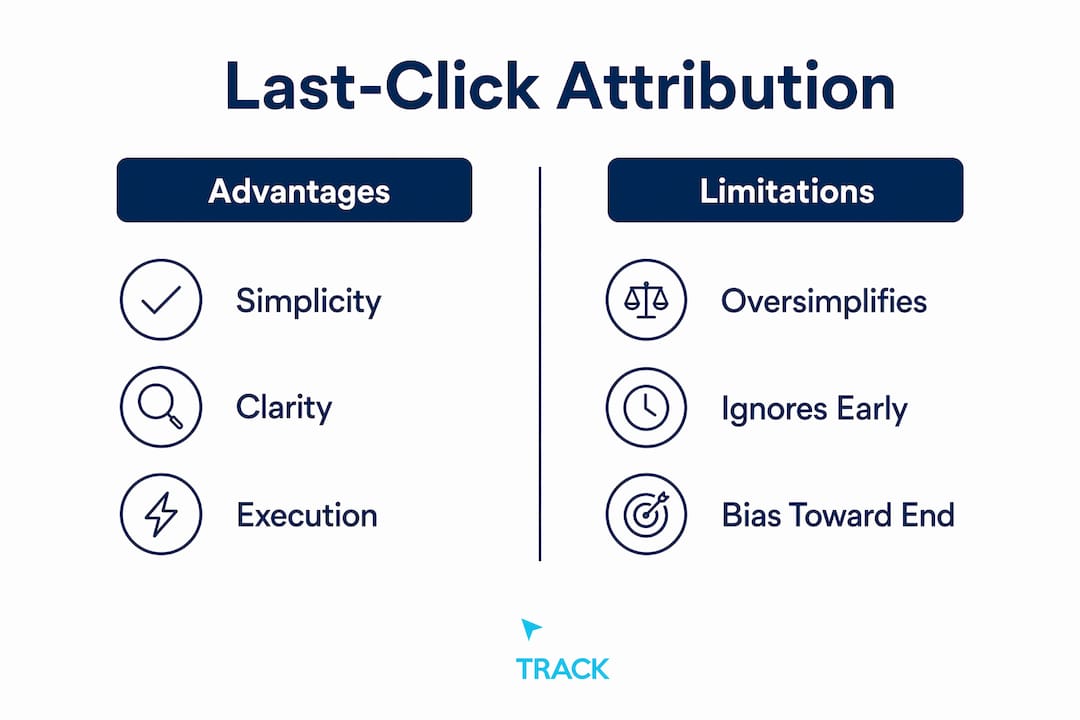
What are the pros and cons of the last-click attribution model?
Last-click attribution has real advantages that explain its dominance, and real costs that explain why sophisticated marketers move beyond it.
Where last-click attribution delivers value
The model is simple to explain. You can tell a CFO or a client that the Google Search campaign drove 40 conversions this month without any statistical caveats. Last-click helps identify which touchpoints most heavily influence the final stage of the buyer's journey, which is genuinely useful for optimizing closing tactics. For small businesses with limited data, it provides a consistent baseline for day-to-day performance monitoring.
“Last-click's biggest risk is the false clarity it creates. It causes budget misallocation toward bottom-funnel channels while starving the brand awareness efforts that feed the funnel in the first place.”
Where last-click attribution misleads you
The model fails to recognize any customer interactions before the final touch. That means your SEO content, your YouTube pre-roll, and your email nurture sequence are invisible in the data, even when they drove the customer to the point of purchase. Budget decisions made on last-click data alone tend to cut awareness spend and over-invest in retargeting, which eventually shrinks the top of the funnel and reduces overall conversions.
Attribution windows add another layer of distortion. Facebook's attribution window can credit clicks occurring within a short timeframe of a site visit, which inflates retargeting performance in ways that do not reflect true influence. A customer who visited your site and then saw a retargeting ad seconds later may trigger a conversion credit that overstates the ad's actual role.
| Factor | Advantage | Limitation |
|---|---|---|
| Simplicity | Easy to explain to stakeholders | Oversimplifies a complex journey |
| Closing channel focus | Highlights what drives final conversions | Ignores upper and mid-funnel contributions |
| Platform default | Works out of the box in most tools | Requires no setup, so it gets used uncritically |
| Data requirements | Works with small data sets | Provides no insight into multi-touch influence |
| Budget guidance | Clear signal for bottom-funnel spend | Leads to underinvestment in awareness channels |
How does last-click compare to other attribution models?
Last-click is one of several single-touch and multi-touch models available in most analytics platforms. Each model answers a different question about the customer journey.
First-click attribution is the direct inverse of last-click. It assigns 100% of the credit to the first interaction, which makes it useful for understanding which channels generate initial awareness. Like last-click, it ignores every touchpoint in between. Both are single-touch models with the same structural blind spot.
Linear attribution splits credit equally across every touchpoint in the journey. A customer with five interactions gives each channel 20% of the credit. This approach is more honest about the full journey but can undervalue the channels that actually drove the decision.
Data-driven attribution uses machine learning to assign fractional credit based on the actual influence each touchpoint had on conversion probability. Data-driven models are increasingly replacing last-click in platforms like Google Ads in 2026, but they require large data volumes to produce reliable results. Smaller businesses often find the model unstable until they reach sufficient conversion volume.
| Model | Credit logic | Best for | Data requirement |
|---|---|---|---|
| Last-click | 100% to final touch | Closing channel analysis | Low |
| First-click | 100% to first touch | Awareness channel analysis | Low |
| Linear | Equal split across all touches | Full-journey visibility | Medium |
| Data-driven | ML-weighted by influence | Accurate full-funnel attribution | High |
Multi-touch attribution models weigh partial credit for all interactions and give a more complete picture than any single-touch model. The tradeoff is complexity. You need clean data, consistent tagging, and a team that can interpret the output. For most growing businesses, the right answer is not one model but a combination.
How can marketers use last-click attribution effectively?
Last-click attribution works best as a diagnostic tool for the bottom of the funnel, not as the sole basis for budget decisions. Used with that constraint in mind, it provides clear, fast signals about which closing channels are performing.
Here is how to get real value from the model without falling into its traps:
- Use last-click to monitor closing performance. Track which paid search terms, retargeting audiences, and landing pages are converting. Last-click is accurate for this narrow question.
- Run a second model in parallel. Google Analytics 4 lets you compare attribution models side by side. Running last-click alongside linear or data-driven attribution reveals which channels are being undercredited.
- Audit your UTM setup before drawing conclusions. Proper UTM parameter setup is the foundation of accurate last-click data. A single untagged campaign can distort your entire channel report.
- Understand your platform's attribution window. Each platform has a default window that determines how long after a click a conversion can be credited. Misreading these defaults leads to inflated or deflated channel performance numbers.
- Match your model to your business stage. Data-driven attribution is unreliable for smaller businesses that lack sufficient conversion volume. Last-click is a reasonable default until you have the data to support something more sophisticated.
Pro Tip: If you are running both Google Ads and Meta campaigns, compare their last-click conversion counts against your actual revenue in your CRM. Overlap between platforms is common, and both will often claim credit for the same sale.
Sophisticated attribution programs use multiple models and know which to deploy depending on the business question being asked. Last-click answers "what closed the deal." Data-driven answers "what drove the decision." You need both questions answered to allocate budget well. For a deeper look at how revenue-based marketing frames attribution within a broader financial lens, that context helps clarify why model choice matters beyond the marketing team.
Key Takeaways
Last-click attribution is a useful but incomplete model that accurately measures closing channel performance while systematically undercrediting the awareness and nurture efforts that make those conversions possible.
| Point | Details |
|---|---|
| Core definition | Last-click assigns 100% of conversion credit to the final touchpoint before a purchase. |
| Primary strength | It clearly identifies which closing channels, like branded search and retargeting, are converting. |
| Primary limitation | It ignores all prior touchpoints, which distorts budget decisions and undervalues awareness channels. |
| Best practice | Run last-click alongside a second model in Google Analytics 4 to surface undercredited channels. |
| Data requirement | Last-click works with small data sets; data-driven models require high conversion volume to be reliable. |
Last-click attribution in an AI-first marketing world
I spent years inside Google working on Ads strategy, and last-click attribution was the default lens for almost every performance conversation. It is simple, fast, and easy to defend in a meeting. I understand why it became the industry standard.
The problem I kept running into was this: clients would cut their content budget or their YouTube spend because last-click showed zero conversions from those channels. Then, six months later, their retargeting costs would spike because the pool of warm prospects had dried up. The closing channel was still working. The funnel feeding it had been starved.
What I have learned is that last-click is a fine tool for one specific job. It tells you what closed the deal. It tells you nothing about what built the relationship that made the deal possible. Treating it as a complete picture of marketing performance is the single most common attribution mistake I see business owners make.
The shift toward AI-driven marketing makes this more urgent, not less. When customers are asking ChatGPT or Perplexity for recommendations before they ever click an ad, the early touchpoints in the journey are happening in places that last-click will never see. If you are only measuring the final click, you are measuring the last inch of a mile-long race.
My recommendation is to use last-click as a monitoring tool, not a strategy tool. Know what it measures. Know what it misses. And build the infrastructure to see the full picture.
How Click Track Marketing approaches attribution differently
Attribution is only useful when it connects to revenue. Most agencies report on clicks and conversions. Click Track Marketing reports on what those conversions actually earned.
Click Track Marketing's full-funnel AI marketing system is built around the principle that last-click data is a starting point, not a conclusion. PeopleLytics, the agency's revenue attribution platform, delivers a weekly dashboard that maps spend to actual revenue across every channel, not just the one that got the final click. BuyerSignals surfaces intent data so you can see who is in the market before they convert. If you want attribution that closes the loop between marketing spend and real business outcomes, schedule a discovery call to see how the system works.
Want to know exactly which marketing is making you money?
Get a free attribution audit — we'll show you where your leads and revenue actually come from. Answer two quick questions to start.