

Quick Answer
Email is the highest-ROI owned channel for affiliate marketing, and the platforms that let you send affiliate links without getting suspended are a short list. Start with GetResponse, AWeber, SendX, or Moosend if you want affiliate-friendly terms and solid deliverability out of the box. Pick an ESP, authenticate your sending domain, and route every email click through a bridge page on your own domain before the affiliate link. That single architecture decision protects your sender reputation and keeps your tracking intact.
Quick shortlist:
- GetResponse, high-volume CPA affiliates who need broadcast tools
- AWeber, legacy lists and steady, predictable deliverability
- SendX, performance affiliates who want affordability and affiliate-friendly terms
- Moosend, creators who want simple automation without enterprise overhead
- Kit, newsletter-first creators who want native monetization
- Brevo, budget-conscious operators who need forms and basic automation
Your immediate next step: pick one ESP from this list, authenticate your sending domain with SPF, DKIM, and DMARC, and build a single bridge page before you send your first campaign.
Table of Contents
- Which email platforms actually allow affiliate marketing?
- How to build an affiliate email funnel step by step
- How to choose an ESP when you plan to promote affiliate offers
- Email sequences and subject-line formulas you can copy today
- How do you track affiliate clicks and attribute conversions from email?
- What are the CAN-SPAM and FTC rules for affiliate email in the U.S.?
- How do you protect inbox placement for affiliate campaigns?
- How we selected vendors and validated best practices for this guide
- Key Takeaways
- What most affiliates get wrong about email infrastructure
- When managed email infrastructure makes sense for your affiliate program
- Useful sources
- FAQ
Which email platforms actually allow affiliate marketing?
The comparison below covers every major affiliate-friendly ESP and ClickBank as the network layer. Policy, deliverability tooling, and automation depth are the three axes that matter most when you are building an affiliate email program.

| Platform | Affiliate policy | Pricing shape | Deliverability tools | Automation | Best for |
|---|---|---|---|---|---|
| Click Track Marketing | Managed setup; bridge pages and AEO landing pages built for you | Custom retainer | PeoplePixel attribution, full authentication setup | Full funnel automation with revenue attribution | Businesses that want managed deliverability and attributed funnels |
| GetResponse | Allows affiliate links; review TOS for restricted verticals | List-based, scales with contacts | Dedicated IP available, DKIM/SPF, warm-up guidance | Strong broadcast and automation builder | High-volume CPA affiliates |
| AWeber | Affiliate-friendly with engagement requirements | List-based | DKIM/SPF, stable reputation | Solid automation, legacy-friendly | Affiliates migrating legacy lists |
| SendX | Explicitly affiliate-friendly per practitioner reports | Flat list-based pricing | DKIM/SPF support | Basic to mid-level automation | Performance affiliates on a budget |
| Moosend | Allows affiliate links; check AUP for restricted niches | List-based, competitive pricing | DKIM/SPF | Simple visual automation | Creators wanting straightforward automation |
| Kit | Creator-focused; affiliate links permitted | Subscriber-based | Standard authentication | Sequence and broadcast tools | Newsletter-first creators |
| Brevo | Allows affiliate links; volume-based pricing | Email-volume pricing | DKIM/SPF, dedicated IP on higher plans | Solid automation and forms | Budget creators needing forms |
| EmailOctopus | Allows affiliate links; basic AUP | Low flat pricing | Standard authentication | Basic sequences | Cost-sensitive publishers |
| Sendlane | E-commerce and behavioral focus; review AUP | Contact-based | DKIM/SPF, deliverability tools | Behavioral triggers, cart-style automation | Behavior-triggered affiliate funnels |
| Benchmark Email | Standard affiliate allowance; review TOS | Contact-based | Standard authentication | Basic automation | Small publishers needing a mainstream ESP |
| ClickBank | Affiliate network, not an ESP; provides tracking and payouts | Commission-based | N/A | N/A | Finding digital-product offers with built-in tracking |
Vendor verdicts:
GetResponse suits affiliates who send high-frequency broadcasts and need deliverability infrastructure at scale. AWeber is the reliable choice when you are migrating an older list and cannot afford deliverability surprises. SendX has built a reputation among performance affiliates for being accommodating to affiliate-style content. Moosend works well for solo creators who want visual automation without paying for features they will never use. Kit is the natural home for newsletter operators who want to monetize subscribers directly. Brevo's volume-based pricing makes it attractive when your list is small but your send frequency is high. EmailOctopus keeps costs low for publishers who need simple list-based blasts. Sendlane's behavioral triggers make it a strong fit for affiliates running cart-style or product-review sequences. Benchmark Email is a mature, unremarkable platform for operators who want standard features and no surprises.
Where to find each vendor's affiliate policy: Look for the Acceptable Use Policy (AUP) or Terms of Service page on each vendor's website. Search for the words "affiliate," "third-party links," and "prohibited content." If the AUP does not mention affiliate links explicitly, contact support and get a written answer before migrating your list.
Pro Tip: Before you move a list to any new ESP, send a test campaign to a seed list and check inbox placement with a tool like GlockApps or Mail-Tester. Policy review and deliverability testing are two separate steps.
How to build an affiliate email funnel step by step
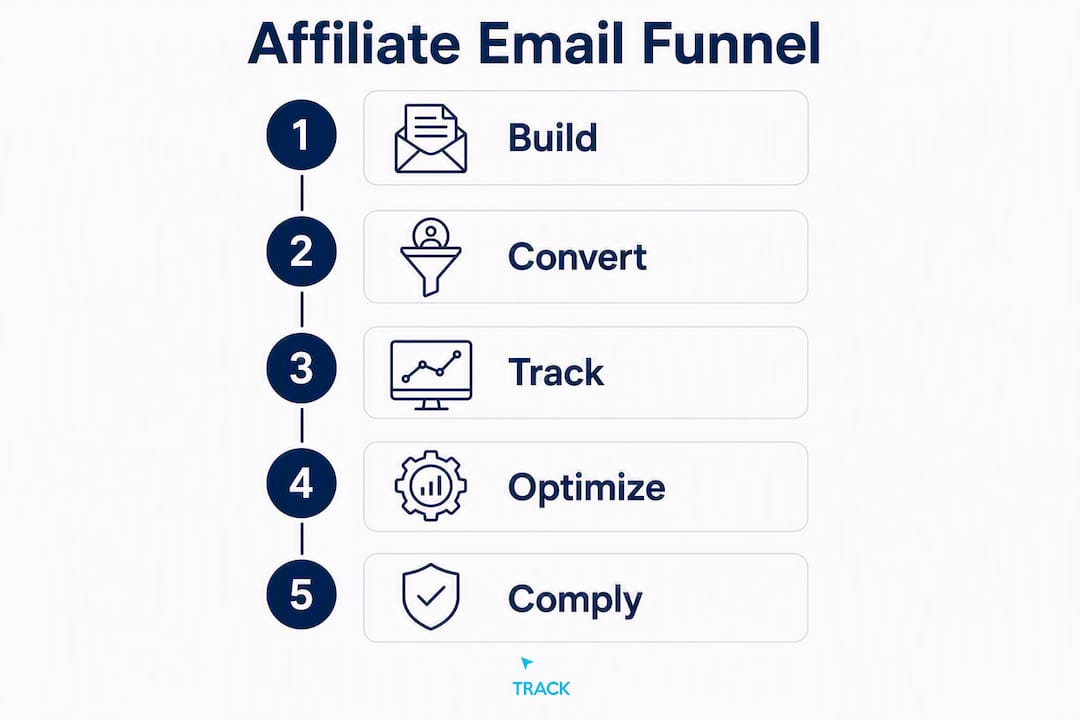
A functioning affiliate email funnel has five components: a sending domain, an authenticated ESP, a bridge page, a lead magnet, and a sequenced email series. Here is how to build each one.
- 1Register a dedicated sending domain. Use a subdomain or a separate domain from your main site (for example, news.yourdomain.com). Never send affiliate campaigns from your primary business domain. A deliverability problem on the sending domain should not take down your main site.
- 1Authenticate the domain. Set up SPF, DKIM, and DMARC records in your DNS before sending a single email. Most ESPs provide step-by-step DNS instructions. DMARC at a minimum "p=none" policy is the starting point; move to "p=quarantine" once you confirm legitimate mail is passing.
- 1Choose an affiliate-friendly ESP. Use the comparison table above. Confirm the AUP allows your vertical before importing any list.
- 1Build a bridge page. Sending raw affiliate links directly in emails damages deliverability and loses cookie attribution. Route every click from your email to a bridge page on your domain. The bridge page adds context, cookies the visitor, and then forwards them to the affiliate offer. This is the single most important architectural decision in affiliate email marketing.
- 1Create a lead magnet matched to your offer vertical. A free checklist, a short PDF guide, or a mini email course all convert well. Match the lead magnet topic to the affiliate offer category. A "5-day keto meal plan" lead magnet pairs naturally with a weight-loss supplement offer. Place opt-in forms on your bridge pages, your blog, and any paid traffic landing pages.
- 1Write a welcome sequence (emails 1 through 5). Email 1 delivers the lead magnet and sets expectations. Emails 2 and 3 provide pure value: a tip, a resource, a story. Email 4 introduces the problem your affiliate offer solves. Email 5 makes the first soft pitch with a bonus.
- 1Build a monetization sequence (emails 6 through 10). Top affiliate operators use roughly four to six value emails for every one to two direct promotions to maintain trust and click-through rates. Rotate between educational content and promotional emails on that ratio.
- 1Set up suppression automation. Any subscriber who unsubscribes or triggers a spam complaint must be removed from active sends automatically. Connect your ESP's webhook or API to your suppression list. A complaint rate above 0.10 percent on Google Postmaster Tools signals urgent remediation.
- 1Diversify monetization once the list matures. Direct CPA and CPS offers are the foundation, but mature lists can add newsletter sponsorships and solo ad revenue to stabilize income across multiple streams.
Action checklist:
- Dedicated sending domain registered and pointed to your ESP
- SPF, DKIM, DMARC records live in DNS
- Bridge page live on your domain with affiliate link behind it
- Lead magnet created and delivery automated
- Welcome sequence (5 emails) written and scheduled
- Suppression webhook or API connected
- Google Postmaster Tools monitoring active
Pro Tip: Plain-text emails often outperform HTML-heavy templates in deliverability-sensitive affiliate contexts. Test a plain-text version of your first promotional email before committing to a designed template.
How to choose an ESP when you plan to promote affiliate offers
The wrong ESP will suspend your account the first time you send a promotional campaign. Evaluate every platform on these criteria before you migrate a list or build a funnel.
Checklist for evaluating an affiliate-friendly ESP:
- Affiliate policy: Does the AUP explicitly allow affiliate links? Does it list prohibited verticals (nutraceuticals, crypto, make-money-online)? Get written confirmation if the policy is ambiguous.
- Deliverability tools: Does the platform offer dedicated IP addresses? Does it support DKIM and SPF setup? Does it provide warm-up guidance or a built-in warm-up tool?
- Automation capability: Can you build behavior-triggered sequences? Can you segment by click behavior, purchase history, or engagement score?
- Integrations: Does it connect to your affiliate network via webhook or postback? Can you pass UTM parameters and track conversions back to specific emails?
- Allowed verticals: Some ESPs allow affiliate links but prohibit specific categories. Confirm your niche is permitted before importing your list.
- Support responsiveness: When deliverability problems happen, you need a human response within hours, not days. Check support reviews before committing.
Red flags that predict account suspension:
- No explicit mention of affiliate links in the AUP (ambiguity is a risk)
- Prohibited verticals that overlap with your niche
- No dedicated IP option for lists above 10,000 subscribers
- No DMARC support or documentation
- Community reports of sudden account terminations without warning
Pricing considerations: List-based pricing (charged per subscriber) is the most common model. Dedicated IPs typically add a fixed monthly fee. For affiliate ROI, the relevant metric is revenue per subscriber, not cost per email. A platform that costs more but delivers to the inbox reliably will outperform a cheaper platform with poor inbox placement.
How to validate an ESP's affiliate policy quickly: Open the AUP and search for "affiliate," "third-party," and "prohibited." If those words do not appear, the policy is incomplete. Email support with a direct question: "Does your platform allow me to include affiliate links in promotional emails?" Save the response. That written answer is your protection if the account is later reviewed.
Email sequences and subject-line formulas you can copy today
Three templates cover the core use cases in affiliate email marketing. Adapt the copy to your vertical and voice.
Template 1: Welcome email (Email 1 of the welcome series)
- 1Subject line: "Here's your [lead magnet name] + one thing to do first"
- 2Open: Deliver the lead magnet link in the first sentence.
- 3Body: Two to three sentences on what they will learn or get from being on your list.
- 4Close: One soft question to encourage a reply ("What's the biggest challenge you have with [topic]?"). Replies improve sender reputation.
A/B test suggestion: Test "Here's your [lead magnet]" against "Your [lead magnet] is ready" in the subject line. The second version often lifts open rates by removing the word "Here's," which some spam filters flag.
Template 2: Value email with a soft pitch (Email 4 of the welcome series)
- 1Subject line: "The [problem] mistake most [audience] make"
- 2Open: One-sentence story or observation about the problem.
- 3Body: Three to four sentences explaining the mistake and the correct approach.
- 4Soft pitch: One sentence introducing the affiliate offer as the tool or resource that solves the problem. Link to your bridge page, not the raw affiliate URL.
- 5P.S.: Restate the offer benefit in one line.
Template 3: Direct promotion with a bonus stack (Email 6 or a standalone broadcast)
- 1Subject line: "I'm adding [bonus name] when you grab [offer name] today"
- 2Open: Name the offer and the bonus in the first sentence.
- 3Body: Three to five sentences on the offer's core benefit, then two to three sentences describing the bonus and why it is exclusive to your list.
- 4CTA: One link to the bridge page, repeated once in the P.S.
Stacking a custom bonus that only you provide can roughly double conversion compared to promoting the raw offer alone. The bonus does not need to be expensive. A short video walkthrough, a private resource list, or a one-page cheat sheet tied to the offer's topic all work.
Subject-line formulas by type:
- Curiosity: "Why [common belief] is costing you [outcome]"
- Urgency: "[Offer name] closes at midnight"
- Social proof: "[Number] people used this to [result]"
- Direct benefit: "Get [specific outcome] in [timeframe]"
Personalization tokens: Insert first name in the subject line or opening sentence when your list has clean name data. Use conditional content blocks to show different body copy to subscribers who clicked a previous offer versus those who did not. High-performing affiliates often segment into 8 to 12 audience groups and use predictive automation to match offer type to subscriber behavior.
How do you track affiliate clicks and attribute conversions from email?
Reliable attribution starts with the bridge page and a consistent UTM tagging convention. Without both, you cannot tell which email drove a conversion.
UTM tagging best practices:
- Use a consistent naming convention across every campaign:
utm_source=email,utm_medium=affiliate,utm_campaign=[campaign-name],utm_content=[email-number-or-subject] - Tag every link in every email, including P.S. links and footer links
- Store UTM parameters in your bridge page URL, not in the final affiliate link (the affiliate network's redirect will strip them)
Bridge page pattern: The bridge page sits between your email and the affiliate offer. It lives on your domain, loads fast, and passes the visitor's cookie to the affiliate network's tracking pixel. Sending raw affiliate network tracking links directly in emails bypasses this layer, exposes your sender reputation to spam filters, and loses cookie attribution when the affiliate network's redirect fires before your pixel loads.
Server-to-server postbacks: When your affiliate network supports S2S postbacks, configure a postback URL that fires on confirmed conversion. This method does not rely on browser cookies and is more reliable than pixel-based tracking for email traffic. Most major networks including ClickBank support postback configuration in the affiliate dashboard.

Link management: Use a branded redirect (for example, go.yourdomain.com/offer-name) for every affiliate link in your emails. Branded redirects look cleaner, are easier to update if an offer URL changes, and give you a click log independent of the affiliate network's reporting. Avoid generic link shorteners like bit.ly in email; many spam filters flag them. Pixel tracking on your bridge page lets you identify which visitors arrived from email and retarget those who did not convert.
What are the CAN-SPAM and FTC rules for affiliate email in the U.S.?
Every commercial email you send in the United States must comply with the CAN-SPAM Act. Affiliate emails are commercial emails. There are no exceptions for small lists or solo operators.
CAN-SPAM checklist:
- Accurate "From," "To," and routing headers (no spoofed sender names)
- Non-deceptive subject lines (no false urgency or misleading claims)
- A valid physical postal address in every email (a P.O. box is acceptable)
- A clear, one-click unsubscribe mechanism in every email
- Unsubscribe requests honored within 10 business days
- No sending to addresses after they have opted out
FTC disclosure requirements: The FTC's Endorsement Guides require you to disclose any material connection to a product you promote. In an affiliate email, that means stating clearly that you may earn a commission if the reader purchases through your link. The disclosure must be conspicuous and placed near the affiliate link, not buried in a footer. Updated FTC Endorsement Guides effective August 1, 2026 introduce stricter requirements for in-content proximity and explicit AI content disclosures where AI-generated content is used.
Practical disclosure examples:
- In the email body, above the link: "I earn a commission if you purchase through this link, at no extra cost to you."
- On the bridge page, near the CTA button: "Affiliate disclosure: I may receive compensation for purchases made through links on this page."
Liability note: You remain legally responsible for CAN-SPAM compliance even when an agency or third party sends email on your behalf. Quarterly audits of any third-party sending partners are mandatory best practice. This is not general advice; it is the statute's plain language.
“**Statistic callout:** Under CAN-SPAM, unsubscribe requests must be honored within 10 business days, and each separate email in violation can carry a civil penalty. Compliance is not optional for any commercial sender, regardless of list size.”
This section is general information, not legal advice. Confirm current rules with the FTC's official guidance or a qualified attorney before launching campaigns.
How do you protect inbox placement for affiliate campaigns?
Authentication is the foundation. Without SPF, DKIM, and DMARC, your emails will fail at the gateway before any content filter ever reads them.
Authentication checklist:
- SPF: Add a TXT record to your DNS that authorizes your ESP's sending servers
- DKIM: Enable DKIM signing in your ESP and add the public key to your DNS
- DMARC: Start at
p=noneto monitor, move top=quarantineafter 30 days of clean reports, thenp=rejectonce you confirm all legitimate mail passes. Gmail bulk senders above 5,000 daily sends must have DMARC in place
Warm-up schedule for a new sending domain:
| Week | Daily send volume | Notes |
|---|---|---|
| Week 1 | , | Send only to your most engaged subscribers |
| Week 2 | , | Expand to recent opt-ins |
| Week 3 | , | Broaden to full recent segment |
| Week 4, 6 | 5,000, 10,000 | Scale gradually; monitor complaint rate daily |
New sending domains need 21 to 45 days of warm-up before scaled sending. Skipping this step is the most common cause of deliverability failure for new affiliate email programs.
Engagement hygiene:
- Suppress any address that generates a spam complaint immediately via API or webhook
- Run a re-engagement sequence for subscribers inactive for 90 days before suppressing them
- Remove hard bounces automatically; most ESPs do this by default, but confirm the setting
- Monitor your complaint rate in Google Postmaster Tools weekly. Above 0.10 percent requires immediate action: pause sends, audit your list, and identify the segment generating complaints
Content hygiene: Plain-text emails often outperform complex HTML templates in deliverability-sensitive affiliate contexts. Avoid spam trigger words in subject lines ("free money," "guaranteed," "no risk"). Keep image-to-text ratios balanced; an email that is 90 percent image will fail most spam filters.
Monitoring tools: Google Postmaster Tools (free, essential), GlockApps for inbox placement testing, and your ESP's deliverability dashboard for bounce and complaint rate trends.
How we selected vendors and validated best practices for this guide
This guide was built through a structured review process, not a sponsored ranking.
Policy review process:
- We read the Acceptable Use Policy and Terms of Service for each ESP listed
- We searched each AUP for explicit affiliate link allowances and prohibited vertical lists
- Where policies were ambiguous, we noted that ambiguity in the vendor verdict rather than assuming allowance
Deliverability feature checks:
- We verified whether each platform offers dedicated IP addresses, DKIM and SPF setup documentation, and warm-up guidance
- We cross-referenced practitioner community reports (affiliate marketing forums and roundups) to validate real-world deliverability reputation
What we did not include and why:
- ESPs with documented histories of sudden account termination for affiliate content without warning were excluded from the primary shortlist
- Platforms with no public AUP or no response to affiliate policy questions were excluded
- ClickBank is included as a network layer, not an ESP, because many affiliates use ClickBank offers in email funnels and the tracking architecture is relevant to this guide
Invitation to validate: Before you migrate a list or build a funnel on any platform in this guide, send a test campaign to a seed list and confirm inbox placement. Policy and deliverability can change. Your final validation is a live test, not a written guide.
Key Takeaways
Email affiliate marketing works when you combine an affiliate-friendly ESP, a bridge-page architecture, authenticated sending, and a value-to-promotion ratio of four to six value emails per one to two promotional sends.
| Point | Details |
|---|---|
| Bridge page is required | Route every email click through a bridge page on your domain before the affiliate link to protect deliverability and preserve cookie attribution. |
| Authenticate before you send | SPF, DKIM, and DMARC must be live in your DNS before your first campaign; new domains need 21 to 45 days of warm-up. |
| Value-to-promo ratio | Send four to six value emails for every one to two promotional emails to maintain trust and click-through rates. |
| Complaint rate threshold | Keep your spam complaint rate below 0.10 percent on Google Postmaster Tools; above that threshold, pause and audit immediately. |
| Click Track Marketing | Provides managed deliverability setup, PeoplePixel revenue attribution, and AEO-driven bridge pages for affiliates who want attributed funnels without building the infrastructure themselves. |
What most affiliates get wrong about email infrastructure
The most common mistake is treating email as a broadcast tool rather than a revenue measurement system. Affiliates spend weeks writing sequences and zero hours on authentication, suppression automation, or attribution. Then they wonder why their open rates decay and their ESP suspends the account after three months.
The second mistake is skipping the bridge page. Sending a raw ClickBank or affiliate network link directly in an email is not just a deliverability risk. It is also an attribution failure. You cannot tell which email drove a conversion, which segment responds to which offer, or what your revenue per subscriber actually is. Without that data, you are optimizing blind.
The third mistake is ignoring the value-to-promotion ratio. A list that receives nothing but promotional emails trains itself to ignore you. Subscribers who stop opening eventually stop existing on your list, because engagement decay leads to deliverability decay. Send four to six value emails for every one to two promotional emails to maintain trust and engagement.
The longer-term thinking that separates durable affiliate email programs from short-lived ones is this: treat your list as infrastructure you own, not a channel you rent. Your ESP can suspend you. Your affiliate network can change commissions. Your list, authenticated and engaged, is the one asset that survives both.
When the infrastructure complexity becomes the bottleneck, that is the right time to bring in managed help.
When managed email infrastructure makes sense for your affiliate program
There are two routes to a functioning affiliate email program. You build it yourself using the platforms and steps in this guide, or you hire a team that has already built the infrastructure and can connect it to attribution data from day one.

Click Track Marketing builds affiliate email infrastructure for businesses that want measurable results, not just sends. The work includes full authentication setup, AEO-structured bridge pages that get cited in AI search results, PeoplePixel visitor identification that shows you who arrived from email and what they did next, and PeopleLytics attribution reporting that ties email sends to actual revenue. That is a different outcome than knowing your open rate.
The platforms in this guide are the right starting point for solo operators and early-stage programs. When your list grows past the point where manual suppression, deliverability monitoring, and attribution stitching become a part-time job, the economics of managed infrastructure shift. Validate your ESP's affiliate policy before any migration, and if you want help with the setup, see how the full system works or get the free AEO checklist as a starting point.
Useful sources
Primary compliance and legal references:
- CAN-SPAM Act, 15 U.S.C. Chapter 103 (U.S. House of Representatives)
- FTC Endorsement Guides and affiliate disclosure requirements (LegalClarity)
- CAN-SPAM compliance and third-party liability (Sender.net)
- FTC Updated Affiliate Disclosure Rules effective August 1, 2026 (Affiliate Times)
Deliverability and funnel architecture:
- Email list building for affiliates: a practical blueprint (AffMaven)
- Complete guide to building a high EPC affiliate email engine (Affiliate Times)
- How to build an affiliate email funnel that actually prints revenue (Affiliate Times)
Campaign strategy and templates:
- Affiliate email marketing: how to turn subscribers into steady affiliate income (Sk Hasan)
- Email marketing for affiliates in 2026: build, automate and convert (EarnifyHub)
- ClickBank affiliate email marketing campaign for beginners (ClickBank)
Want to know exactly which marketing is making you money?
Get a free attribution audit — we'll show you where your leads and revenue actually come from. Answer two quick questions to start.