
Quick Answer
Paid social media marketing means buying ad placements on social platforms to reach a defined audience and drive a specific business outcome. The single most important action you can take right now is to pick one measurable objective, one primary metric, and one platform, then run a small, trackable test before you scale anything.
Most campaigns fail not because the creative is bad or the budget is too small, but because there is no clear line between ad spend and revenue. Paid social works when it is built to prove incremental revenue, not to accumulate impressions. That distinction shapes every decision in this guide, from platform selection to attribution setup to how you read the numbers at the end of week one.
Table of Contents
- What Is Paid Social Media Marketing and How Does It Differ from Organic?
- What Business Objectives Can Paid Social Solve?
- Which Platform Should You Use for Paid Social Ads?
- How Do You Plan a Paid Social Campaign from Start to Finish?
- What Ad Formats and Creative Practices Actually Work?
- How Do You Set Up Measurement Before You Launch?
- How Do You Test and Optimize Paid Social Campaigns?
- How Much Does Paid Social Advertising Cost?
- What Are the Most Common Paid Social Mistakes?
- Seven-Step Quick Launch Checklist and a One-Week Monitoring Plan
- Key Takeaways
- The Measurement Gap Most Paid Social Guides Skip
- How Click Track Marketing Builds Paid Social That Proves Revenue
- Useful Sources
- FAQ
What Is Paid Social Media Marketing and How Does It Differ from Organic?
Paid social is the practice of purchasing ad inventory on social platforms so your content reaches people outside your existing followers. You define the audience, set a budget, choose a format, and the platform serves your ad based on its targeting and auction system. Organic social, by contrast, relies on the platform's algorithm to distribute content you post for free, typically to people who already follow you.
The practical difference comes down to four things:
- Reach: Organic reach on most platforms has declined sharply. Paid placements reach any audience segment you define, including cold prospects who have never heard of your brand.
- Targeting: Paid ads let you target by demographics, interests, behaviors, lookalike audiences, and first-party data. Organic posts go where the algorithm decides.
- Speed: A paid campaign can reach thousands of qualified people within hours of launch. Organic growth takes weeks or months to compound.
- Measurability: Paid campaigns generate event-level data tied to spend. Organic content produces engagement signals that are harder to connect to revenue.
| Dimension | Paid Social | Organic Social |
|---|---|---|
| Reach | Defined, scalable, immediate | Algorithm-dependent, limited |
| Targeting | Precise: demographics, interests, first-party data | Followers and algorithmic distribution only |
| Time to impact | Hours to days | Weeks to months |
| Measurability | Event-level, tied to spend | Engagement signals, hard to attribute |
Use paid social when you need to reach new audiences quickly, test a message against a specific segment, or drive a conversion event with a measurable cost. Lean on organic when you are nurturing an existing audience, building brand voice, or supporting SEO with content that earns shares over time. The two work best together, but they answer different questions.
What Business Objectives Can Paid Social Solve?
Paid advertising on social media can serve five distinct business objectives. The mistake most advertisers make is running a campaign without committing to one. When you optimize for everything, the platform's algorithm optimizes for nothing useful.
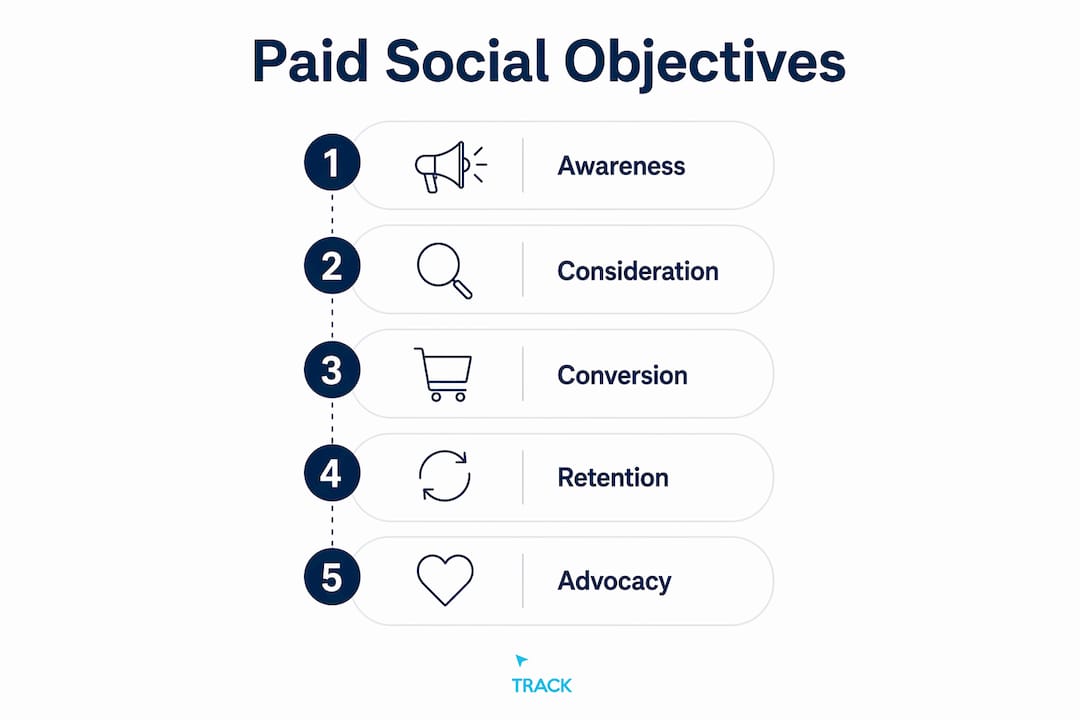
The five objectives and their primary KPIs are:
| Objective | Primary KPI | Practical example target |
|---|---|---|
| Awareness | CPM (cost per thousand impressions) | $6 CPM for broad B2C audiences |
| Consideration | CTR / CPC | CTR above 1%, CPC under $2 for consumer goods |
| Direct response | CPA (cost per acquisition) | CPA at or below 30% of product margin |
| Lead generation | CPL (cost per lead) | CPL under $50 for local service businesses |
| Retention / LTV | Repeat purchase rate / ROAS | ROAS above 3x for e-commerce retargeting |
Mapping one objective to one KPI removes the mixed signals that kill optimization. If your campaign goal is lead generation but you are measuring CTR, you will make creative decisions that drive clicks but not form fills. The platform's bidding algorithm also needs a single conversion signal to learn from. Give it two and it gets confused. Give it one and it gets efficient.
Pro Tip: If you have multiple business goals, run separate campaigns for each objective rather than asking one campaign to serve all of them. Awareness and conversion campaigns need different bidding strategies, creative formats, and audience pools.
Which Platform Should You Use for Paid Social Ads?
Platform selection is where most advertisers either overspend or miss their audience entirely. The right platform depends on your business type, your audience, and where in the funnel you are trying to reach people. Here is a practical breakdown.
| Platform | Best for | Common ad formats | Targeting strengths | Relative cost |
|---|---|---|---|---|
| Meta (Facebook + Instagram) | B2C, e-commerce, local services | Image, video, carousel, Reels, Stories, lead forms | Behavioral, lookalike, retargeting, first-party | CPC around average cost for consumer goods |
| TikTok | B2C awareness, DTC brands, Gen Z/Millennial reach | In-Feed video, TopView, Spark Ads | Interest, behavioral, lookalike | CPC generally low |
| B2B, enterprise, professional services | Sponsored Content, Message Ads, Lead Gen Forms | Job title, company size, industry, seniority | CPC generally higher | |
| X (Twitter) | News, tech, finance, real-time events | Promoted Posts, Trend Takeovers, video | Interest, keyword, follower lookalike | Moderate |
| Home, fashion, food, wedding, DIY | Static pins, video pins, shopping ads | Intent-based, keyword, demographic | Low to moderate | |
| Snapchat | Young adult age group, mobile-first brands | Snap Ads, Story Ads, Collection Ads | Age, location, interest, behavioral | Low to moderate |
| YouTube | Video-first brands, high-intent research | Skippable in-stream, bumper, discovery | Search intent, demographic, topic | Moderate to high |
A few rules of thumb worth keeping:
- B2C and e-commerce: Start with Meta. Meta tends to deliver a median ROAS favorable for many direct-to-consumer brands.
- B2B: LinkedIn is expensive, but it is often the only platform that delivers consistently positive ROAS for enterprise campaigns. Expect B2B ROAS to be modest and plan budgets accordingly.
- Top-of-funnel awareness: TikTok's low CPCs make it effective for reach, but conversion rates for B2B and high-ticket items fall under 1%, so pair it with retargeting on a higher-intent platform.
For a broader view of where platform and creative trends are heading, the 2026 social media trends overview from lflow.co is worth a read before you finalize your platform mix.
How Do You Plan a Paid Social Campaign from Start to Finish?
Good campaign planning happens before you open Ads Manager. The sequence matters because every downstream decision, from creative to bidding, depends on what you decide at the top.

Step 1: Define the business objective. Not the marketing goal. The business outcome. "Generate 20 qualified leads per month at a CPL under $40" is a business objective. "Increase brand awareness" is not.
Step 2: Set the KPI and attribution window. Choose one primary metric and decide how you will count a conversion. A 7-day click attribution window is standard for most direct-response campaigns. Awareness campaigns use view-through windows. Commit to one before launch so you can compare results consistently.
Step 3: Map your funnel stages. Prospecting campaigns reach cold audiences. Retargeting campaigns reach people who visited your site, watched a video, or engaged with your content. These need separate ad sets, separate creative, and often separate budgets.
Step 4: Build your audience framework. For prospecting, use interest or behavioral targeting for initial tests, then shift to lookalike audiences once you have 500 or more matched customers in your pixel data. For retargeting, segment by recency and depth of engagement. Note that Meta removed dozens of detailed interest targeting categories in early 2026, which means algorithmic audience tools like Advantage+ Audience are now the primary prospecting lever for many advertisers.
Step 5: Audit your landing page before you spend. The ad gets the click. The landing page earns the conversion. Check that the page headline matches the ad promise, the form or checkout is mobile-optimized, and the page load time is under three seconds.
Step 6: Set your budget and bidding strategy. For a first test, spend enough to collect 50 conversion events within the campaign's learning phase, typically 7, 14 days. Automated bidding strategies like Meta's Advantage+ or TikTok's Smart Performance require minimum conversion volume to exit the learning phase. Plan your budget to meet that threshold, not just to "see what happens."
Pro Tip: When adopting automated bidding, set a cost cap or target CPA from day one. Without a guardrail, the algorithm will spend your full budget optimizing for volume, not efficiency. A cost cap keeps the learning phase honest.
What Ad Formats and Creative Practices Actually Work?
Creative is the variable that moves performance more than any other single factor once targeting and tracking are in place. Here is a practical spec sheet for the formats that drive results across major platforms.
| Format | Aspect ratio | Recommended length | Hook timing |
|---|---|---|---|
| Short-form video (TikTok, Reels, Shorts) | vertical | 15, 30 seconds | First 2, 3 seconds |
| In-Feed video (Facebook, LinkedIn) | 4:5 or 1:1 | 15 seconds | First 3 seconds |
| Static image | 1:1 or 4:5 | N/A | Headline above fold |
| Carousel | 1:1 per card | 3, 10 cards | Card 1 as hook |
| Stories / Reels | vertical | 6, 15 seconds | Immediate visual hook |
| Lead form ads | N/A | N/A | Headline + one-line value prop |
A few creative rules that hold across platforms:
The first three seconds of any video determine whether someone keeps watching. Lead with the problem, the product in use, or a visual pattern interrupt. Do not open with your logo or a slow pan.

Headlines in static ads carry most of the conversion weight. Test at least two headline variants per ad set: one that states the benefit directly and one that frames a problem the audience recognizes. Keep primary text under 125 characters for mobile feeds.
Carousels work well for e-commerce product catalogs and for walking someone through a multi-step value proposition. Each card should stand alone as a complete message, not require the viewer to swipe to understand it.
When you adapt creative across platforms, respect native behaviors. A polished brand video that works on LinkedIn will feel out of place on TikTok, where lo-fi, direct-to-camera content tends to outperform high-production assets.
Paid social spend increased while aggregate CPC decreased, driven largely by expanded short-form video inventory. More inventory means more competition for attention, not less. Creative quality is the differentiator.
Pro Tip: Refresh creative every 3, 4 weeks for active campaigns. High frequency per user per week is a reliable signal of creative fatigue. When CTR drops more than 20% from its peak without a targeting change, the creative is the problem.
How Do You Set Up Measurement Before You Launch?
Measurement infrastructure needs to be in place before the first dollar is spent. Setting it up after launch means you will be making optimization decisions on incomplete data.
Here is the implementation sequence:
- 1Install the platform pixel on your website. Every major platform, Meta, TikTok, LinkedIn, Pinterest, and Snapchat, provides a base pixel that fires on page load and tracks standard events like page views, add-to-cart, and purchase.
- 1Implement server-side Conversion API (CAPI). Browser-based pixels lose data to ad blockers and iOS privacy changes. Server-side CAPI sends conversion events directly from your server to the platform, recovering signal that the browser pixel misses. For Meta, this means running both the pixel and CAPI in parallel and deduplicating events by a shared event ID.
- 1Configure Google Analytics 4 (GA4) with conversion events. GA4 tracks cross-channel behavior and gives you a platform-independent view of the user journey. Set up GA4 goals for the same conversion events you are tracking in platform pixels so you can compare platform-reported conversions against GA4-reported conversions.
- 1Connect your CRM. Map platform lead or purchase events to CRM records so you can track what happens after the conversion. Did the lead close? Did the purchase repeat? CRM data closes the loop between ad spend and actual revenue.
- 1Triangulate before you trust any single number. Platform attribution can significantly inflate combined revenue when you add platform-reported conversions together without triangulation. Each platform claims credit for conversions that other platforms also claim. GA4 and CRM revenue are your ground truth.
The goal is a confidence-weighted attribution view that uses platform data for optimization signals and GA4 plus CRM data for revenue reporting. For a deeper look at how to build this system, the marketing attribution guide from Click Track Marketing walks through the full implementation.
“**Statistic callout:** Summing platform-reported revenue across channels without triangulation can overstate total revenue significantly, according to paid media analytics research. That gap is the difference between a campaign that looks profitable and one that actually is.”
Pro Tip: Use UTM parameters on every ad URL and verify they are passing through to GA4 before launch. A missing UTM means GA4 will classify that traffic as direct, making your attribution data unreliable from day one.
For more on pixel tracking and lead identification, the Click Track Marketing blog covers the technical setup in detail.
How Do You Test and Optimize Paid Social Campaigns?
Testing is how you find what works. Optimization is how you scale it. Most advertisers do both poorly because they test too many variables at once and make decisions too quickly.
A clean test follows this structure: one hypothesis, one variable changed, and enough data to be confident in the result. Changing two variables at once obscures the cause of differences.
For conversion campaigns, wait until each ad set has collected at least 50 conversion events before making a decision. Below that threshold, the data is too noisy to act on. For awareness or traffic campaigns, 1,000 impressions per variant is a reasonable minimum before comparing CTR.
Automated campaigns can reduce CPA and improve ROAS when conversion volume thresholds are met, with varying degrees of improvement reported for Meta Advantage+ and TikTok Smart Performance. These gains are real, but they require the algorithm to have enough conversion data to learn from. If your campaign is generating fewer than 50 conversions per week, automated bidding will underperform a well-set manual cost cap.
When a test produces a clear winner, move the winning creative or audience into a dedicated scaling campaign rather than raising the budget on the test campaign. Scaling within the same campaign resets the learning phase and can temporarily inflate CPA.
Pro Tip: Pair creative iteration with algorithmic bidding by feeding the algorithm a steady supply of new creative variants every 2, 3 weeks. Automated campaigns that run on stale creative lose efficiency faster than manually managed ones because the algorithm amplifies what works, and when the creative stops working, it amplifies nothing.
How Much Does Paid Social Advertising Cost?
Cost varies significantly by platform, objective, industry, and audience size. These benchmark ranges give you a starting point for planning, not a guarantee.
| Platform | Typical CPM | Typical CPC | Expected CPA range |
|---|---|---|---|
| Meta (B2C consumer goods) | $6 | $1.72 | $15, $50 |
| Meta (B2B) | $8 | $2, $5 | $50 |
| TikTok | $4, $10 | $0.44, $1.00 | $20 |
| $30 | $5.58, $15.00 | , | |
| $5, $15 | , | $20 | |
| Snapchat | $3, $10 | , | $20 |
To build a test budget, work backward from your target CPA. If your target CPA is $40 and your expected conversion rate from click to purchase is 2%, you need 50 clicks to generate one conversion. At a $1.72 CPC on Meta, that is $86 per conversion in click cost alone. To collect 50 conversions for a statistically meaningful test, you need roughly $4,300 in test budget. That number changes with every variable, but the math is always the same: target CPA divided by expected conversion rate equals cost per click needed, multiplied by the number of conversions you need for confidence.
For ROAS planning, a B2C e-commerce brand with a $50 average order value and a 30% margin needs a minimum ROAS of 3.3x just to break even on ad spend before accounting for fulfillment or overhead. Brands with higher LTV:CAC ratios can afford to run at lower initial ROAS because the customer's lifetime value justifies the acquisition cost. For a practical framework on tying spend to revenue, the Click Track Marketing blog covers the calculation in detail.
You can benchmark your own CPM, CPC, and CTR against current published ranges using the AdSights benchmark checker, which covers Meta, TikTok, LinkedIn, and YouTube with objective-specific bands.
Agency management fees for paid social typically run 10%, 20% of ad spend, with minimums that vary by agency. In-house management makes sense when you have a dedicated media buyer and enough campaign volume to justify the overhead. For most small businesses running under $10,000 per month in ad spend, managed services tend to produce better returns than a part-time in-house effort.
What Are the Most Common Paid Social Mistakes?
Most budget waste in paid social comes from a short list of repeatable mistakes. Recognizing them early saves money and produces cleaner data.
- No clear objective. Running a campaign without a defined conversion goal means the platform optimizes for engagement or reach by default. Set a specific conversion event before you launch.
- Poor landing page alignment. If the ad promises a discount and the landing page shows a homepage, the conversion rate will reflect that mismatch. Every ad should land on a page built for that specific offer.
- Testing too many variables at once. Changing creative, audience, and bid strategy simultaneously makes it impossible to know what drove a result. Test one variable per experiment.
- Trusting platform attribution alone. Platform over-reporting can inflate revenue by 20%, 40% when you sum across channels. Always triangulate with GA4 and CRM data.
- Ignoring creative fatigue. An ad that performed well in week one will degrade. Frequency above 3.0 per user per week is a reliable warning sign.
- Skipping the learning phase. Pausing or editing campaigns during the learning phase resets the algorithm's optimization. Give automated campaigns at least 7, 14 days and 50 conversion events before making changes.
Pro Tip: When a campaign underperforms, check your CPM first. A high CPM relative to benchmarks usually means your audience is too narrow or your creative relevance score is low. A low CPM with low CTR means the creative is not stopping the scroll. Diagnosing the bottleneck before changing anything saves you from fixing the wrong problem.
Seven-Step Quick Launch Checklist and a One-Week Monitoring Plan
You can complete this checklist in a single day before your first campaign goes live.
- 1Define your objective and primary KPI. Write them down. "Generate leads at a CPL under $45 using Meta lead forms" is a complete objective.
- 2Set up conversion tracking. Install the platform pixel, implement server-side CAPI, configure GA4 conversion events, and verify all three are firing correctly using the platform's test event tool.
- 3Build your audience. Create one prospecting audience and one retargeting audience. Keep them in separate ad sets.
- 4Prepare creative. Build at least two creative variants per ad set. Follow the format specs in the table above. Make sure the first three seconds of any video deliver a clear hook.
- 5Audit your landing page. Confirm the headline matches the ad, the form is mobile-optimized, and the page loads in under three seconds.
- 6Set your budget and bid strategy. Size the budget to collect 50 conversions within the learning phase. Set a cost cap or target CPA if using automated bidding.
- 7QA the full funnel. Click your own ad in preview mode, complete the conversion action, and confirm the event fires in GA4 and the platform's event manager.
One-week monitoring plan:
- Days 1, 2: Check that tracking events are firing. Do not make optimization decisions yet. The algorithm is still learning.
- Days 3, 4: Review CPM and CTR. If CPM is significantly above benchmark, the audience may be too narrow. If CTR is below 0.5%, the creative hook is not working.
- Days 5, 6: Check CPA or CPL against your target. If cost is more than 50% above target, pause the underperforming ad set and shift budget to the better performer.
- Day 7: Pull a full performance report. Compare platform-reported conversions against GA4 conversions. If the gap is larger than 20%, review your CAPI deduplication setup.
If a campaign is spending but generating zero conversions after 48 hours, check the landing page and the conversion event setup before touching the ad. The problem is almost always downstream of the click.
Key Takeaways
Paid social media marketing works when every campaign decision, from platform choice to creative to bidding, is tied to a single measurable revenue outcome and verified through triangulated attribution rather than platform-reported numbers alone.
| Point | Details |
|---|---|
| One objective, one KPI | Commit to a single conversion goal per campaign so the algorithm and your reporting stay aligned. |
| Triangulate attribution | Platform over-reporting can inflate combined revenue by 20%, 40%; always cross-check with GA4 and CRM data. |
| Match platform to business type | Meta delivers a median ROAS of 2.79x for B2C consumer goods and a much lower B2B ROAS of 1.62x; LinkedIn is the primary B2B option despite CPCs of $5.58, $15.00. |
| Automate with guardrails | Meta Advantage+ can reduce CPA by up to 32%, but only when conversion volume thresholds are met and a cost cap is set. |
| Click Track Marketing | Provides paid media management grounded in revenue attribution, with PeoplePixel and PeopleLytics closing the loop between ad spend and actual revenue. |
The Measurement Gap Most Paid Social Guides Skip
Most paid social guides stop at campaign setup. They tell you how to build an ad, pick an audience, and set a budget. What they rarely address is the gap between what the platform reports and what actually happened in your business.
That gap is where most advertisers lose confidence in paid social. A campaign shows a 4x ROAS in Meta Ads Manager. GA4 shows half that. The CRM shows fewer closed deals than either platform suggests. The instinct is to blame the platform or the agency. The real problem is that no one built the measurement infrastructure before the campaign launched.
The platforms are not lying. They are reporting within their own attribution windows, which overlap with every other platform running simultaneously. When you add those numbers together, you get a picture that is 20%, 40% more optimistic than reality. The fix is not to distrust paid social. It is to build a system that triangulates between platform data, GA4, and CRM revenue so you have a defensible number to act on.
There is also a creative discipline that most guides undervalue. The best-performing paid social campaigns are not the ones with the biggest budgets. They are the ones where someone is watching creative fatigue weekly, refreshing assets before performance degrades, and feeding the algorithm a steady supply of new signals. Automated bidding amplifies what works. When the creative stops working, it amplifies nothing, and the budget drains quietly.
The advertisers who win at paid social treat it as infrastructure, not a campaign. They build the tracking before they spend. They test one variable at a time. They measure revenue, not impressions. And they refresh creative on a schedule, not when the numbers get bad enough to force it.
How Click Track Marketing Builds Paid Social That Proves Revenue
Running paid social without a measurement system is like driving without a dashboard. You can move, but you cannot tell how fast, how far, or whether you are heading in the right direction.
Click Track Marketing builds the infrastructure that makes paid social accountable. PeoplePixel identifies the anonymous visitors your campaigns are sending to your site, including the ones who do not convert. BuyerSignals surfaces who is in-market right now. PeopleLytics delivers a weekly revenue attribution dashboard that shows exactly which campaigns are producing customers and which are producing noise. Together, these tools answer the question that matters: is the spend making money?
For businesses ready to connect paid media to real revenue, the free AEO checklist is a practical starting point that covers the measurement and visibility infrastructure your campaigns need to perform. If you want to see how the full system works, the AI marketing overview walks through the complete funnel. To talk through your specific situation, reach out directly at clicktrackmarketing.com.
Useful Sources
These resources support the benchmarks, platform specs, and measurement guidance in this guide.
- 2026 Paid Social Advertising Performance Benchmarks by Platform, Cross-platform CPM, CPC, ROAS, and CPA benchmarks for Meta, TikTok, LinkedIn, and more. Use this to set realistic cost expectations before you plan a budget.
- AdSights Paid Social Benchmark Checker, A live tool that compares your CPM, CPC, and CTR against current published ranges for Meta, TikTok, LinkedIn, and YouTube. Useful for diagnosing whether a performance problem is creative, audience, or market-level.
- Paid Media Analytics: The Metrics That Actually Matter, Guidance on triangulating platform reports with GA4 and CRM revenue, and why summing platform-reported conversions overstates total revenue by 20%, 40%.
- How Marketing Attribution Works: 2026 Guide | Click Track Marketing, Implementation steps for server-side tracking, attribution windows, and CRM integration. Start here if you are setting up measurement from scratch.
- How to Track Marketing ROI by Channel | Click Track Marketing, Practical methods for comparing channel performance and calculating ROI across paid social, search, and organic.
Want to know exactly which marketing is making you money?
Get a free attribution audit — we'll show you where your leads and revenue actually come from. Answer two quick questions to start.