

Quick Answer
Remodeling marketing ROI is defined as the net revenue from booked jobs minus all marketing costs, divided by those costs. To track remodeling marketing ROI accurately, you must connect every marketing dollar to a signed contract, not just a phone call or a form fill. Most remodeling companies measure leads. The ones that grow measure revenue by channel. That distinction, between counting activity and counting money, is what separates a remodeling marketing strategy that scales from one that bleeds budget quietly.
What tools do remodelers need to track marketing ROI?
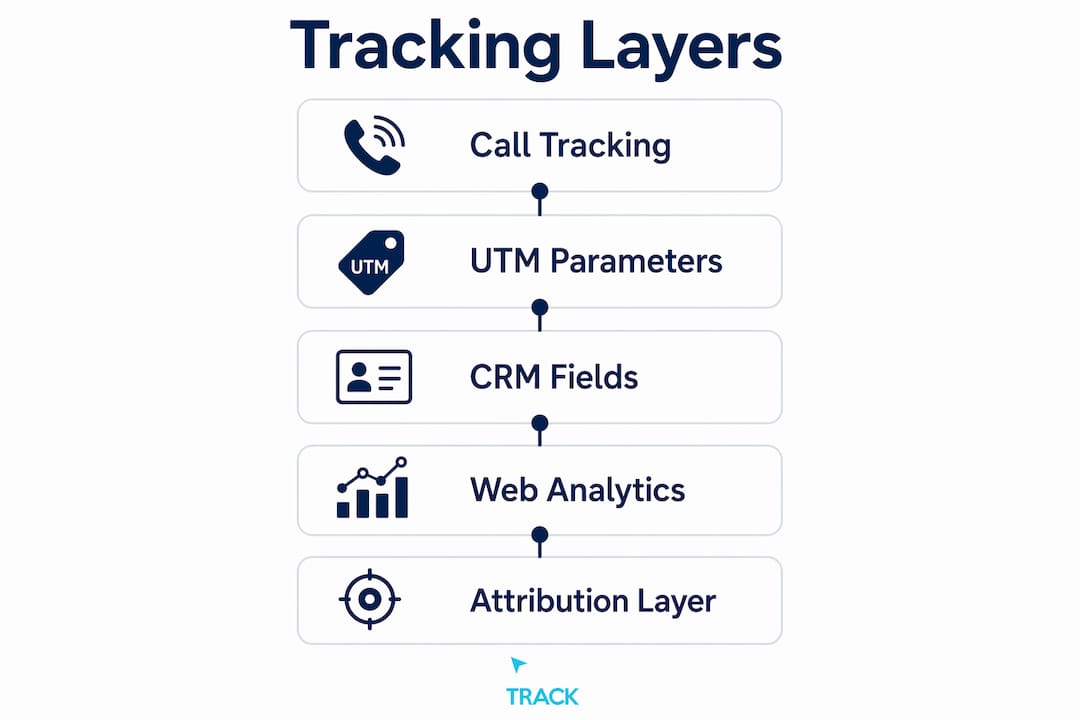
The foundation of marketing ROI tracking for remodeling companies is a five-layer attribution stack. Each layer captures a different part of the customer journey, and missing even one layer creates blind spots that distort your numbers.
Layer 1: Call tracking. Because 60 to 80% of home-service conversions happen via phone, call tracking is not optional. CallRail assigns unique phone numbers to each marketing channel, so a call from a Google Ads campaign is never confused with one from a yard sign or a direct mail piece.

Layer 2: UTM parameters. Every digital link you publish, whether in a Google Ads campaign, a Facebook post, or an email, needs UTM tags. These parameters carry source and campaign data into Google Analytics 4 and your CRM, so you know which digital effort generated each session.
Layer 3: CRM lead source fields. ServiceTitan and similar platforms let you configure lead source fields that match your marketing channels exactly. When your office staff logs a new lead, they select the source. This step is where most remodelers lose data. Staff training and a short, clear source list are non-negotiable.
Layer 4: Website analytics. Google Analytics 4 links sessions to form fills and call events, giving you a session-level view of which pages and sources drive contact attempts.
Layer 5: Attribution layer. This is where ad spend connects to booked revenue. Platforms like Rivet pull data from your CRM and ad accounts to calculate cost per booked job by channel. That single metric, cost per booked job, is the primary decision metric for any remodeling marketing strategy. Cost per lead is a proxy. Cost per booked job is the answer.
| Tool | Role in the tracking stack |
|---|---|
| CallRail | Assigns unique numbers per channel; records and logs calls |
| ServiceTitan | CRM with lead source fields tied to booked job revenue |
| Google Analytics 4 | Session and event tracking; links digital sources to conversions |
| Rivet | Attribution layer connecting ad spend to CRM revenue data |
| Google Analytics 360 | Cross-channel measurement with Meridian and predictive modeling |
Pro Tip: Set up your CRM lead source list before you launch any campaign. A list of 20 vague options produces garbage data. A list of 8 specific, channel-matched options produces decisions.
How to implement tracking for remodeling's long sales cycle
Remodeling projects carry sales cycles that can run from two weeks to six months. A homeowner may see your Facebook ad in January, search your name in March, and call from a yard sign in April. Standard last-click tracking credits the yard sign. The reality is that all three touchpoints contributed.
Start by assigning unique tracking numbers to every offline and online channel. Your Google Ads campaign gets one number. Your Angi listing gets another. Your truck wrap gets a third. This is the only way to avoid undercounting phone-driven conversions, which are the majority of your actual leads.
Next, map the customer journey in two stages. Awareness channels, including social media, content marketing, and display ads, introduce your brand. Conversion channels, including branded search, Google Local Services Ads, and direct calls, close the deal. Cutting awareness channels because they show no direct conversions is a common and costly mistake. Multi-touch journey analysis shows that Facebook awareness frequently drives the Google searches that produce booked jobs.
Track micro-conversions as well. Page visits to your project gallery, time spent on your financing page, and repeat visits within 30 days are leading indicators of intent. They do not close jobs, but they tell you which channels are warming prospects before the call.
- 1Assign a unique CallRail number to each active marketing channel.
- 2Apply UTM parameters to every digital link before publishing.
- 3Configure CRM lead source fields to match your channel list exactly.
- 4Train every person who logs leads on the source selection process.
- 5Review CRM source data weekly for missing or miscategorized entries.
Pro Tip: Accurate lead source entry depends on your team, not your software. Run a 15-minute training session every quarter and spot-check 10 records per week. Data hygiene is a people problem before it is a technology problem.
What attribution models work best for remodeling ROI analysis?
Attribution models determine how credit for a conversion is distributed across the touchpoints that preceded it. For remodeling companies, the right model depends on your volume and your technical capacity.
Last-touch attribution is the starting point. It credits the final channel before a conversion. It is simple, easy to explain to a team, and directionally useful when your volume is low. Its weakness is that it ignores every channel that built awareness and intent before the final click or call.
Multi-touch attribution distributes credit across all touchpoints in the journey. Linear models split credit equally. Time-decay models give more credit to touchpoints closer to conversion. Position-based models weight the first and last touch most heavily. For remodelers running Google Ads, Facebook, and email simultaneously, multi-touch models produce far more accurate budget decisions.
The most important concept for improving remodeling ROI is incremental ROAS. Reported ROAS includes customers who would have converted without your ads. Incremental ROAS measures only the revenue your ads actually caused. The gap between the two numbers is often large, and it represents budget you are spending to reach people who would have found you anyway.
For advanced measurement, Google Analytics 360 integrates Meridian, a marketing mix modeling tool that uses causal measurement to separate true ad-driven revenue from organic demand. The platform's Qualified Future Conversions metric links current ad spend to future sales through brand search signals. This is particularly useful for remodelers because it accounts for the delayed conversion behavior that makes standard attribution unreliable.
- Use last-touch attribution as a baseline when you have fewer than 50 leads per month.
- Add multi-touch modeling when you run three or more active channels simultaneously.
- Test incrementality by pausing one channel for two weeks and measuring the revenue impact.
- Triangulate platform data with CRM revenue and call tracking to catch inflated platform-reported numbers.
Pro Tip: Platform-reported ROAS is a tactical indicator, not a strategic truth. Treat it as one input, then cross-reference it with your CRM's booked job data before making any budget decision.
How often should you review remodeling marketing performance?
Measurement frequency should match your ability to act on the data. Reviewing Google Ads performance annually is useless. Reviewing SEO rankings daily is noise.
Track paid channel ROI weekly or biweekly. Paid search and paid social spend can shift quickly, and a campaign that was profitable on Monday can be burning money by Friday. Weekly reviews let you catch bid changes, audience fatigue, and quality score drops before they compound.
Measure organic channels monthly. SEO, content marketing, and Google Business Profile performance change slowly. Monthly reviews give you enough data to identify real trends rather than reacting to weekly fluctuations.
Run a quarterly comprehensive review to reallocate budget and assess overall marketing health. This is where you compare channel-level cost per booked job, cut underperformers, and increase spend on what is working. Accurate ROI tracking requires including all costs in this review: media spend, agency fees, software subscriptions, and the staff time spent managing campaigns. Most remodeling companies undercount marketing costs, which inflates apparent ROI and leads to poor budget decisions.
Your quarterly review agenda should cover these KPIs:
- Cost per booked job by channel
- Lead-to-appointment rate by source
- Appointment-to-signed-contract rate
- Average project value by lead source
- Blended ROAS across all platforms
- Call answer rate and call-to-lead conversion rate
Pro Tip: Build a single dashboard in Google Looker Studio that pulls from Google Analytics 4, your CRM, and CallRail. A visual trend line catches anomalies faster than a spreadsheet and gives your team a shared reference point in every review meeting.
Key takeaways
Remodeling marketing ROI tracking requires a five-layer attribution stack connecting call tracking, CRM data, and analytics to booked job revenue, reviewed on a cadence that matches each channel's pace.
| Point | Details |
|---|---|
| Define ROI by booked jobs | Cost per booked job by channel is the only metric that drives sound budget decisions. |
| Build the five-layer stack | CallRail, ServiceTitan, Google Analytics 4, UTM parameters, and an attribution layer all work together. |
| Match attribution to volume | Use last-touch when volume is low; add multi-touch and incrementality testing as you scale. |
| Review at the right cadence | Paid channels weekly, organic monthly, full budget review quarterly. |
| Count all costs | Include agency fees, software, and staff time or your ROI calculation is wrong from the start. |
What most remodelers get wrong about attribution
I have reviewed attribution setups for dozens of home service businesses, and the same failure appears repeatedly. The problem is rarely missing data. It is the absence of a framework to turn data into a specific channel decision.
A remodeler running Google Ads, Angi, and direct mail simultaneously will often see three lead sources in their CRM and assume the one with the most leads is the best channel. That logic ignores close rates, average project value, and the time each channel takes to convert. A channel that produces 10 leads at a 70% close rate and a $45,000 average job is worth far more than one producing 30 leads at a 20% close rate and a $12,000 average job.
The other mistake I see constantly is over-reliance on platform-reported numbers. Google will tell you your ads are performing well. Meta will tell you the same. Both platforms use attribution windows and modeling assumptions that favor their own numbers. The only way to know the truth is to cross-reference pixel tracking data with your CRM's actual booked revenue.
My practical advice: start simple. If you are a smaller remodeling operation, get call tracking and CRM lead source fields working correctly before you touch attribution modeling. Accurate inputs matter more than sophisticated models. Once your data is clean, you can layer in multi-touch attribution and incrementality testing. The businesses that win are the ones who can see clearly what is working and commit to it. That clarity comes from infrastructure, not from a better-looking dashboard.
How Click Track Marketing helps remodelers prove what their marketing earns
Remodeling companies that work with Click Track Marketing stop guessing which channels produce revenue and start seeing it directly. The agency's attribution infrastructure connects call tracking, CRM lead source data, and analytics into a single weekly reporting view through PeopleLytics, showing cost per booked job by channel without manual data pulls.
PeoplePixel identifies anonymous site visitors so you know who is showing buying intent before they call. BuyerSignals surfaces which prospects are actively in the market right now. Together, these tools give remodeling marketers the visibility to cut waste and increase spend where it actually produces signed contracts. If you want to know exactly what your marketing is earning, book a free strategy call with the Click Track Marketing team.
Want to know exactly which marketing is making you money?
Get a free attribution audit — we'll show you where your leads and revenue actually come from. Answer two quick questions to start.