

Quick Answer
AI search optimization services are specialized techniques that structure your content to be cited inside AI-generated answers on platforms like ChatGPT, Google Gemini, and Perplexity. The goal is not a higher ranking on a results page. The goal is to become the answer that an AI engine delivers when your ideal customer asks a question you should be answering.
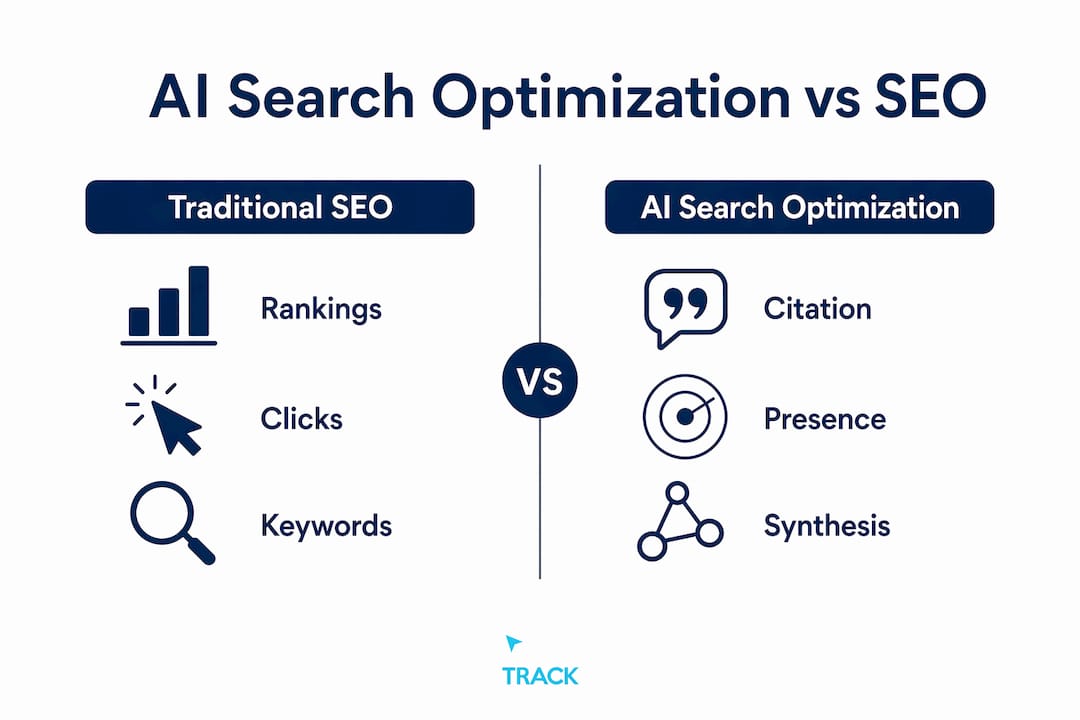
This is a real shift in how visibility works. Traditional SEO measures success through organic clicks and keyword rankings. AI search optimization measures success through citation frequency and share of voice inside AI responses. The industry term for this practice is Answer Engine Optimization, or AEO. You will also hear the term Generative Engine Optimization, or GEO, used for the broader goal of shaping how AI systems represent your brand voice. Both disciplines sit under the umbrella of AI search optimization, and both are growing fast.
What are AI search optimization services and how do they differ from SEO?
Traditional SEO optimizes for rankings and clicks. AI search optimization optimizes for citation frequency and presence inside AI-generated answer blocks. That distinction matters because the two goals require different content structures, different measurement systems, and different definitions of success.

AEO is best understood as an evolutionary layer on top of SEO. It focuses on how AI systems synthesize, cite, and surface content rather than how search engines rank pages. GEO extends that further by targeting brand voice recognition across AI-generated content, not just individual citations. The table below shows how the three disciplines compare.
| Discipline | Primary goal | Success metric | Key tactic |
|---|---|---|---|
| SEO | Page ranking | Organic clicks and traffic | Keyword targeting and backlinks |
| AEO | AI citation | Citation frequency in AI answers | Direct-answer content and schema |
| GEO | Brand voice in AI | Brand mention share | Entity signals and off-page authority |
One finding worth understanding: only 38% of AI-cited URLs now come from Google's top 10 organic results. That means ranking well no longer guarantees citation. A page can rank on page one and still be invisible inside AI answers. That decoupling is why AI search optimization has become its own discipline.
SEO fundamentals still matter. Crawlability, content authority, and site structure are the foundation that AEO builds on. You cannot skip them. But they are no longer sufficient on their own.
Core strategies for effective AI-driven SEO solutions
The most direct path to AI citation is content that answers a specific question in the first one or two sentences of a section. AI systems extract answers. They do not summarize long paragraphs. They pull the clearest, most direct response to a query and surface it. Structure your content to make that extraction easy.
Pro Tip: Map your content to actual prompts users type into ChatGPT or Perplexity. This is called prompt mapping. Run the queries yourself, note what AI engines currently cite, and identify where your brand is absent. That gap is your content roadmap.
The core tactics for AI-citable content break down into five areas:
- Question-based headings. Use H2 and H3 headings that mirror natural-language queries. "What is X?" and "How does Y work?" signal to AI systems that a direct answer follows.
- Structured data schemas. Implement FAQPage, How-To, and Article schema markup. FAQ schema maps questions to answers in a format AI engines extract with high accuracy.
- Brand entity signals. Publish consistent name, address, phone, and category data across your website, Google Business Profile, and third-party directories. AI systems build entity models from these signals.
- Unlinked brand mentions. Earn mentions of your brand name in trusted publications, forums, and industry sites. AI systems use these mentions to assess brand authority even without a backlink.
- Accessible technical structure. Use proper heading hierarchy, descriptive alt text, and semantic HTML. Accessible content directly improves AI extractability and citation prevalence.
Each tactic reinforces the others. A page with strong schema but poor heading structure will underperform. A brand with strong mentions but a slow, poorly structured site will still lose citations to a faster, cleaner competitor.
How do you measure AI search visibility and citation success?
Measurement is the hardest part of AI search optimization, and most businesses are not doing it at all. Traditional analytics tools like Google Search Console do not capture AI visibility. There is no dashboard that shows you how often ChatGPT cited your brand last week. That gap is called the Monitoring Gap, and it is a real operational problem.
The practical solution right now involves a combination of manual testing and emerging monitoring tools. Here is a repeatable process:
- 1Build a prompt library. Write out 20, 30 questions your ideal customer would ask an AI engine. Include product questions, comparison questions, and local service questions.
- 2Run structured prompt tests. Enter each prompt into ChatGPT, Perplexity, Gemini, and Google AI Overviews. Record whether your brand is cited, how it is described, and which competitors appear instead.
- 3Log results in a tracking sheet. Date each test. Track citation rate as a percentage of prompts where your brand appears. This becomes your baseline.
- 4Retest monthly. AI models update frequently. A brand cited in january may not be cited in april. Monthly testing catches changes before they become revenue problems.
- 5Integrate with existing analytics. Cross-reference citation gains with direct traffic and branded search volume. Both tend to rise when AI citation increases.
Pro Tip: When you run prompt tests, vary the phrasing. "Best [service] in [city]" and "Who provides [service] near me?" will sometimes return different citations from the same AI engine. Test both forms.
The shift from tracking clicks to tracking AI mentions fundamentally changes how marketing success is measured. Revenue attribution becomes more important, not less. You need to know which AI citations are driving real customer actions, not just brand impressions.
Common challenges and misconceptions in AI search optimization
The most common misconception is that AEO replaces SEO. It does not. AEO is an evolutionary enhancement to traditional search optimization, not a substitute. Businesses that abandon SEO fundamentals to chase AI citations will lose both.
A second misconception is that structured data alone guarantees citation. Schema markup helps AI systems understand your content. It does not guarantee they will cite it. Citation depends on content quality, brand authority, and how well your answers match actual user prompts. Schema is a signal, not a shortcut.
The organizational challenges are just as real as the technical ones. Effective AI search optimization requires cross-functional coordination among content teams, IT, analytics, and compliance. Content teams write the answers. IT implements the schema and maintains site performance. Analytics tracks citation rates. Compliance reviews AI-generated brand representations for accuracy. When these teams work in silos, the program fails.
Other pitfalls to avoid:
- Optimizing for one platform only. ChatGPT, Perplexity, and Gemini use different models and different citation logic. A strategy built for one will miss the others.
- Ignoring AI trends entirely. Brands that delay adoption lose citation share to competitors who act earlier. That lost visibility compounds over time.
- Chasing every new AI feature. New AI search features launch constantly. Prioritize based on where your customers actually ask questions, not where the press coverage is loudest.
The businesses that succeed treat AI search optimization as infrastructure, not a campaign. It requires ongoing maintenance, regular testing, and cross-team accountability.
Key Takeaways
AI search optimization services succeed when brands combine direct-answer content, structured data, consistent entity signals, and continuous citation monitoring across multiple AI platforms.
| Point | Details |
|---|---|
| AEO differs from SEO | AEO targets citation frequency in AI answers; SEO targets rankings and clicks. |
| Schema helps but does not guarantee | FAQPage and How-To schema improve extractability but citation requires content quality too. |
| The Monitoring Gap is real | Google Search Console does not track AI citations; manual prompt testing is required. |
| Cross-team coordination is required | Content, IT, analytics, and compliance must work together for AI optimization to succeed. |
| Fundamentals still matter | Crawlability, site speed, and content authority remain the foundation for AI citation eligibility. |
Why measurement has to come before optimization
I have worked with enough business owners to know that the instinct is to start with content. Write more, publish faster, add schema everywhere. That instinct is understandable, but it puts the cart before the horse.
The first thing I tell any business entering this space is to establish a citation baseline before changing anything. Run your prompt library. Record where you appear and where you do not. That data tells you which content gaps to close and which platforms to prioritize. Without it, you are optimizing blind.
The second thing I have learned is that AI search optimization rewards patience in a way that paid media does not. A well-structured page with strong entity signals can start earning citations months after it is published, as AI models update and re-index the web. That lag frustrates owners who expect immediate results. The answer is not to abandon the strategy. The answer is to build the measurement system so you can see progress even when it is incremental.
The third lesson is harder to accept: your brand's AI reputation is already being built, whether you are managing it or not. AI engines are citing sources right now. If you are not in the mix, someone else is. That is not a reason to panic. It is a reason to start with a clear audit, a realistic roadmap, and a measurement framework that connects citation gains to actual revenue.
How Click Track Marketing builds your AI search foundation
Click Track Marketing was built specifically for the shift from traditional search to AI-driven answers. The agency's work spans AI-structured website builds, AEO strategy, and the attribution systems that connect citation gains to real revenue.
The free AEO Checklist is the fastest way to see where your content stands today. It covers the technical, content, and entity signal requirements that determine whether AI engines cite your brand or skip it. For businesses ready to go further, Click Track Marketing's full AEO service builds the infrastructure that makes your brand the answer that comes back when your customers ask. You can also learn more about getting recommended by ChatGPT through the agency's dedicated AI search service.
Want to know exactly which marketing is making you money?
Get a free attribution audit — we'll show you where your leads and revenue actually come from. Answer two quick questions to start.