

Quick Answer
Marketing automation is defined as software that executes repetitive marketing tasks across email, social media, and lead nurturing workflows without manual intervention. Understanding marketing automation basics means recognizing that it replaces hours of manual work with rule-based and AI-driven systems that deliver the right message to the right person at the right time. Platforms like Salesforce, HubSpot, and Marketo have made this technology accessible to businesses of every size. Research shows marketing automation delivers an average ROI of $5.44 for every dollar spent, with a payback period under six months. That number tells you this is not a luxury. It is infrastructure.
What is marketing automation explained for business owners?
Marketing automation is software that connects your marketing channels, customer data, and campaign logic into a single system that runs without you touching it every day. The industry term for the broader practice is "marketing automation," though you will also hear it called "marketing technology" or "martech" when referring to the full stack of tools involved.
The core functions break down into five areas:
- Lead capture and scoring: Forms, landing pages, and behavioral tracking assign point values to prospects based on actions like email opens, page visits, and content downloads. A lead that visits your pricing page three times scores higher than one who opened a single newsletter.
- Email campaign automation: Triggered sequences send messages based on user behavior. A new subscriber gets a welcome series. A cart abandoner gets a reminder. Neither requires you to press send.
- Social media scheduling: Tools like Buffer and Sprout Social publish posts across platforms on a set schedule, freeing your team from daily manual posting.
- CRM and data integration: Platforms integrate with CRM and CDP software to share lead data bi-directionally, so your sales team always sees the most current prospect activity.
- Workflow automation with if-then logic: If a contact clicks a specific link, then they move to a new segment and receive a targeted follow-up. This conditional logic is the backbone of every automation sequence.
Pro Tip: Overbuying features is the most common mistake new adopters make. If your primary use case is email nurturing, a tool like Mailchimp or ActiveCampaign will outperform a complex enterprise platform you will never fully use. Match the tool to your actual workflow, not to the feature list in a sales demo.
How does AI change the way marketing automation works?

Traditional marketing automation follows static, pre-written rules. You define the trigger, you define the action, and the system executes it exactly as written. That works well for predictable workflows, but it cannot adapt when customer behavior changes.
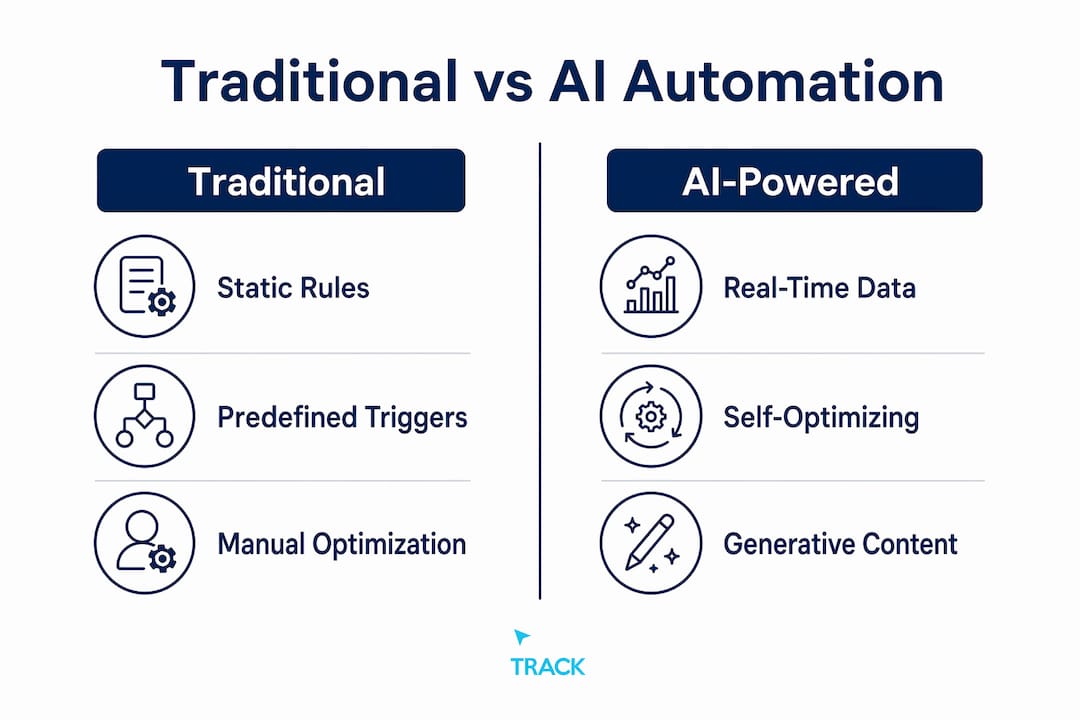
AI-driven systems enable continuous self-optimization using real-time customer behavior data, which is the defining difference from rule-based automation. Machine learning models analyze patterns across thousands of data points simultaneously and adjust campaign variables without waiting for a human to review a monthly report.
| Feature | Traditional automation | AI marketing automation |
|---|---|---|
| Decision logic | Static if-then rules | Dynamic, data-driven predictions |
| Personalization | Segment-based | Individual-level, real-time |
| Optimization | Manual A/B testing | Autonomous continuous testing |
| Content creation | Human-written templates | Generative AI at scale |
| Campaign management | Human-reviewed workflows | Agentic AI with autonomous execution |
Generative AI creates marketing content instantly, including email subject lines, product descriptions, and social assets, allowing creative teams to scale output without proportional headcount increases. Natural language processing reads customer replies and routes them to the correct follow-up sequence. Predictive analytics flag which leads are most likely to convert this week, not just which ones opened an email.
The most advanced tier is agentic AI. Salesforce describes agentic AI systems that independently diagnose campaign performance issues, generate new content, segment audiences dynamically, and relaunch campaigns without human intervention. This is not a future concept. It is available in enterprise platforms today and moving into mid-market tools rapidly.
Pro Tip: AI effectiveness depends entirely on data quality. A system trained on incomplete or inconsistent CRM data will produce poor predictions. Before investing in AI-enhanced automation, audit your contact database and standardize your data fields. Clean data is the foundation everything else runs on.
What benefits can businesses expect from marketing automation?
The financial case for automation is direct. Marketing automation delivers $5.44 ROI per dollar invested, with most businesses recovering their costs in under six months. For a business spending $1,000 per month on a platform, that math points to a meaningful return within one quarter if the system is set up correctly.
Beyond the ROI figure, the operational benefits compound over time. Automating repetitive tasks frees your team to focus on strategy, creative work, and relationship building. A marketing manager who previously spent three hours per day scheduling emails and updating spreadsheets can redirect that time toward campaign strategy and content quality.
“Marketing automation drives consistent follow-ups and lead scoring improvements that directly improve marketing-sales alignment.”
Lead quality improves because automation enforces a consistent qualification process. Every lead goes through the same scoring criteria. No prospect falls through the cracks because someone forgot to follow up. Automation drives consistent follow-ups and lead scoring that improve the handoff between marketing and sales, which is where most revenue leaks occur in growing businesses.
Personalization at scale is the third major benefit. Without automation, sending a personalized message to 10,000 contacts is impossible. With it, every contact receives communication based on their specific behavior, industry, and stage in the buying process. That level of relevance increases conversion rates and reduces unsubscribe rates simultaneously.
When should you implement marketing automation?
The clearest signal that you are ready for automation is time. If manual repetitive tasks consume 5 or more hours weekly, the ROI potential from automation is strong. That threshold applies to individual contributors and teams alike.
Three additional readiness indicators:
- 1You have a defined sales funnel. Automation works best when you can map the stages a prospect moves through from awareness to purchase. If your sales process is undefined, automate the definition first.
- 2You are coordinating across multiple channels or team members. When email, social, paid ads, and sales outreach all need to stay synchronized, manual coordination creates errors and delays. Automation enforces consistency.
- 3You have enough content to support a nurture sequence. A six-email welcome series requires six pieces of content. Common implementation mistakes include launching automation without sufficient content assets, which forces sequences to end prematurely or repeat.
The "automate, delegate, delete" framework is the most practical tool for evaluating which tasks belong in your automation system. Focusing automation on repetitive, rule-based workflows produces the highest ROI. Tasks that require judgment, creativity, or relationship management belong in the delegate or delete categories, not in an automation sequence.
One challenge worth naming directly: automation is effective for structured campaigns but struggles with complex multi-channel customer journeys that require journey orchestration. If your customer moves between in-store, online, email, and phone touchpoints in unpredictable sequences, a standard automation platform will not handle that alone. You will need journey orchestration tools layered on top.
Ongoing optimization requires monthly analytics reviews, A/B testing, workflow updates, and quarterly audits. Automation is not a set-and-forget system. It is infrastructure that needs maintenance to stay effective as your audience and offers evolve.
Key takeaways
Marketing automation produces measurable ROI only when it is built on clean data, defined workflows, and sufficient content assets.
| Point | Details |
|---|---|
| Core definition | Marketing automation is software that executes repetitive marketing tasks without manual intervention. |
| AI advantage | AI-driven automation self-optimizes in real time, unlike static rule-based systems. |
| ROI benchmark | Businesses average $5.44 returned per $1 spent, with payback under six months. |
| Readiness signal | Spending 5 or more hours weekly on manual marketing tasks signals strong automation ROI potential. |
| Maintenance requirement | Monthly analytics reviews and quarterly audits keep automation sequences effective over time. |
Why most businesses automate the wrong things first
I have watched businesses invest in marketing automation platforms and see almost no return, not because the tools failed, but because they automated the wrong things. The instinct is to automate everything visible: email, social posting, ad scheduling. What gets ignored is the data layer underneath all of it.
The shift from manual workflows to automated systems is not primarily a technology decision. It is a process decision. AI marketing automation shifts marketer roles from manual task execution to strategic oversight. That only works if the strategy is sound before the automation runs. A poorly defined lead qualification process, automated at scale, produces a high volume of poorly qualified leads faster than you could generate them manually.
The businesses I see win with automation share one habit: they treat their CRM data as a product. They clean it, they audit it, they enforce standards for how contacts are entered and updated. When AI tools run on that foundation, the predictions are accurate and the personalization is genuine. When they run on messy data, the output is noise.
The other thing worth saying plainly: automation does not replace the need for good marketing. It amplifies whatever you already have. If your offer is weak, automation will deliver a weak offer to more people faster. If your content is generic, automation will send generic content on a perfect schedule. The leverage is real, but it runs in both directions. Start with the quality of what you are automating, then build the system around it.
You can also use pixel tracking for lead identification to feed higher-quality behavioral data into your automation sequences, which is one of the fastest ways to improve lead scoring accuracy without rebuilding your entire system.
How Click Track Marketing builds your automation infrastructure
Click Track Marketing builds marketing automation systems that are tied directly to revenue, not just activity metrics. If you are spending time on manual follow-ups, inconsistent lead nurturing, or campaigns you cannot measure, the problem is not effort. It is infrastructure.
Our approach starts with attribution. We identify who is visiting your site, what they are doing, and which marketing activities are producing customers. Then we build automation that runs on that data. The result is a system where every sequence, every trigger, and every message is connected to a measurable outcome.
If you are ready to stop guessing which marketing is working, book a free strategy call with our team. We will show you exactly where your current setup is leaving revenue on the table and what it would take to fix it. You can also explore our full AI marketing automation services to see how we build these systems for businesses like yours.
Want to know exactly which marketing is making you money?
Get a free attribution audit — we'll show you where your leads and revenue actually come from. Answer two quick questions to start.