

Quick Answer
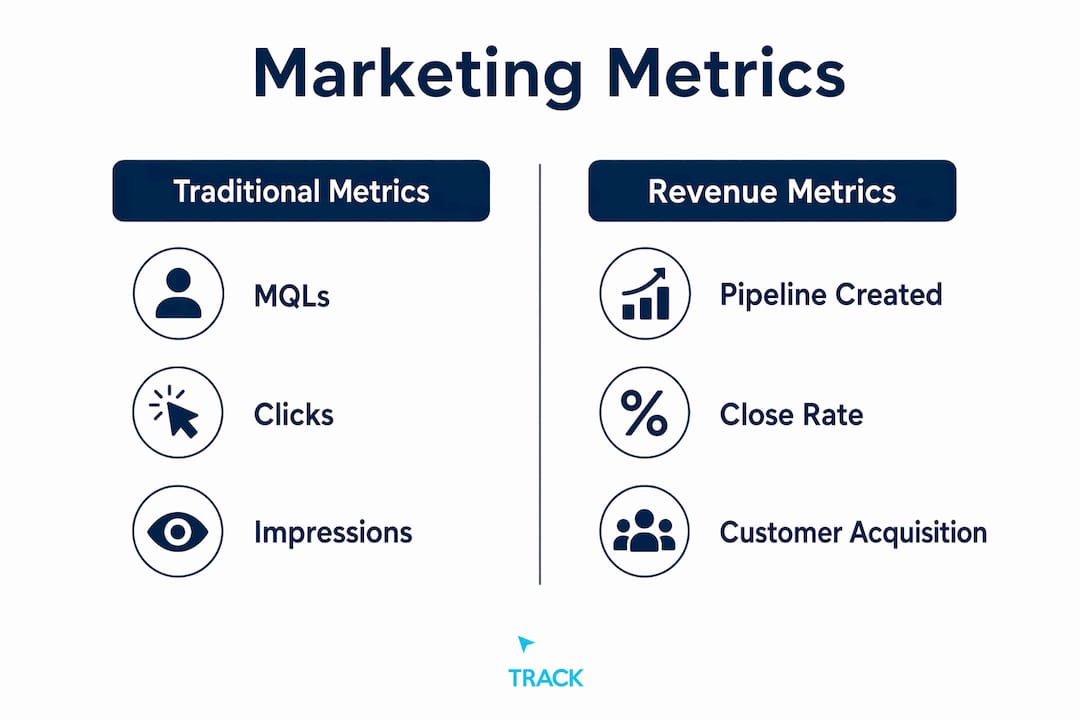
Revenue-based marketing is a strategic approach that ties every marketing activity directly to measurable revenue outcomes, specifically pipeline created and closed deals. Known formally as revenue marketing, this model holds marketing accountable for financial results rather than activity metrics like clicks, impressions, or marketing-qualified leads (MQLs). Platforms like Demandbase, Salesforce, and Cognism have built entire product lines around this shift. Click Track Marketing applies the same discipline to local businesses and e-commerce brands that have never had access to this level of accountability before.
What is revenue-based marketing and how does it differ from traditional marketing?
Revenue-based marketing is defined as the practice of aligning marketing campaigns, budgets, and reporting directly with pipeline contribution and closed revenue. Traditional marketing measures success by volume: how many leads came in, how many people clicked an ad, how many emails were opened. Revenue marketing measures success by one thing: how much money did marketing actually produce.
The distinction matters because volume metrics can look great while revenue stays flat. A campaign generating 500 MQLs that close at 1% is less valuable than one generating 50 highly qualified leads that close at 30%. Traditional marketing rarely surfaces that difference. Revenue marketing makes it impossible to ignore.

Organizational structure changes too. Traditional marketing and sales teams often operate in separate silos with separate goals. Revenue marketing breaks that apart. Marketing becomes accountable for pipeline, not just leads handed off to sales. Both teams share targets and review the same numbers weekly.
| Dimension | Traditional marketing | Revenue marketing |
|---|---|---|
| Primary metric | MQLs, clicks, impressions | Pipeline created, closed revenue |
| Success definition | Lead volume | Revenue contribution |
| Team structure | Marketing and sales siloed | Shared pipeline ownership |
| Budget justification | Activity reports | Marketing-sourced revenue |
| Optimization target | Engagement rate | Lead-to-close conversion rate |
The table above shows why the two models produce different decisions. When marketing owns pipeline numbers, every budget call becomes a revenue conversation, not a creative preference.
What metrics define revenue marketing effectiveness?
Closed-loop measurement is the technical foundation of revenue marketing. It connects marketing touchpoint data, from first ad click to content download to demo request, directly to CRM records showing whether that contact became a customer. Without this connection, you are guessing which campaigns work.
The core metrics revenue marketers track are:
- Pipeline created: Total deal value sourced by marketing in a given period
- Pipeline influenced: Deals where marketing touched the prospect at any point before close
- Lead-to-close conversion rate: The percentage of marketing-sourced leads that become paying customers
- Customer acquisition cost (CAC): Total marketing spend divided by new customers acquired
- Customer lifetime value (CLV): Projected revenue from a customer over the full relationship
- Net revenue retention: Whether existing customers are growing, shrinking, or staying flat
These metrics replace vanity metrics like page views and social shares with numbers that appear directly on a financial statement. That shift changes how marketing justifies its budget to a CEO or board.
Multi-touch attribution models add another layer. Instead of crediting the last click before a sale, multi-touch models distribute credit across every marketing interaction in the buyer's journey. This guides smarter budget allocation. A webinar that rarely gets last-click credit may consistently appear in the journeys of your highest-value customers.
Pro Tip: Connect your CRM directly to your marketing automation platform before building any attribution report. If the data does not flow automatically, your attribution numbers will always be incomplete and your budget decisions will reflect that gap.
CRM and RevOps integration is not optional in this model. Tools like Salesforce provide the shared revenue data that marketing, sales, and finance all need to review the same pipeline picture. Without that shared data layer, each team is working from a different version of reality.
How do teams align and operate under a revenue marketing framework?
Revenue marketing is as much an organizational model as a measurement model. Marketing accountability for pipeline only works when sales, marketing, RevOps, and finance agree on shared definitions and shared goals. That alignment does not happen by accident.
The operational shift typically follows four steps:
- 1Define shared revenue targets. Marketing and sales agree on a pipeline number marketing is responsible for sourcing each quarter. This number connects directly to the company's revenue plan.
- 2Establish joint pipeline reviews. Weekly or biweekly meetings where marketing and sales review pipeline health together, not separately. Marketing sees which leads are progressing and which are stalling.
- 3Build feedback loops from sales to marketing. Sales development reps (SDRs) report back on lead quality, not just lead volume. Marketing uses that feedback to adjust targeting, messaging, and channel mix.
- 4Integrate technology for data sharing. Marketing automation platforms feed data into the CRM in real time. RevOps owns the data architecture so no team is working from a stale export.
This structure reduces revenue leakage. Salesforce research on RevOps shows that coordinated alignment across marketing, sales, service, and finance identifies new revenue opportunities and closes gaps where deals fall through the cracks. A lead that marketing considers "handed off" but sales has not yet contacted is a gap. Revenue marketing makes that gap visible.
The SDR relationship is worth highlighting specifically. When marketing owns pipeline, it has a direct incentive to send SDRs warmer, better-qualified contacts. SDRs spend less time on cold outreach and more time on conversations that are already primed to convert. That efficiency compounds over time.
How to implement revenue-based marketing in your business
Getting started does not require a full RevOps team or enterprise software. The foundation is closing the loop between your marketing data and your sales outcomes.
Here are the practical steps to build that foundation:
- Audit your current measurement. Identify every marketing channel you run and ask whether you can trace its contribution to a closed deal. If the answer is no, that is your starting point.
- Connect your CRM to your marketing tools. Whether you use HubSpot, Salesforce, or a lighter CRM, the connection between campaign data and contact records is the infrastructure everything else depends on. Use pixel tracking to identify who visits your site before they ever fill out a form.
- Set pipeline targets for marketing. Assign marketing a specific dollar value of pipeline it is responsible for generating each quarter. This single change shifts the entire conversation about marketing's role.
- Align budgets to revenue influence data. Once you have attribution running, reallocate spend toward channels and campaigns that show up consistently in closed deals, not just in click reports.
- Optimize for pipeline velocity, not lead volume. A channel that generates fewer leads but moves them to close faster is more valuable than one that floods your CRM with contacts that never convert.
- Review continuously. Revenue marketing requires ongoing reviews of pipeline and revenue data. Monthly is the minimum. Weekly is better.
Pro Tip: Bring your sales manager and a finance stakeholder into your quarterly marketing review. When they see the pipeline numbers alongside the spend, budget conversations shift from "justify this cost" to "how do we scale what is working."
CEOs and boards increasingly demand that marketing translate its results into business outcomes like ARR, CAC, and margin. Revenue marketing gives you the language and the data to have that conversation with confidence.
Key takeaways
Revenue marketing works because it replaces activity metrics with financial accountability, connecting every campaign directly to pipeline and closed revenue through closed-loop measurement and cross-team alignment.
| Point | Details |
|---|---|
| Core definition | Revenue marketing ties campaigns directly to pipeline and closed deals, not clicks or MQLs. |
| Closed-loop measurement | Connecting CRM data to marketing touchpoints is the technical foundation of revenue attribution. |
| Key metrics | Track pipeline created, CAC, CLV, and lead-to-close conversion rate instead of engagement volume. |
| Team alignment | Marketing, sales, RevOps, and finance must share pipeline targets and review the same data weekly. |
| Implementation start | Audit your current measurement gaps, connect your CRM, and assign marketing a pipeline dollar target. |
Why revenue marketing is the only model worth building toward
I have spent years inside the Google Ads machine watching businesses spend confidently on campaigns they could not actually measure. The pattern is consistent. Marketing reports impressions and clicks. Sales reports pipeline. Finance reports revenue. Nobody connects the three. The result is a marketing budget that feels like a cost rather than an investment.
Revenue marketing fixes that, but it requires something most marketing teams resist: real accountability. When marketing owns a pipeline number, there is nowhere to hide behind a good-looking dashboard. That discomfort is exactly why it works. Accountability forces precision in targeting, honesty about channel performance, and genuine collaboration with sales.
The challenge I see most often is not technology. The tools exist. HubSpot, Salesforce, and attribution platforms like Click Track Marketing's PeopleLytics can close the loop technically in weeks. The harder challenge is cultural. Marketing teams accustomed to reporting on reach and engagement have to accept that those numbers are inputs, not outcomes.
The businesses that make this shift stop asking "how many people saw our ad" and start asking "which campaigns produced customers." That question changes everything about how you allocate budget, build content, and measure success. As AI continues to reshape how buyers find and evaluate vendors, the marketers who can prove revenue contribution will be the ones who keep their budgets and grow them.
How Click Track Marketing builds revenue attribution for your business
Click Track Marketing is built specifically for business owners who want to know whether their marketing is producing revenue, not just traffic. The agency's infrastructure connects your marketing spend to real outcomes through tools designed for attribution and visibility. PeoplePixel identifies anonymous site visitors before they convert. BuyerSignals surfaces who is actively in the market right now. PeopleLytics delivers a weekly revenue attribution dashboard showing exactly which efforts are driving closed revenue.
If you are ready to move from vanity metrics to financial accountability, start with a free strategy call and see how Click Track Marketing builds the measurement infrastructure your business needs. You can also explore the full agency approach to understand how AI-structured websites and revenue attribution work together.
Want to know exactly which marketing is making you money?
Get a free attribution audit — we'll show you where your leads and revenue actually come from. Answer two quick questions to start.