

Quick Answer
Buyer intent data identifies which accounts are actively researching your category right now, so your sales team knows who to contact before a competitor does. The practical first step: install a visitor identification pixel, de-anonymize high-value site visits, and route those signals into your CRM the same day they fire.
Account-level signals like repeated pricing-page visits and case study downloads are the clearest indicators that an account has moved from passive interest to active evaluation. When you tie those signals to a revenue attribution layer, you stop guessing which pipeline is real and start seeing exactly which accounts are worth pursuing this week.
Key Takeaways
Buyer intent data works when you combine first-party identity resolution, a fit-plus-intent scoring model, real-time routing, and revenue attribution into a single connected system.
| Point | Details |
|---|---|
| Start with first-party data | Install a visitor identification pixel first; it is your highest-fidelity signal and costs the least to act on. |
| Layer in third-party for discovery | Add topic-surge feeds for outbound prospecting once first-party tracking is running cleanly. |
| Score fit and intent together | A combined 0 to 100 model with routing thresholds (hot at 80+) keeps high-fit, high-intent accounts at the top of the queue. |
| Validate with a 90-day pilot | Run a controlled test with a holdout group before scaling; vendor ROI claims are often overstated without experimental controls. |
| Click Track Marketing closes the loop | PeoplePixel, BuyerSignals, PeopleLytics, and OnboardIQ connect intent signals to closed revenue in a weekly attribution dashboard. |
Table of Contents
- What Buyer Intent Data Really Means for B2B Teams
- The Three Types of Intent Data You Need to Understand
- Common Buying Signals and What They Actually Tell You
- How Sales and Marketing Use Intent Data Day to Day
- How to Implement Intent Data in Your Stack
- How to Measure the Impact of Intent-Driven Campaigns
- Privacy and Compliance When Using Intent Data in the U.S.
- Common Pitfalls and How to Avoid Them
- A Checklist for Choosing an Intent Data Approach
- How to Evaluate Intent Data Vendors
- Combining Intent Data with Demographic and Behavioral Data
- Real-Time Intent Data: How to Act Before the Window Closes
- Scaling Intent Data Programs Across Your Organization
- Global Privacy Regulations Beyond the U.S.
- The Part Most Teams Get Wrong About Intent Data
- Click Track Marketing Turns Intent Signals into Revenue You Can Measure
- Sources
- FAQ
What Buyer Intent Data Really Means for B2B Teams
Buyer intent data is behavioral information that shows who is researching a purchase, not just who fits your ideal customer profile. Fit data answers "could this company buy from us?" Intent data answers "is this company trying to buy right now?" That distinction matters because a perfect-fit account that is not in a buying window is a cold call. An in-market account, even one with imperfect firmographics, is a live opportunity.
Foundry defines intent data as behavioral signals from first and third-party sources used to predict interest, with examples including search terms, content consumption, and website visits.
A concrete example: an account visits your pricing page twice in three days, then downloads a case study from your industry vertical. That sequence signals late-stage evaluation. The right response is a same-day, personalized outreach from a rep who references the specific problem your case study addresses, not a generic sequence that starts with "just checking in."
Three core benefits for B2B teams:
- Lead prioritization: Route the highest-intent accounts to sales first, so reps spend time on deals that are actually moving.
- Personalized outreach: Match messaging to the specific content or topic the account researched, which lifts reply rates.
- Shorter sales cycles: Engaging accounts already in a buying window compresses the time from first contact to qualified opportunity.
The Three Types of Intent Data You Need to Understand
Not all intent signals carry the same weight, and the source determines both fidelity and reach. Bombora maps seven distinct types of intent data to different funnel stages, from early account discovery through late-stage competitive evaluation.
First-party intent comes from your own properties: site visits, product usage events, form fills, and email engagement. It is the highest-fidelity signal you can collect because you own the data and know exactly what the visitor did. The tradeoff is reach. First-party signals only cover accounts that already found you.
Second-party intent comes from partners, review platforms, and co-marketing channels. When a prospect researches your category on a review site or engages with a partner's content, that signal reaches you through a data-sharing arrangement. It is most useful in late-stage evaluation, when buyers are comparing vendors side by side.
Third-party intent is aggregated across publisher networks and content co-ops. A vendor monitors topic-level research activity across thousands of sites and surfaces accounts showing a surge in relevant keyword consumption. The reach is broad, which makes it valuable for cold outbound and account discovery. The per-signal fidelity is lower because you cannot always confirm the specific behavior behind the surge.
As Datalane's comparison of first-party and third-party intent puts it: first-party intent is high-fidelity and narrow-reach, while third-party intent provides broader account discovery at lower per-signal fidelity. Most mature programs run both.
| Intent Type | Source | Fidelity | Reach | Best Use Case |
|---|---|---|---|---|
| First-party | Your site, product, email | High | Narrow (known visitors) | Routing, personalization, scoring |
| Second-party | Review sites, partners | Medium | Mid (in-market evaluators) | Late-stage competitive intel |
| Third-party | Publisher co-ops | Lower | Broad (cold discovery) | Outbound prospecting, ABM targeting |
Account-level vs. contact-level signals add another layer. Account-level data tells you a company is researching your category. Contact-level data tells you which person at that company is doing the research. When you have both, you can route to the right rep and personalize to the right title. When you only have account-level data, start with the most likely buyer persona and let the conversation surface the real decision-maker.
Common Buying Signals and What They Actually Tell You
Signals vary widely in what they indicate. Mapping each one to a buying stage helps you prioritize response speed and message type.
- Pricing-page views: Late-stage evaluation. The account is comparing costs. Same-day outreach with a clear value-to-price framing is appropriate.
- Demo requests: Late-stage, high intent. Respond within the hour. Every hour of delay reduces conversion probability.
- Case study downloads: Mid-funnel. The account is building an internal business case. Follow up with a relevant customer story or ROI framework.
- Review-site activity: Mid to late-stage. The account is comparing vendors. A competitive positioning message works here.
- Topic surges (third-party): Early to mid-funnel. The account is researching the problem category, not necessarily your solution yet. Educational content and awareness outreach fit this stage.
- Funding rounds or hiring events: Early-stage trigger. A new budget or a new VP of Marketing signals potential spend. Use as a trigger to enter an account, not to close it.
Weighting signals in practice means assigning higher scores to signals closer to a purchase decision. A demo request outweighs a single blog visit by a wide margin. Clay's intent data guide makes the point clearly: fit and intent live on different clocks, and acting on intent quickly is the main determinant of value. Pricing-page visits are short-lived and warrant same-day outreach. Funding rounds and leadership changes stay useful for weeks.
How Sales and Marketing Use Intent Data Day to Day
Intent data is not a reporting tool. It is an activation tool. The value comes from what your team does with the signal, not from the signal itself.
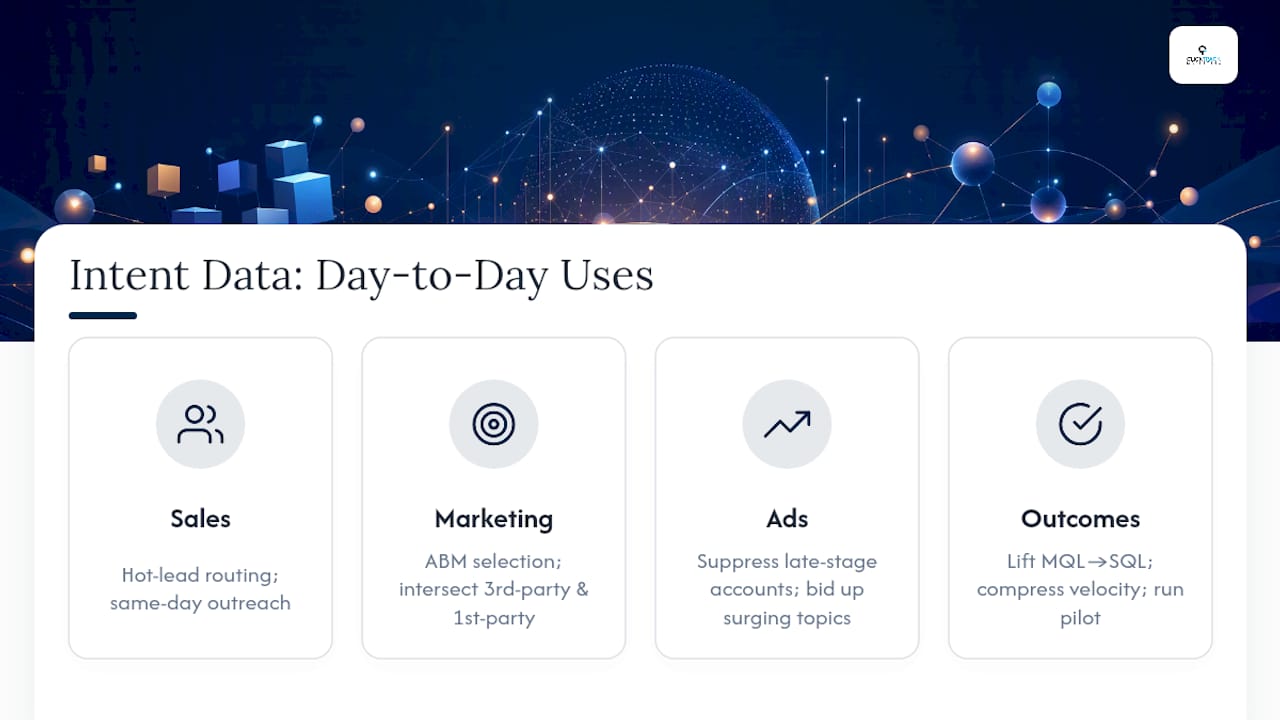
For sales teams, the primary use case is hot-lead routing. When an account crosses a scoring threshold, an automated alert fires to the assigned rep with context: which pages the account visited, how many times, and over what timeframe. The rep reaches out the same day with a message tied to that specific behavior. Reply rates on intent-triggered outreach are consistently higher than cold sequences because the message is relevant and the timing is right.
For marketing teams, intent data drives ABM audience selection. You build a target account list from accounts showing third-party topic surges, then layer on first-party signals to identify which of those accounts are already engaging with your content. That intersection is your highest-priority ABM segment. Creative personalization follows naturally: an account researching "revenue attribution" gets ads and landing pages about attribution, not a generic brand message.
Ad targeting and retargeting benefit directly from intent signals. You can suppress ads to accounts already in late-stage sales conversations, bid up on accounts showing topic surges, and seed lookalike audiences from your in-market account list to find net-new prospects with similar research behavior. For more on behavioral targeting in paid media, the mechanics translate directly to intent-driven bid strategies.
On realistic outcome metrics: intent-driven programs tend to lift MQL-to-SQL conversion rates and compress pipeline velocity, but the magnitude varies by industry, traffic volume, and how well the signal is operationalized. Forrester warns that vendor ROI claims tied to intent data are often overstated, and that headline multipliers frequently reflect selection bias rather than causal lift. Run a controlled pilot with a holdout group before committing to a full program budget.
How to Implement Intent Data in Your Stack
A clean implementation follows a specific sequence. Skipping steps creates data quality problems that compound over time.
- 1Install a visitor identification pixel. A tool like PeoplePixel sits on your site and begins de-anonymizing company-level visits immediately. This is your first-party foundation.
- 2Map your event schema. Define which page visits, form fills, and content downloads count as intent signals and assign preliminary weights to each.
- 3Connect to your CRM. Push identified accounts and their signal history into your CRM as enriched records. Match on domain to avoid duplicate account creation.
- 4Set up enrichment and deduplication. Append firmographic data (industry, employee count, revenue range) to each account record so scoring can factor in fit alongside intent.
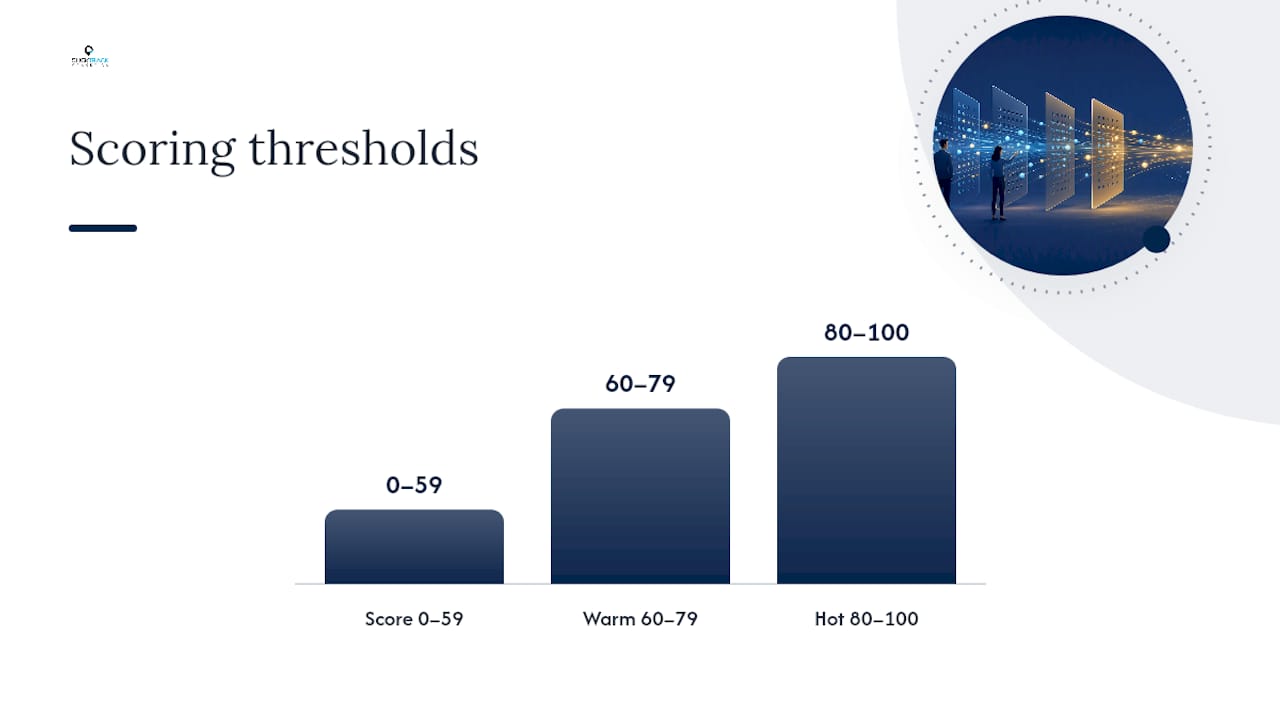
- 5Build your scoring model. A fit-plus-intent model on a 0 to 100 scale works well in practice. Artemis GTM's lead scoring framework describes routing thresholds: hot leads at 80 or above go directly to sales, warm leads at 60 to 79 enter a nurture sequence with rep visibility.
- 6Automate routing and alerts. When an account crosses the hot threshold, trigger a Slack or CRM notification to the assigned rep with the signal context attached.
- 7Integrate third-party intent. Once first-party is running cleanly, layer in a third-party topic-surge feed for outbound prospecting and ABM audience building.
For CRM and automation context, the marketing automation guide from Click Track Marketing covers integration patterns and workflow design in detail.
Data hygiene is where most implementations break down. Canonical account matching (resolving "Acme Corp," "Acme Corporation," and "acme.com" to a single record) prevents score fragmentation. Recency decay rules ensure a pricing-page visit from 90 days ago does not still count as a hot signal today. WorksBuddy's lead scoring best practices emphasize that skipping explicit point weights and recency decay are the two most common reasons scoring models fail.
Pro Tip: When you send an intent-triggered alert to a rep, include the specific pages visited and the content downloaded, not just the account name and score. A rep who knows the account read your "revenue attribution for B2B" case study can open with that context. A rep who only knows the score will default to a generic opener, which wastes the signal entirely.
How to Measure the Impact of Intent-Driven Campaigns
Measurement starts before you launch. Define a control group of similar accounts that will not receive intent-triggered outreach, then compare outcomes after 90 days. Without a holdout, you cannot separate the effect of intent routing from the effect of your reps simply working harder.
The metrics that matter most are pipeline-level, not top-of-funnel:
| Metric | What It Measures | 90-Day Target |
|---|---|---|
| MQL to SQL velocity | Days from lead creation to sales-qualified | Track baseline, target reduction |
| SQL to opportunity conversion | Rate of SQLs that become open opportunities | Track baseline, target lift |
| Win rate on routed accounts | Close rate for intent-triggered accounts vs. control | Primary lift metric |
| Pipeline influenced | Total pipeline value touched by intent signals | Volume indicator |
| Revenue attributed | Closed-won revenue from intent-routed accounts | Primary ROI metric |
An attribution flow that works: PeoplePixel identifies an anonymous visit and resolves it to a known account. That account enters the CRM as an enriched record. The rep's outreach is logged against the account. When the deal closes, PeopleLytics connects the original intent signal to the closed-won revenue in the weekly dashboard. That chain gives you a defensible revenue attribution number, not a correlation.
Reporting cadence: daily alerts for hot-lead triggers, weekly pipeline reviews that include intent-influenced opportunities, and a 90-day controlled lift analysis to validate the program. For a deeper look at how marketing attribution works in practice, the mechanics of multi-touch attribution apply directly to intent-driven pipelines.
Privacy and Compliance When Using Intent Data in the U.S.
U.S. privacy law is not uniform. The California Consumer Privacy Act (CCPA) and its 2023 update under CPRA are the most stringent state-level rules and set a practical floor for any national program.
Key compliance steps for U.S. teams:
- Vendor contracts: Require data processing agreements that specify the source of third-party intent data, anonymization methods, and opt-out mechanisms. Do not accept vague "industry-standard" language.
- Consumer data vs. business data: CCPA applies to personal information about California residents. B2B intent data that resolves to individual contacts (name, email, job title) triggers CCPA obligations. Account-level IP resolution to a company name generally does not, but confirm with legal counsel for your specific use case.
- Consent posture: For first-party data, your site's cookie consent banner should disclose behavioral tracking. For third-party data, confirm the vendor's consent chain covers the jurisdictions where your target accounts are located.
- Retention windows: Set a data retention policy. Intent signals older than 90 days rarely drive action and create unnecessary compliance exposure. Delete or archive on a defined schedule.
- Opt-out mechanisms: Honor opt-out requests promptly. Build a suppression list that syncs across your CRM, email platform, and ad audiences.
One note on GDPR: if your intent data program touches European accounts, even incidentally through a third-party publisher co-op, GDPR's lawful basis requirements apply. The legitimate interest basis is commonly used for B2B prospecting in the EU, but it requires a documented balancing test. Consult legal counsel before activating European contact-level signals.
Common Pitfalls and How to Avoid Them
Intent data programs fail in predictable ways. Knowing the failure modes in advance lets you design around them.
- False positives from generic keywords: A topic surge for "project management" could mean the account is evaluating your software or hiring a project manager. Narrow your topic clusters to terms specific to your category, not the broader industry.
- Stale signals: A pricing-page visit from six weeks ago is not a hot lead. Implement recency decay so signals lose weight over time. Most teams set a 30-day half-life on site-behavior signals.
- Coverage gaps for niche audiences: Third-party publisher co-ops have strong coverage for enterprise software buyers and weak coverage for local service businesses or highly specialized verticals. If your audience does not read the publishers in the co-op, the signal volume will be thin. First-party instrumentation is the fix.
- Attribution fallacies: Crediting a closed deal entirely to an intent signal that fired two days before close ignores the six months of nurture that preceded it. Use multi-touch attribution, not last-touch, when measuring intent program impact.
- Over-reliance on vendor ROI claims: As Forrester notes, headline multipliers often reflect selection bias. Validate lift with a controlled pilot before scaling spend.
Mitigation in practice: combine fit scoring with intent scoring so a low-fit, high-intent account does not jump the queue ahead of a high-fit, high-intent account. Run a 90-day pilot with a defined holdout. Add custom vertical signals (local hiring posts, permit filings, seasonal search patterns) for audiences underserved by standard publisher co-ops.
A Checklist for Choosing an Intent Data Approach
Before selecting tools or vendors, confirm you can check every box on this list:
- 1Identity resolution: Can the system resolve anonymous IP visits to named accounts and, where available, named contacts?
- 2CRM integration: Does the data flow into your existing CRM without manual exports? Is the latency under 24 hours?
- 3Real-time alerts: Can you trigger a rep notification within minutes of a hot-signal event?
- 4Enrichment: Does the system append firmographic and technographic data to each account record automatically?
- 5Vendor transparency: Can the vendor explain exactly where their third-party signals come from and how consent was obtained?
- 6Reporting and attribution: Does the platform connect intent signals to pipeline and closed revenue, or does it stop at lead creation?
Click Track Marketing's product suite maps directly to this checklist. PeoplePixel handles identity resolution and first-party visitor de-anonymization. BuyerSignals surfaces intent data so you know which accounts are in-market right now. PeopleLytics closes the attribution loop with a weekly revenue dashboard that connects signals to closed deals. OnboardIQ makes the initial setup and client onboarding structured from day one.
A 90-day pilot is the right scope for a first implementation. Define your target account list, instrument first-party tracking, set up CRM routing, and measure MQL-to-SQL velocity and win rate against a holdout group. At 90 days, you have enough data to make a defensible budget decision.
How to Evaluate Intent Data Vendors
The vendor market for purchase intent analytics spans point solutions, data co-ops, and full-stack platforms. Evaluating them requires looking past the demo and into the data.
Start with data provenance. Ask every vendor: where do your signals come from, which publishers or co-ops are in your network, and how is consent documented? A vendor that cannot answer these questions clearly is a compliance risk, not just a data quality risk.
Coverage is the second filter. Third-party co-ops vary significantly by vertical and geography. A vendor with strong coverage for enterprise SaaS buyers may have thin coverage for manufacturing, healthcare, or local services. Request a sample account list from your target segment before signing a contract.
Latency matters more than most buyers realize. A topic-surge signal delivered 72 hours after the behavior occurred is far less useful than one delivered in near real time. Ask specifically about the time between a behavioral event and when it appears in your dashboard or CRM.
Integration depth separates useful tools from shelf-ware. A vendor that delivers a CSV export requires manual work on your end. A vendor with a native CRM connector, webhook support, and a documented API is one you can actually operationalize.
Finally, evaluate the reporting layer. Can the vendor show you which intent signals correlated with pipeline creation and revenue? Or does their reporting stop at signal volume and account lists? The platforms that connect signals to revenue outcomes are the ones worth paying for.
Combining Intent Data with Demographic and Behavioral Data
Intent data alone is incomplete. An account showing a topic surge for "revenue attribution software" could be a 10-person startup with no budget or a 500-person company with a defined procurement process. Intent tells you timing. Demographic and firmographic data tells you fit. Behavioral data tells you engagement depth.
The most effective scoring models layer all three. Firmographic fit (industry, company size, revenue, technology stack) sets the baseline. Intent signals adjust the score upward when an account enters a buying window. Behavioral data from your own properties (email opens, webinar attendance, content downloads) adds a third dimension that reflects relationship depth, not just research activity.
Combining these layers also reduces false positives. An account with a high intent score but poor firmographic fit stays in a low-priority nurture track. An account with strong fit, a topic surge, and active first-party engagement goes straight to sales.
For ad targeting, the combination is particularly powerful. You can build audiences that require all three conditions: right industry, right company size, and active research behavior. That intersection is small but highly qualified, which makes ad spend far more efficient than broad demographic targeting alone.
Real-Time Intent Data: How to Act Before the Window Closes
The value of a buying signal decays fast. Clay's research on intent signal decay confirms that pricing-page visits warrant same-day outreach, while signals like funding rounds remain useful for weeks. The practical implication is that your routing and alert system needs to operate in near real time, not on a daily batch schedule.
Real-time activation requires three things: a pixel or tracking layer that fires events immediately, a scoring engine that updates account scores as new signals arrive, and an alert mechanism that notifies the right rep within minutes of a threshold crossing.
Automation is what makes real-time intent practical at scale. A rep cannot monitor a dashboard all day. The system should push the alert to wherever the rep already works, whether that is Slack, a CRM task, or an email notification, with the signal context included. The rep's job is to act on the alert, not to find it.
For paid media, real-time intent enables bid adjustments that match account behavior. When an account crosses a high-intent threshold, increase bids on that account's firmographic lookalike segment. When an account closes or goes dark, suppress them from active campaigns. This kind of dynamic audience management requires an integration between your intent platform and your ad accounts, but the efficiency gains are real.
Scaling Intent Data Programs Across Your Organization
A pilot that works for one sales team does not automatically scale to a full organization. The challenges that emerge at scale are mostly organizational, not technical.
Data governance is the first friction point. When multiple teams (sales, marketing, customer success) all have access to intent signals, you need clear rules about who acts on which signal and when. Without governance, the same account gets outreach from three different people in the same week, which damages the relationship rather than advancing it.
Change management is the second challenge. Sales reps who are accustomed to working their own lists will resist a system that tells them which accounts to prioritize. The fix is showing them the data: intent-routed accounts close at a higher rate than cold-prospected accounts. Let the numbers make the case.
Technology integration complexity grows with scale. A single-team pilot might run on a lightweight pixel and a CRM field. A full-organization deployment requires identity resolution across multiple domains, CRM deduplication at scale, and a data warehouse that can hold historical signal data for attribution analysis.
Budget allocation is the third scaling challenge. Third-party intent data is priced per account or per signal volume, and costs rise quickly as you expand your target account list. Start with a defined ICP segment, prove the ROI in that segment, and expand incrementally. Scaling before you have proven unit economics is how intent programs become expensive and abandoned.
Global Privacy Regulations Beyond the U.S.
If your B2B program targets accounts in the European Union, Canada, or the United Kingdom, additional privacy frameworks apply alongside U.S. rules.
The EU's General Data Protection Regulation (GDPR) is the most demanding. It requires a documented lawful basis for processing personal data. For B2B prospecting, legitimate interest is the most commonly used basis, but it requires a balancing test that weighs your business interest against the individual's privacy rights. Contact-level intent data (a named person's browsing behavior) is personal data under GDPR. Account-level IP resolution to a company name is a grayer area, but many EU supervisory authorities treat it as personal data when the company is small enough that the IP identifies an individual.
Canada's PIPEDA and its provincial equivalents impose consent requirements for commercial electronic messages. The UK's UK GDPR mirrors the EU framework post-Brexit. Australia's Privacy Act is currently under reform and is moving toward stricter consent standards.
The practical implication for U.S.-based teams running global ABM programs: segment your account list by geography before activating intent signals. Apply your strictest privacy standard (GDPR) to EU accounts, and document your lawful basis before any outreach. For cross-border signal activation, legal review is not optional.
The Part Most Teams Get Wrong About Intent Data
Most teams treat intent data as a lead generation tool. They buy a third-party feed, import a list of "in-market accounts," and hand it to sales as a new prospecting list. That approach produces mediocre results because it skips the two things that actually create value: context and speed.
Context means knowing why an account is signaling intent, not just that it is. A rep who knows an account downloaded a case study about reducing customer acquisition costs can open with that specific problem. A rep who only knows the account appeared on an intent list opens with a generic pitch. The first conversation advances. The second one gets ignored.
Speed means acting on the signal before it decays. Most teams review intent data in weekly meetings. By then, the pricing-page visit is five days old and the account may have already had a demo with someone else. The teams that win with intent data have automated routing that puts the signal in front of a rep within hours, not days.
The third thing most teams underinvest in is attribution. Without a clear line from intent signal to closed revenue, you cannot defend the program budget when results are questioned. Building the attribution infrastructure before you scale the program is not overhead. It is the only way to know whether the program is working.
Click Track Marketing Turns Intent Signals into Revenue You Can Measure
Most intent data programs stall because the signal never connects to a dollar. You know an account visited your pricing page. You do not know whether that visit became a conversation, a proposal, or a closed deal. That gap is where budget gets cut.
Click Track Marketing builds the infrastructure that closes that gap. PeoplePixel de-anonymizes your site visitors so you see who is actually showing up. BuyerSignals surfaces which accounts are in-market right now. PeopleLytics delivers a weekly attribution dashboard that ties every signal back to pipeline and revenue. OnboardIQ makes the setup structured and fast. The result is a system where you can see, in plain numbers, whether your intent-driven outreach is producing customers.
The engagement starts with an audit of your current tracking and attribution setup, followed by instrumentation, CRM integration, and weekly reporting from day one. If you want to see what your site traffic is actually worth, request a revenue attribution audit and get a clear picture of what your marketing is earning.
Sources
- Decoding the 7 types of Intent data - Bombora
- The Complete Guide to Intent Data (2026) | Clay
- Lead Scoring: Fit + Intent Model | Artemis GTM
Want to know exactly which marketing is making you money?
Get a free attribution audit — we'll show you where your leads and revenue actually come from. Answer two quick questions to start.