

Quick Answer
The Local Map Pack is the box of three business listings and a map that Google shows at the top of search results for local searches, like "plumber near me" or "coffee shop downtown." It pulls its listings directly from Google Business Profile, and Google decides which three businesses appear based on relevance, distance, and prominence. For a local business owner, this box is often the single most valuable piece of real estate on the internet: it sits above the organic results, and it comes with a phone button already built in.
Key Takeaways
The Local Map Pack ranks businesses on relevance, distance, and prominence, and owners can directly influence two of those three factors through Google Business Profile management.
| Point | Details |
|---|---|
| Map Pack defined | A map plus three local business listings pulled from Google Business Profile for local-intent searches. |
| Three ranking factors | Google weighs relevance, distance, and prominence, and only distance is outside your control. |
| Priority checklist | Verify your profile, fix your primary category, keep NAP consistent, and generate reviews steadily. |
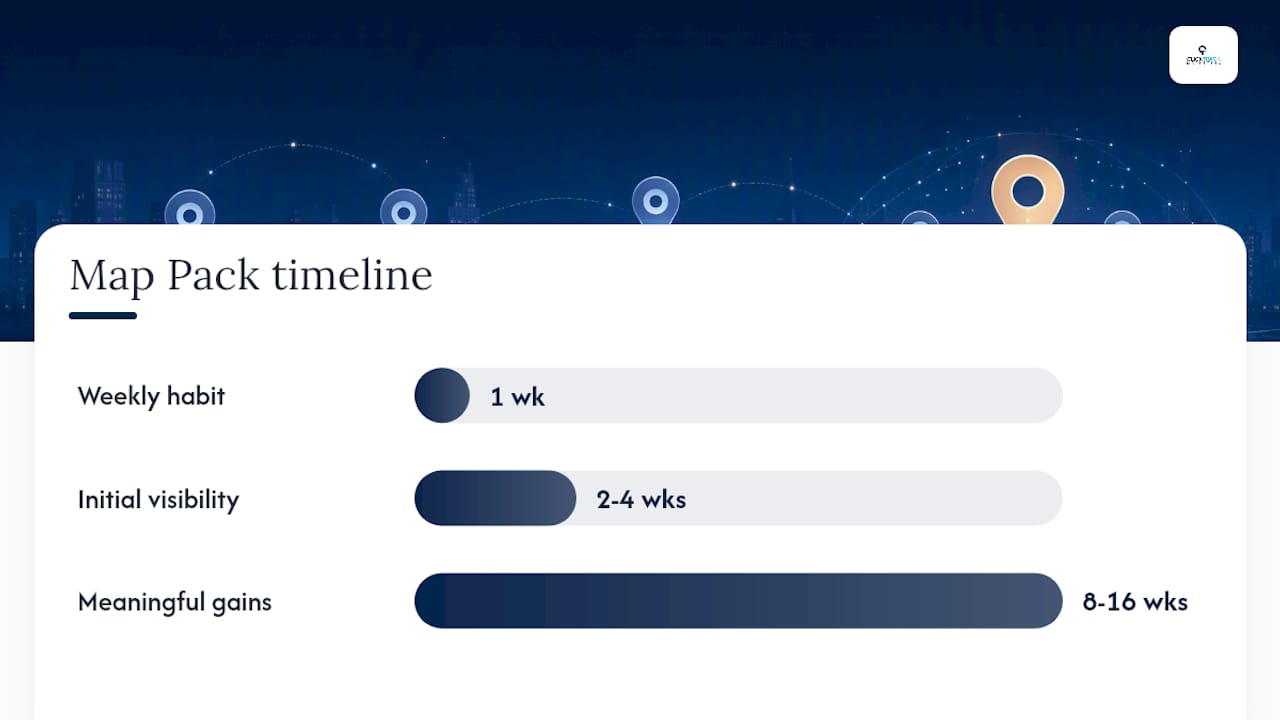
| Timeline expectations | Small gains often appear in 2 to 4 weeks; competitive gains typically take 2 to 4 months. |
| Measure real outcomes | Track calls, directions, and website clicks, and use Click Track Marketing's PeoplePixel to tie visibility to actual revenue. |
Table of Contents
- What Appears in the Google Local Map Pack?
- How Does Google Decide Who Makes the Map Pack?
- Why Does the Map Pack Matter for Your Business?
- How Do You Get Your Business Into the Map Pack?
- Map Pack vs. Organic Search vs. Google Maps: What's the Difference?
- How Do You Measure Map Pack Performance?
- How Does the Map Pack Fit Into Answer Engine Optimization?
- Get Map Pack Visibility That Ties Back to Revenue
- Sources
- FAQ
What Appears in the Google Local Map Pack?
Look at any Map Pack and you'll see the same set of pieces every time. Google keeps the format tight on purpose, because it wants searchers to compare businesses fast and take action without scrolling.
Here's what shows up:
- An interactive map with pins marking the top three businesses
- The business name, address, and phone number (often called NAP)
- Hours of operation, including whether the business is currently open
- Star rating and total review count
- A website link, if one is listed
- Action buttons for calling or getting directions
- The primary business category and sometimes a short list of services
All of this comes straight from Google Business Profile, and Google fills in gaps using other sources it trusts around the web when your profile is incomplete. This is also why the Map Pack, Google Maps, and Google Search all show the same core details for a listing. They're drawing from one shared data source, not three separate ones.
Pro Tip: Log into your Google Business Profile today and check three things first: your primary category, your hours, and your phone number. Those three fields get checked more than any other part of the listing.

How Does Google Decide Who Makes the Map Pack?
Google has been fairly direct about this: placement in local results comes down to relevance, distance, and prominence. Understanding what each one actually means changes how you prioritize your time.
- 1Relevance measures how well your Business Profile matches what someone searched for. A bakery that lists "custom wedding cakes" as a service will surface for that exact phrase far more reliably than one that just says "bakery."
- 1Distance measures how far your business is from the searcher's location, or from the location named in the query. This is the one factor you genuinely cannot influence. You can't move your storefront to rank better.
- 1Prominence measures how well known and well reviewed your business is, both on Google and across the web. Review volume, review quality, citation consistency, and even backlinks all feed into this.
Here's where it gets interesting. Two people standing on opposite sides of the same city, typing the identical search, will often see two completely different Map Packs. Distance shifts the results even when nothing else changes. Change the query slightly, say from "electrician" to "emergency electrician," and prominence and relevance can reshuffle the same three slots entirely, because Google now weighs different signals for a query that implies urgency.
The practical takeaway: you have real control over two of the three factors. Distance is fixed by geography, but relevance and prominence respond directly to how well you manage your profile and your reputation.
Why Does the Map Pack Matter for Your Business?
Because it sits above the organic results, the Map Pack is often the first thing a searcher sees, and it's built for action rather than reading. Someone searching "HVAC repair near me" isn't looking to browse ten blue links. They're looking to call someone in the next five minutes. The Map Pack hands them a phone number and a map before they even have to click through to a website.
That structure translates directly into business outcomes:
- Phone calls placed straight from the listing
- Direction requests from people already close by
- Website clicks from users who want more detail before committing
- Foot traffic from searchers acting on immediate, local intent
Industry data backs up the intuition here: the Map Pack functions as prime search real estate precisely because it captures high-intent local queries at the exact moment someone is ready to buy or book. A business that isn't in that box isn't just less visible. It's invisible to a huge share of people who never scroll past it.
How Do You Get Your Business Into the Map Pack?
Ranking in the Map Pack isn't a mystery, but it does take consistent, prioritized effort. Here's the order that actually moves the needle.
- 1Claim and fully verify your Google Business Profile. An unverified or incomplete profile almost never appears, no matter how good your business is. This is the single highest-priority step.
- 2Choose the right primary category. Google leans heavily on this field for relevance. A "general contractor" who does mostly kitchen remodels should consider whether "kitchen remodeler" better matches what people search.
- 3Keep your name, address, and phone number identical everywhere online. Inconsistent citations across directories confuse Google's confidence in your prominence.
- 4Generate reviews consistently, not in one burst. A steady stream of recent reviews signals an active, trustworthy business. Our Google Reviews playbook breaks down a repeatable ask-for-review workflow.
- 5Add photos regularly. Fresh photos of your storefront, team, and completed work signal activity and improve engagement with your listing.
- 6Use local keywords on your website, not just your profile, so the two reinforce each other.
- 7Post updates through Google Posts and keep your services list current. Both are underused levers most competitors ignore.
On timeline, expect small movements within two to four weeks once your profile is complete and verified, especially if you fix an obvious gap like a missing category or a wrong phone number. Meaningful competitive gains against established businesses usually take two to four months of steady review generation and citation cleanup. Budget mostly in time rather than dollars: a business owner can execute most of this checklist personally, though review workflows and citation audits are where paid help saves the most hours. For a deeper, category-specific version of this checklist, see our remodeling company local SEO guide, which shows how granular the process gets for a competitive trade.
Pro Tip: Set a recurring calendar reminder to add one new photo and request two reviews every week. That small, consistent habit compounds into prominence far faster than a one-time profile cleanup.
For a full 30/60/90 day plan and Maps-specific ranking tactics, our step-by-step Google Maps ranking guide walks through each phase in order.
Map Pack vs. Organic Search vs. Google Maps: What's the Difference?
These three surfaces look related because they share a data source, but they serve different jobs. The Local Pack shows exactly three businesses for queries with clear local intent, like "dentist in [city]." Organic search results, by contrast, are broader and content driven: Google ranks whole web pages based on relevance and authority, not just profile fields.
Google Maps is a separate discovery app entirely. Open Maps and search the same term, and you'll see dozens of pins rather than three, because Maps is built for browsing, not for quick decision-making.
- The Map Pack: three results, local intent, appears within Search
- Organic results: unlimited results, content driven, appears within Search
- Google Maps: many results, exploratory, its own app
All three draw from Google Business Profile as the shared foundation. This is why fixing your profile improves your standing everywhere at once.
How Do You Measure Map Pack Performance?
Tracking Map Pack success means watching outcomes, not vanity numbers like profile views alone. The metrics that actually connect to revenue include:
- Calls placed directly from your Business Profile
- Direction requests, which signal someone is on their way
- Website clicks originating from your GBP listing
- Booking or form conversions once a visitor lands on your site
- Offline attribution, meaning sales that started with a Map Pack interaction but closed in person
Start inside Google Business Profile Insights for call and direction volume, then connect GA4 to track what happens once someone reaches your website. Be aware that linking GBP to GA4 alone doesn't close the attribution loop for higher-ticket businesses, since it can't always tell you which specific visitor became which specific customer. Tools like PeoplePixel fill that gap by identifying visitors and tying their activity back to actual revenue. Set a baseline before you start any optimization work, or you'll have no way to prove what changed.
How Does the Map Pack Fit Into Answer Engine Optimization?
Answer Engine Optimization is the practice of structuring your business information so AI tools like ChatGPT, Google's AI Overviews, and Perplexity can find it and cite it directly, not just so Google's traditional algorithm can rank it. A well-structured, complete Business Profile feeds both systems at once, since AI answer engines increasingly pull from the same local business data that powers the Map Pack.
Picture a home services company that tightens its GBP categories, adds structured local content to its site, and starts tagging Map Pack driven form fills as a distinct event in its analytics. Within a few months, it can trace a rising share of booked jobs back to that one visibility improvement instead of guessing which marketing dollar worked.
Pro Tip: If you only do one thing this quarter, add schema markup to your local pages and tag your GBP referral traffic as its own event. That's what lets you actually prove a Map Pack improvement turned into revenue. Our free AEO checklist walks through the setup.
Treat the Map Pack as infrastructure, not decoration
I've watched too many owners treat their Business Profile like a business card they fill out once and forget. That's backward. The Map Pack is measurable infrastructure that either feeds your revenue attribution system or sits there as an unmeasured guess, and the difference shows up directly in your pipeline.
Get Map Pack Visibility That Ties Back to Revenue
Click Track Marketing builds Business Profile optimization, AI-structured websites, and revenue attribution as one connected system, so a Map Pack improvement doesn't just raise your visibility, it shows up as traceable calls and dollars in your reporting. Most local SEO providers stop at rankings and leave you guessing whether any of it paid off. Our approach pairs local SEO and Google Maps ranking work with PeoplePixel, so you can see which visitors turned into customers instead of assuming.
Every engagement runs on a multi-month minimum, roughly the timeline it takes to see real prominence gains and enough data to prove attribution is working. If you want a fast read on where your business currently stands, start with a free discovery call and we'll show you exactly what's fixable this month.
Sources
Want to know exactly which marketing is making you money?
Get a free attribution audit — we'll show you where your leads and revenue actually come from. Answer two quick questions to start.