

Quick Answer
E-E-A-T for websites is Google's framework for judging whether content and its creators demonstrate first-hand experience, domain expertise, recognized authority, and clear trust signals. Google added Experience to the Search Quality Rater Guidelines in December 2022, expanding the older E-A-T into E-E-A-T and making first-hand knowledge a formal quality dimension alongside credentials.
The single most useful action you can take right now: add a clear author byline to every content page, link it to a dedicated author page, and mark it up with Person schema. That one change makes your authorship readable by both Google's quality raters and AI answer engines.
Key Takeaways
E-E-A-T improvements produce measurable results only when author signals are machine-readable, trust signals are accurate, and a baseline measurement plan is in place before changes go live.
| Point | Details |
|---|---|
| Author markup is the first fix | Add named bylines, linked author pages, and Person schema with sameAs links to every content page. |
| Trust signals are the foundation | HTTPS, privacy policy, contact info, and accurate policies matter as much as credentials. |
| YMYL pages carry the highest risk | Medical, legal, and financial content requires credentialed authors and primary source citations. |
| Schema makes E-E-A-T machine-readable | Article and Person schema raise AI citation probability for pages with named authors and visible dates. |
| Click Track Marketing measures the outcome | PeoplePixel and PeopleLytics connect E-E-A-T and AEO work to visitor identity and revenue attribution. |
Table of Contents
- What E-E-A-T for Websites Actually Means: Each Component Explained
- How E-E-A-T Differs from the Older E-A-T Guidance
- Why E-E-A-T Matters for Search Rankings
- How Google's Quality Raters Apply E-E-A-T and How You Can Self-Audit
- Concrete Steps to Improve E-E-A-T Across Your Site
- Which Pages Should Prioritize E-E-A-T Work
- How to Measure the Impact of E-E-A-T Improvements
- Common Myths About E-E-A-T and What the Research Actually Says
- An Agency Perspective on E-E-A-T and Measurement
- How Click Track Marketing Approaches E-E-A-T and AI Visibility
- Sources
- FAQ
What E-E-A-T for Websites Actually Means: Each Component Explained
E-E-A-T stands for Experience, Expertise, Authoritativeness, and Trustworthiness. Each component signals something different to Google's raters, and each requires different on-page and off-page evidence.
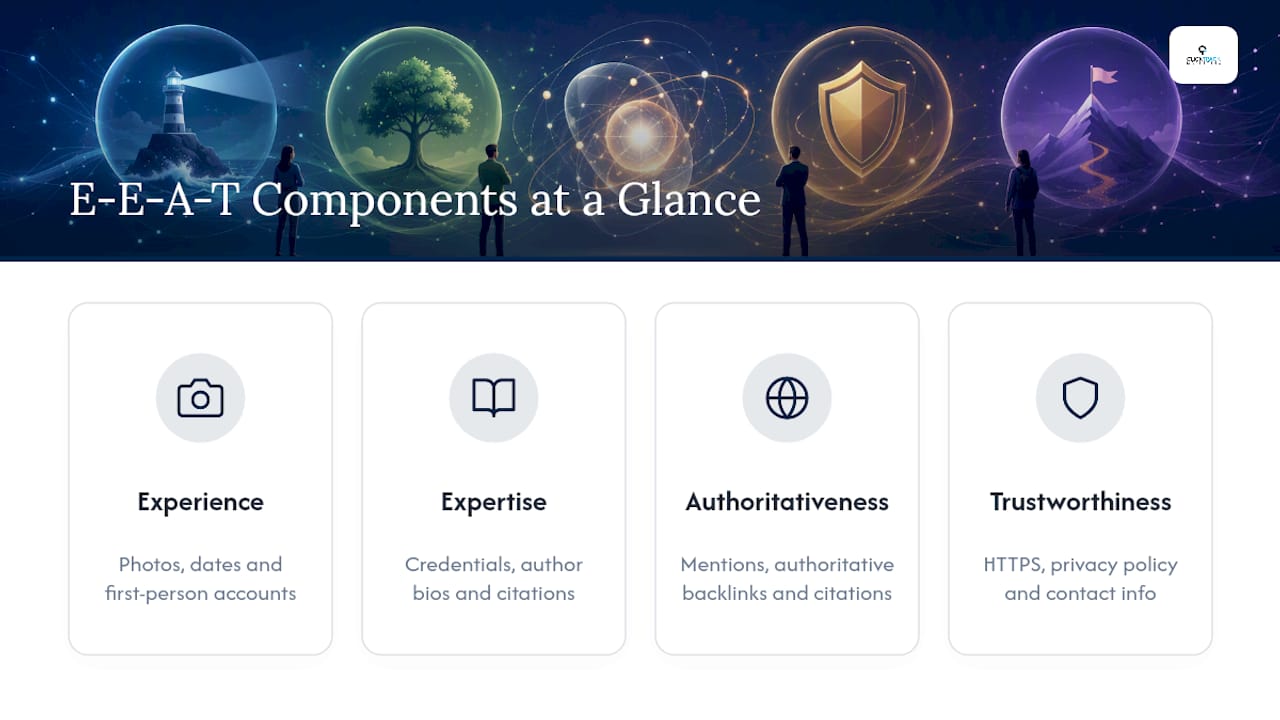
Experience is about first-hand involvement. A product reviewer who has actually used the item, a travel writer who visited the destination, or a contractor who has completed the type of job being described all demonstrate experience. The signal is concrete and personal. You show it through photos, specific details, dates, and first-person accounts that could not have been written from a desk.

Expertise is formal or demonstrated knowledge. For a medical article, that means a licensed clinician. For a software tutorial, it can mean a developer with a verifiable track record. The key distinction from experience: expertise implies depth and accuracy, not just presence. You signal it through credentials in author bios, citations to primary sources, and content that goes beyond what a general summary would cover.
Authoritativeness is recognition from others in your field. It lives off your page: mentions in reputable publications, backlinks from authoritative domains, citations by other experts, and a Wikipedia or Wikidata entry if your brand or author warrants one. You cannot manufacture this signal on your own site. It has to be earned through reputation work.
Trustworthiness is the foundation the other three rest on. Google's documentation and company blog emphasize trust as central, while expertise and authoritativeness remain core signals for high-impact topics. Trust signals include HTTPS, a clear privacy policy, accurate contact information, visible correction and update policies, and factual accuracy throughout your content.

Not every page needs the same level of all four. A personal blog post about a hiking trail needs experience more than it needs formal credentials. A page advising on medication dosages needs both expertise and trust signals at the highest level.
Pro Tip: Link your author byline to a dedicated author page that lists credentials, published work, and social or professional profiles. That page is where raters and AI systems go to verify who wrote the content.
How E-E-A-T Differs from the Older E-A-T Guidance
The original E-A-T framework covered Expertise, Authoritativeness, and Trustworthiness. Google used it as a quality signal in its Search Quality Rater Guidelines for years before the December 2022 update.
The addition of Experience reflects a real shift in how Google thinks about content quality. Before, a formally credentialed author writing about a topic they had never personally encountered could technically satisfy E-A-T. The new framework recognizes that first-hand experience carries its own validity, separate from academic or professional credentials. A nurse practitioner writing about managing a chronic illness they live with brings something a textbook cannot.
The practical consequence for content strategy is that experience and expertise are now treated as distinct signals. For some queries, experience alone is sufficient. A detailed, first-person account of renovating a bathroom from a homeowner carries real quality value even without a contractor's license. For others, formal expertise is still required. A page advising on tax liability needs a credentialed professional, not just someone who has filed their own taxes.
The clearest use-case split: informational content about personal decisions (travel, product choices, lifestyle) can lean on experience. Content that affects health, finances, or legal standing needs formal expertise alongside any personal account.
Why E-E-A-T Matters for Search Rankings
E-E-A-T is not a direct ranking factor in the sense of a single algorithmic switch. Google's overview of the quality rater guidelines explains that raters use E-A-T concepts to judge main content quality, supplementary content, and reputation research when assessing search result quality. Rater scores feed into the calibration of Google's algorithmic systems over time, not into individual page rankings.
That said, the practical SEO consequences are real. Pages that consistently score low on quality rater assessments inform the training of systems that do affect rankings. The connection is indirect but durable.
“"Your Money or Your Life" (YMYL) topics receive the strongest scrutiny under E-E-A-T. Google defines YMYL as content that could significantly affect a person's health, financial stability, safety, or happiness. Medical advice, legal guidance, financial planning, and news about current events all fall here. For these topics, the bar for expertise and trust is materially higher than for a recipe blog or a product review site.”
The practical implication for content risk management: a YMYL page with weak author signals, no citations, and no visible editorial standards is a liability. It is not just unlikely to rank well; it is the type of page that quality raters are specifically trained to flag. Prioritize E-E-A-T work on your highest-stakes pages first.
How Google's Quality Raters Apply E-E-A-T and How You Can Self-Audit
Quality raters are contractors hired by Google to evaluate search results using the Search Quality Rater Guidelines. Their ratings do not directly change rankings for individual pages. They calibrate the systems that do. Think of them as the training data for Google's quality signals.
Raters assess three main areas when reviewing a page:
- 1Main content quality: Is the content accurate, well-written, and does it serve the user's need? Does the author have the experience or expertise to write it?
- 2Supplementary content: Does the page have helpful navigation, related links, and supporting material that improves the experience?
- 3Reputation research: What do external sources say about the site and its authors? Raters actively search for reviews, mentions, and third-party coverage.
You can run a basic self-audit by asking the same questions a rater would ask about your site:
- 1Does every content page have a named author with a linked bio?
- 2Does the author bio include verifiable credentials, published work, or professional profiles?
- 3Is there a clear About page that explains who runs the site and why they are qualified?
- 4Are your privacy policy, terms of service, and contact information easy to find?
- 5Does your site have external mentions, reviews, or press coverage a rater could find independently?
- 6Are your publication and last-updated dates visible on content pages?
- 7Do your high-stakes pages cite primary sources rather than other secondary summaries?
Running through these seven questions on your top-traffic pages will surface the gaps that matter most.
Concrete Steps to Improve E-E-A-T Across Your Site
Improving E-E-A-T is not a one-time task. It is an ongoing editorial and technical practice. The steps below are organized by type, with rough timelines.
Editorial fixes (weeks 1 to 4):
- 1Add a named byline to every content page and link it to a dedicated author page.
- 2Write author pages that include credentials, professional history, published work, and at least one external profile link (LinkedIn, a professional association, a published book).
- 3Add a visible "last updated" date to content pages alongside the original publication date.
- 4Include a brief methodology or sourcing note on research-heavy pages explaining how you gathered information.
- 5Replace secondary source citations with primary sources wherever possible. Link to the original study, government page, or official documentation rather than another blog's summary of it.
Technical fixes (weeks 2 to 6):
- 1Implement Article schema on all content pages with
author,datePublished, anddateModifiedfields populated. - 2Add Person schema to author pages with
sameAslinks pointing to LinkedIn, Google Scholar, or other verifiable external profiles. Making author and publisher signals machine readable via Person and Article schema and sameAs links raises the chance of AI systems extracting and citing content. - 3Confirm your site runs on HTTPS and that your privacy policy, cookie notice, and contact page are all accessible from the footer.
Reputation work (months 2 to 6):
- 1Pursue earned media: guest posts, expert quotes in industry publications, and podcast appearances that generate external mentions.
- 2Build or claim your Wikidata entry if your brand or key authors have sufficient public presence.
- 3Actively manage your review profile on Google Business Profile, Trustpilot, or industry-specific platforms. Volume and recency both matter.
Pro Tip: Do not add schema markup to pages that do not already have the underlying content it describes. Schema that references an author with no real bio page, or a date that does not appear visibly on the page, can look manipulative to both raters and automated systems.
Which Pages Should Prioritize E-E-A-T Work
Not every page on your site needs the same investment. Allocating limited time and budget to the right pages first is the practical decision most teams need to make.
| Page Type | E-E-A-T Priority | Key Signals to Address |
|---|---|---|
| Medical, legal, financial advice | High | Credentialed author, primary source citations, editorial review policy |
| News and current events | High | Named journalist, publication date, corrections policy |
| Product pages (ecommerce) | Medium to High | Accurate specs, verified reviews, clear return and privacy policies |
| Local service pages | Medium | Named team, license or certification info, Google reviews |
| Personal blog (lifestyle, opinion) | Lower | First-hand experience signals, consistent author identity |
| About and contact pages | High (trust baseline) | Accurate business info, team bios, physical address if applicable |
For small teams, the triage is straightforward. Fix the trust baseline first: HTTPS, privacy policy, contact page, and About page. Then move to your highest-traffic YMYL or commercial pages and add author signals and schema. Reputation work is a longer play and can run in parallel once the on-page foundation is in place.
How to Measure the Impact of E-E-A-T Improvements
Attribution is the hardest part of E-E-A-T work. The changes you make do not produce a direct ranking signal you can observe in Google Search Console. What you can track is a set of proxy metrics that, taken together, tell a coherent story.
Metrics worth tracking:
- Organic conversions on pages where you made E-E-A-T changes (set a pre-change baseline)
- Brand query volume in Google Search Console (a rising brand search trend often follows reputation improvements)
- AI citation occurrences: manually check whether your content appears in ChatGPT, Perplexity, or Google AI Overviews responses for your target queries
- Referral traffic from earned media mentions
- Review volume and average rating on third-party platforms
AEO-focused frameworks report higher AI citation probability for pages that include named authors, visible dates, primary source citations, and structured schema. The practical implication: the same signals that improve E-E-A-T for traditional search also improve your extractability for AI answer engines.
A 90-day test plan gives you enough data to see directional movement:
- Days 1 to 14: Establish baselines. Record current organic conversion rates, brand query volume, and AI citation status for your target pages.
- Days 15 to 45: Implement editorial and technical fixes on a defined set of test pages. Leave comparable pages unchanged as a control group.
- Days 46 to 75: Monitor. Check for changes in Search Console performance, AI citation occurrences, and referral traffic.
- Days 76 to 90: Analyze and document. Compare test pages against control pages. Note any correlation between specific changes and observed metric shifts.
Use UTM parameters on any links you build through PR or earned media during the test period so referral traffic from those efforts is attributable. The timeline for algorithmic impact is longer than 90 days, but AI citation changes can appear faster, sometimes within weeks of adding schema and author markup.
Common Myths About E-E-A-T and What the Research Actually Says
Several misconceptions about E-E-A-T circulate widely. Getting them straight saves time and prevents wasted effort.
Myth: You can add E-E-A-T to a page by checking a list of features. John Mueller confirmed that E-E-A-T is not something SEOs can simply add to pages as a checklist and that algorithmic emphasis is higher for YMYL topics. Adding an author bio to a page that has no real author does not improve E-E-A-T. The signals have to reflect reality.
Myth: AI-generated content cannot meet E-E-A-T standards. Google's guidance focuses on the quality and accuracy of content, not its production method. AI-generated content that is reviewed, edited, and published under a named author with real credentials can satisfy E-E-A-T. AI-generated content published without any human oversight, on a site with no author identity, cannot.
Myth: E-E-A-T is a single ranking factor with a measurable score. E-E-A-T is a rater framework, not a score. It informs how Google trains its quality systems over time. There is no E-E-A-T score in Search Console, and no single change will produce an immediate ranking jump.
What remains genuinely uncertain:
- How much weight individual E-E-A-T signals carry in specific algorithmic systems
- Whether AI citation probability and traditional search ranking respond to the same signals at the same rate
- How Google's systems handle author identity for organizations versus individual bylines
These are open questions practitioners should monitor as Google's documentation and spokesperson comments evolve.
An Agency Perspective on E-E-A-T and Measurement
Most E-E-A-T advice stops at the editorial layer. Add a bio. Get some links. That is necessary but not sufficient, especially now that AI answer engines are a real traffic source alongside traditional search.

The work that actually moves the needle treats E-E-A-T as infrastructure. Author markup, schema, and sameAs links are not decorative. They are the signals that let AI systems extract and cite your content rather than a competitor's. A page with identical prose but no machine-readable author signals is structurally invisible to answer engines.
The measurement gap is where most teams lose confidence in the work. Without a baseline and a control group, you cannot tell whether a ranking improvement came from E-E-A-T changes or from something else entirely. Tools like PeoplePixel, which surfaces who is actually visiting your site, and PeopleLytics, which ties traffic sources to revenue outcomes, give you the attribution layer that makes E-E-A-T work defensible to a CFO or a client. The typical client sees directional signal within 60 to 90 days of implementing the full editorial and technical stack, with more durable ranking and citation gains appearing over a 6-month horizon.
How Click Track Marketing Approaches E-E-A-T and AI Visibility
E-E-A-T work without measurement is just editorial housekeeping. Click Track Marketing builds the infrastructure that connects your content quality signals to real revenue outcomes.
The practical starting point is the free AEO checklist, which covers the author, schema, and citation signals that matter most for both Google search and AI answer engines like ChatGPT and Perplexity. From there, Click Track Marketing's AI-structured website builds embed Article and Person schema, sameAs links, and visible editorial signals at the architecture level, not as an afterthought. PeoplePixel identifies the visitors arriving from AI-driven discovery so you know the work is producing real traffic. PeopleLytics closes the loop by connecting that traffic to booked appointments and revenue in a weekly reporting dashboard.
If you want to know whether your E-E-A-T improvements are actually earning citations and customers, book a discovery call and we will show you exactly how to set up the measurement layer.
Sources
These are the primary references worth bookmarking for ongoing E-E-A-T and AEO work.
- Google Search Central blog: Google raters guidelines E E A T
- Overview: Our rater guidelines for search | Google Blog
- Google confirms you can t add EEAT to your web pages | Search Engine Journal
- E E A T Optimisation for AI Search | BetterAISearch
Want to know exactly which marketing is making you money?
Get a free attribution audit — we'll show you where your leads and revenue actually come from. Answer two quick questions to start.