

Quick Answer
Retargeting advertising is a paid digital ad strategy that re-engages people who visited your site but left without converting. Rather than chasing cold audiences, retargeting focuses on the visitors who already showed interest in your brand. Platforms like Google Ads and Meta Ads Manager use tracking pixels to identify those visitors and serve them tailored ads across the web. Understanding how retargeting works, how it differs from remarketing, and how to segment audiences correctly separates campaigns that recover lost revenue from ones that burn budget.
What is retargeting advertising and how does it work?
Retargeting works by deploying a small tracking tag or pixel on your website to record user behavior and create an identifier that ad platforms use to recognize visitors later. When someone lands on your product page, adds an item to their cart, or reads a blog post, that pixel fires and logs the event. The ad platform then matches that identifier to the same person browsing other sites, social feeds, or watching YouTube videos.
The data flow has three steps. First, the pixel captures behavior such as pages viewed, clicks, and add-to-cart events. Second, the platform groups those visitors into audiences based on what they did. Third, your ads appear to those audiences on display networks, social platforms, and search results.

Dynamic creative takes this further. Dynamic creative templates allow advertisers to tailor banner ads on the fly to each visitor based on the specific pages or products they viewed. A visitor who looked at a red running shoe sees an ad for that exact shoe, not a generic brand message. That specificity is what separates effective retargeting from standard display advertising.
Retargeting ads run across several channels: Google Display Network, Meta (Facebook and Instagram), LinkedIn, YouTube, and programmatic display exchanges. Each channel reaches visitors in a different context, which matters when you are matching message to mindset.
Pro Tip: Align your tracking sophistication with your audience quality. Tracking only page views gives you a broad, low-intent pool. Tracking specific events like AddToCart or InitiateCheckout gives you a smaller, higher-intent audience that converts at a much better rate.
Retargeting vs. remarketing: what is the difference?
Retargeting and remarketing are not the same tactic, though marketers use the terms interchangeably. The key distinction lies in the channels used and the audience type. Retargeting targets anonymous past visitors through paid ads. Remarketing typically re-engages known contacts through owned channels like email or CRM sequences.
A visitor who browsed your pricing page but never gave you their email is a retargeting audience. A past customer who bought six months ago and is now in a win-back email sequence is a remarketing audience. Both tactics serve re-engagement, but they use different data, different channels, and different levels of personalization.
| Feature | Retargeting | Remarketing |
|---|---|---|
| Audience type | Anonymous past visitors | Known contacts with identifiable data |
| Primary channels | Paid display, social, search ads | Email, SMS, CRM sequences |
| Data source | Pixel or cookie tracking | First-party CRM or customer lists |
| Personalization depth | Behavioral, based on site actions | Deep, based on purchase and profile history |
| Cost model | Paid media spend | Owned channel costs |
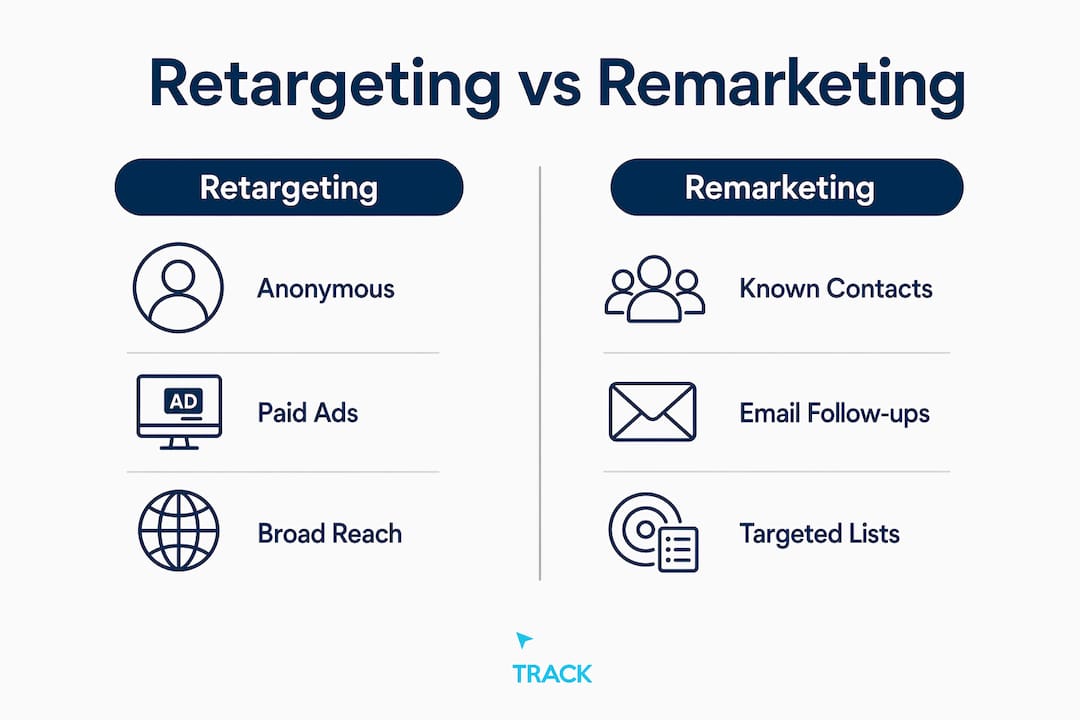
The strongest re-engagement programs use both. Retargeting recaptures anonymous visitors before they forget you. Remarketing deepens the relationship with customers you already know. Running them together creates a full-funnel re-engagement system rather than a single-channel patch.
How to segment retargeting audiences for better results
Audience segmentation is where most retargeting campaigns either win or fail. Common retargeting audiences include site visitors, product page viewers, cart abandoners, and past purchasers, each segmented by funnel stage for targeted messaging. Treating all four groups with the same ad is the fastest way to waste budget.
Here is how to think about each segment and what message fits:
- 1Site visitors (top of funnel). These people know your brand but showed limited intent. Use brand awareness ads, social proof, or content that builds trust. Avoid hard sell offers at this stage.
- 2Product page viewers (mid funnel). These visitors showed specific interest. Show them the product they viewed, a comparison, or a benefit-focused message. Dynamic creative works well here.
- 3Cart abandoners (high intent). This is your highest-value retargeting segment. They were one step from buying. A time-sensitive offer, free shipping reminder, or objection-handling ad can recover a significant share of these visitors.
- 4Past purchasers (retention and upsell). Exclude these visitors from acquisition campaigns. Instead, serve them cross-sell or loyalty ads. Showing a past buyer the same acquisition offer they already converted on wastes impressions and can feel tone-deaf.
Segmenting by behavior and excluding converters improves campaign performance and reduces wasted impressions. This is not optional. It is the baseline for any retargeting campaign worth running.
Personalization goes beyond just showing the right product. The offer, the copy, and the creative format should all reflect where the visitor is in their decision process. A cart abandoner needs urgency. A first-time site visitor needs credibility. Matching message to intent is what intent-based targeting is built on.
Pro Tip: Never run one generic ad to your entire retargeting pool. Segment at minimum into three groups: browsers, cart abandoners, and past buyers. Each group needs a different message, a different offer, and a different creative format.
What are the benefits and limitations of retargeting ads?
Retargeting delivers clear advantages over cold audience advertising. Retargeting acts as a second chance to convert previous visitors who already demonstrated interest. That prior engagement means lower friction, higher relevance, and better conversion rates compared to reaching people who have never heard of your brand.
The core benefits are:
- Efficient budget use. Retargeting ads run on lower-cost media such as display, which costs less per impression than premium placements. You spend less to reach people who are already warm.
- Improved conversion rates. Visitors who see retargeting ads are further along in their decision process. They need less convincing than a cold audience.
- Brand recall. Repeated exposure across channels keeps your brand visible during the consideration phase, which can be days or weeks for higher-ticket purchases.
Retargeting also has real limitations that marketers need to plan around:
- Traffic dependency. Retargeting effectiveness depends on having sufficient traffic and quality tracking. A site with 500 monthly visitors cannot build meaningful retargeting audiences. You need volume before retargeting pays off.
- Privacy and cookie changes. Third-party cookies are declining across browsers. Safari and Firefox already block them by default. Chrome has been moving toward restrictions as well. Pixel-based retargeting reach will shrink without first-party data strategies in place.
- Ad fatigue. Showing the same ad to the same person too many times damages brand perception. Frequency caps and creative rotation are not optional.
For e-commerce brands, retargeting cart abandoners is the most direct revenue recovery tactic available. For service businesses, retargeting pricing page or contact page visitors with a specific offer or testimonial ad is equally effective. The channel works across industries when the segmentation is right.
Key Takeaways
Retargeting advertising works best when precise event tracking, tight audience segmentation, and behavior-matched creative work together to convert visitors who already showed intent.
| Point | Details |
|---|---|
| Core definition | Retargeting re-engages past visitors through paid ads before they convert elsewhere. |
| Tracking precision matters | Event-level tracking like AddToCart outperforms generic page-view audiences. |
| Retargeting vs. remarketing | Retargeting uses paid ads for anonymous visitors; remarketing uses owned channels for known contacts. |
| Segment every audience | Separate browsers, cart abandoners, and past buyers to match message to intent. |
| Traffic is a prerequisite | Retargeting requires sufficient site traffic and quality tracking to build effective audiences. |
Why most retargeting campaigns underperform
Most retargeting campaigns fail not because the channel does not work, but because the setup is wrong from the start. I have audited dozens of paid media accounts where the retargeting audience was a single bucket labeled "all website visitors" with one creative running to everyone. That is not retargeting. That is broadcasting to a slightly warmer list.
The single biggest lever I have seen move retargeting performance is event-level tracking. Businesses that track only page views get a broad, low-signal audience. Businesses that track AddToCart, InitiateCheckout, and specific product views get audiences that convert at a fraction of the cost. The specificity of what user actions you track strongly influences campaign effectiveness versus generic page views. That is not a minor detail. It is the difference between a campaign that breaks even and one that generates real return.
The second mistake I see constantly is ignoring the CRM side. Retargeting and remarketing are most powerful when they run together. Your pixel handles the anonymous visitors. Your email sequences handle the known contacts. When both are running with consistent messaging, you cover the full re-engagement picture. Treating retargeting as a standalone tactic leaves money on the table.
My honest advice: before you spend another dollar on retargeting ads, audit your pixel events. Make sure you are tracking the right actions, not just traffic. Then segment your audiences by intent level and write different ads for each group. That work takes a few hours. The return on it lasts for the life of the campaign.
How Click Track Marketing builds retargeting infrastructure that ties back to revenue
Retargeting is only as good as the data behind it. Click Track Marketing builds the tracking and attribution infrastructure that makes retargeting campaigns measurable from first click to closed revenue.
PeoplePixel identifies anonymous visitors most businesses never see, giving you the audience data to build retargeting segments that actually reflect buying intent. BuyerSignals surfaces who is in the market right now, so your ad spend goes to the people most likely to convert. PeopleLytics ties it all back to revenue in a weekly dashboard, so you know exactly which retargeting campaigns are producing customers and which are producing clicks. If you want retargeting that connects to real business outcomes, see how the full system works or learn more about Click Track Marketing.
Want to know exactly which marketing is making you money?
Get a free attribution audit — we'll show you where your leads and revenue actually come from. Answer two quick questions to start.