

Quick Answer
Outdoor design company referral tracking is the practice of systematically capturing and managing data on every client referral to understand lead sources and improve marketing decisions. Referrals account for 23% to 30% of total leads for outdoor design firms in 2026, making them a critical growth driver. Yet most companies have no formal system to log, measure, or reward those referrals. The result is lost revenue, wasted rewards, and no clear picture of which clients are actually driving growth. A structured referral management system fixes all three problems at once.
What tools are essential for outdoor design company referral tracking?
The right tools determine whether your referral data is accurate or full of gaps. Modern landscaping CRMs start around $30 per month and automate reporting that would otherwise require manual spreadsheets. That automation matters because manual tracking breaks down the moment your team gets busy.
When evaluating tools, focus on what data fields they support out of the box. A complete referral record includes:
- Lead name and contact information
- Referral source (the client who referred them)
- Date the referral was received
- Estimated job value
- Lead status (new, quoted, booked, lost)
- Deposit date once the job is confirmed
- Reward details including amount and payment date
Entry-level field apps handle basic contact logging but often lack reward tracking and revenue reporting. Mid-tier CRM platforms built for service businesses add automated status updates, referral source tagging, and payout tracking in one place. Enterprise platforms connect referral data to full revenue dashboards, which is where the real insight lives.
Pro Tip: Choose a CRM that lets you add a custom "referral source" field to every new lead record. That single field, filled in consistently, becomes the foundation of your entire landscape design referral management system.

The table below shows the core feature categories to compare when selecting a tool.
| Feature category | Why it matters |
|---|---|
| Referral source tagging | Links every lead to the client who sent them |
| Automated status updates | Reduces manual data entry errors |
| Reward tracking | Logs payout amounts and timing |
| Revenue reporting | Shows booked job value per referral source |
| CRM integration | Connects referral data to your full client record |
How do you implement accurate referral tracking step by step?
A reliable outdoor project referral system depends on process, not just software. The best CRM in the world produces bad data if your team does not follow a consistent intake routine. These five steps build a process that captures every referral reliably.
- 1Add a referral question to every intake call. Ask every new lead, "Who can we thank for referring you?" Clients frequently forget the referral source unless you ask directly and immediately. A scripted question removes the guesswork.
- 1Assign unique referral codes or links to top clients. When a loyal client refers multiple people, a unique code or tracking link ties each new lead back to the correct source automatically. This is the same method used in AI lead tracking for outdoor contractors and it works just as well for word-of-mouth programs.
- 1Log the referral in your CRM the same day. Delayed logging creates errors. Record the lead name, referral source, estimated value, and current status before the end of the business day. Automated referral systems using unique links eliminate missed referrals and reduce administrative workload significantly.
- 1Update lead status at every stage. Move the record from "new" to "quoted" to "booked" as the job progresses. This status trail is what lets you calculate true conversion rates by referral source.
- 1Pay rewards only after a deposit or signed contract. Timing is everything. Paying before a job is confirmed burns margin on leads that never convert. The reward trigger should be a concrete financial event, not just a meeting or a quote.
Pro Tip: Use the "plant the seed" technique at project completion. Tell satisfied clients, "If you know anyone who needs outdoor design work, we'd love to help them." This scripted moment increases referral rates dramatically in both maintenance and project contexts.
What are the most common pitfalls in referral tracking?
Most outdoor design companies make the same four mistakes. Knowing them in advance saves real money.
- Tracking introductions instead of booked jobs. An introduction is not a referral until it converts. Connecting leads to booked jobs is the only way to calculate true ROI. If your system counts every mention as a referral, your conversion data is meaningless.
- Paying rewards too early. Rewards paid before a contract is signed or a deposit is received reduce your margin on jobs that may never start. Best practice is to reward referrals after contract signing, deposit receipt, or project completion.
- Skipping the intake question. Clients often arrive without mentioning who sent them. Without a standardized intake question, those referrals go unrecorded. You lose both the attribution data and the chance to thank the referring client.
- Never reviewing the program. A referral program that made sense two years ago may now offer rewards that no longer motivate clients. Referral programs reviewed quarterly maintain accuracy, engagement, and appropriate incentive structures. Tiered rewards, where a client who sends three jobs earns more than one who sends one, keep top advocates motivated over time.
Each of these mistakes is easy to fix once you see it. The harder problem is not knowing the mistake exists because you have no data at all.
How does referral tracking fit into your broader marketing measurement?
Referral data alone tells you who is sending clients. Combined with other channel data, it tells you where to spend your budget. Integrating referral tracking with SEO, Google Business Profile, and paid lead data enables data-driven spend decisions rather than relying on vanity metrics like impressions or clicks.
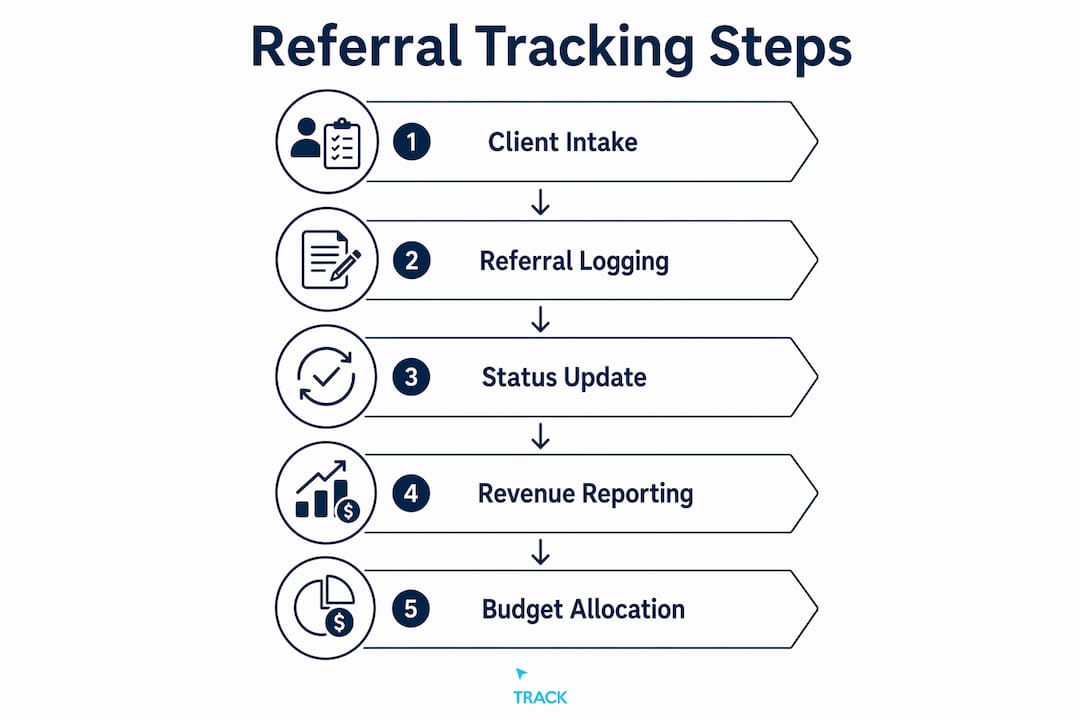
The comparison that matters most is booked revenue per lead source, not lead volume. A paid ad campaign that generates 20 leads but books 3 jobs loses to a referral program that generates 8 leads and books 6. Volume without revenue context is a misleading number.
For outdoor design companies, the standard practice is to track booked revenue by channel, not just lead counts. This is the same discipline covered in paid ads ROI tracking for outdoor builds. The table below shows how to compare channels on the metric that actually matters.
| Marketing channel | Track this metric |
|---|---|
| Referrals | Booked revenue per referring client |
| Google paid ads | Cost per booked job |
| Google Business Profile | Leads to booked job conversion rate |
| SEO / organic search | Revenue attributed to organic leads |
| Social media | Booked jobs per platform |
When you see these numbers side by side, budget decisions become straightforward. You put more resources behind the channels producing the highest booked revenue per dollar spent. Referrals consistently rank at the top of that list because they close faster and cost less than any other lead type.
Key Takeaways
Outdoor design company referral tracking requires consistent intake questions, CRM logging, status tracking through to booked jobs, and quarterly program reviews to produce accurate revenue data.
| Point | Details |
|---|---|
| Referrals drive 23, 30% of leads | Referrals are a top lead source and require a formal tracking system to measure and protect. |
| Log six core data fields | Record lead name, referral source, date, job value, status, and reward details in your CRM. |
| Ask every new lead directly | A scripted intake question catches referrals clients would otherwise forget to mention. |
| Pay rewards after a deposit | Tying reward payment to a financial event protects your margin and ensures ROI accuracy. |
| Review the program quarterly | Regular reviews keep incentives motivating and tracking data accurate over time. |
Why referral tracking is infrastructure, not a bonus program
I have worked with outdoor design companies that run referral programs on sticky notes and gut instinct. They know referrals matter. They just have no idea which clients send the most valuable ones, what those jobs are worth, or whether their reward structure makes financial sense. That is not a referral program. That is a hope strategy.
The shift I keep pushing for is treating referral tracking as marketing infrastructure. Not a nice-to-have program you set up once and forget. The companies that grow consistently are the ones that review their referral data the same way they review their job costs. They know their top five referring clients by name. They know the average booked value of a referred job versus a paid ad lead. They adjust their rewards based on what the numbers show, not what feels generous.
The quarterly review cadence is the piece most companies skip. A reward that worked well when your average job was $8,000 may not motivate the same clients when your average job is $18,000. The program has to evolve with your business. Referral tracking and management must be treated as a marketing asset that requires regular evaluation to stay effective.
The other thing I have seen consistently is that the intake question is the single highest-leverage action most companies are not taking. One question, asked every time, captures data that would otherwise disappear. That data, over 12 months, tells you exactly which clients to invest in, which neighborhoods to target, and which marketing channels to cut.
How Click Track Marketing connects referral data to real revenue
Referral tracking produces valuable data. The question is whether that data connects to your full revenue picture or sits in a spreadsheet no one reads.
Click Track Marketing builds the attribution infrastructure that ties referral sources, paid leads, and organic traffic to actual booked revenue. Through PeopleLytics, our weekly revenue attribution dashboard, you see exactly which channels are producing jobs and which are producing noise. BuyerSignals surfaces intent data so you know who is in the market right now, not just who clicked an ad last month. If you want to see how full-funnel AI marketing connects referral tracking to revenue clarity, the system is built for exactly that. Outdoor design companies ready to move beyond lead counts and into real revenue data can see how it works and request a consultation directly.
Want to know exactly which marketing is making you money?
Get a free attribution audit — we'll show you where your leads and revenue actually come from. Answer two quick questions to start.