

Quick Answer
Behavioral targeting in ads is defined as the practice of delivering personalized advertisements based on a user's past online actions, such as browsing history, search queries, and purchase patterns, rather than their age, location, or the content of the page they are viewing. This approach improves purchase likelihood by 76% compared to non-personalized advertising. The industry term for this practice is behavioral advertising, and it sits at the core of how modern paid media campaigns reach the right person at the right moment. For digital marketers and business owners, understanding behavioral targeting is the difference between spending on reach and spending on results.
What is behavioral targeting in ads and how does it work?
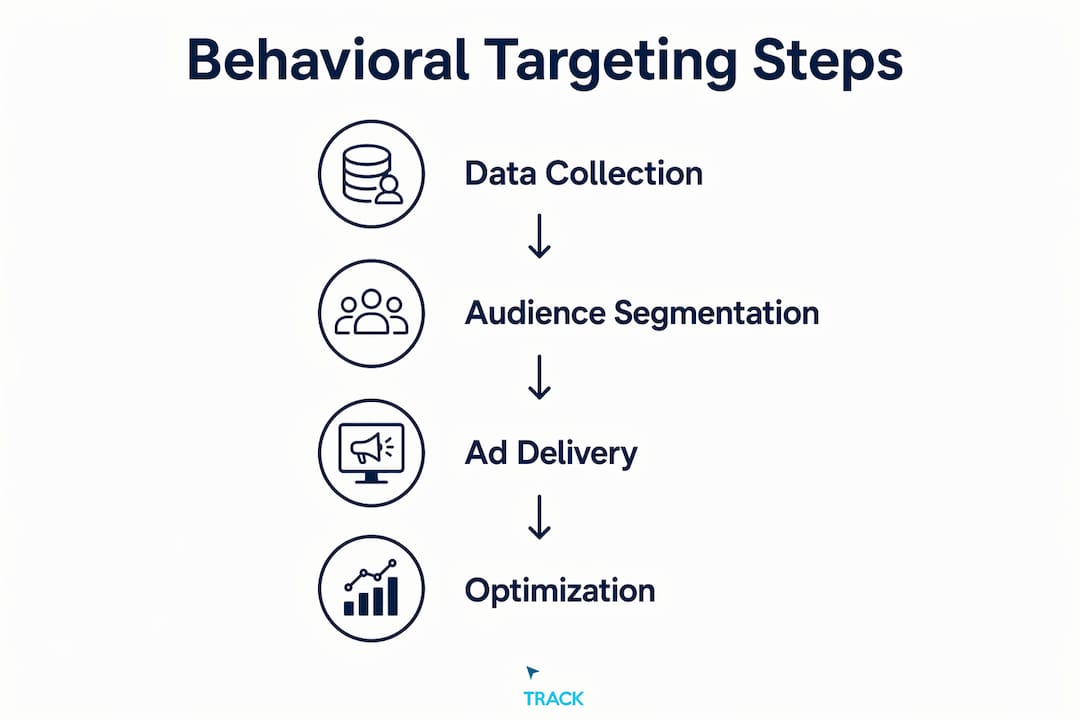
Behavioral targeting works through three sequential steps: data collection, audience segmentation, and real-time ad delivery. Each step builds on the last, and skipping any one of them produces weaker results.
Step 1: Data collection. Ad platforms and websites collect behavioral signals through tracking pixels, first-party cookies, CRM uploads, and server-side event tracking. Every page visit, product view, search query, and email click becomes a data point. These signals accumulate into a behavioral profile for each user.

Step 2: Audience segmentation. The platform groups users into segments based on shared behavioral patterns. A segment might include everyone who viewed a product page but did not purchase, or everyone who searched for a specific category in the past seven days. These segments reflect demonstrated intent, not assumed interest.
Step 3: Real-time ad delivery. When a user enters an ad auction, the platform matches their behavioral segment to relevant campaigns and serves the most appropriate ad. This reduces wasted impressions and concentrates budget on users who have already shown interest.
Pro Tip: Set your behavioral segments to refresh every 24, 48 hours. Stale segments serve ads to users whose intent has already expired, which wastes budget and lowers your Quality Score.
The result is a system that prioritizes spend on users with demonstrated purchase intent. That is a fundamentally different allocation than demographic targeting, which bets on who a person is rather than what they have actually done.
What are the main types and data sources of behavioral targeting?
Behavioral advertising draws from a wide range of data sources. The most common inputs are browsing history, on-site search queries, purchase history, app usage patterns, and email interaction data such as opens and clicks. Each source adds a layer of specificity to the behavioral profile.
The table below shows how behavioral targeting compares to other common targeting methods:
| Targeting type | Primary signal | Strength | Limitation |
|---|---|---|---|
| Behavioral | Past user actions | High intent accuracy | Requires sufficient data volume |
| Contextual | Current page content | Privacy-safe | No user history used |
| Demographic | Age, gender, income | Easy to set up | Low intent signal |
| Psychographic | Values and lifestyle | Deep personalization | Hard to verify at scale |
Behavioral targeting focuses on historical actions across sites and sessions rather than the current page. That distinction matters because a user reading a product review is not the same as a user who has already added that product to a cart. The cart abandoner has a far stronger intent signal.
Common behavioral audience segments include:
- Cart abandoners: Users who added items to a cart but did not complete checkout
- Frequent purchasers: Users who have bought two or more times in a defined window
- Category browsers: Users who viewed a specific product category multiple times
- Lapsed customers: Users who purchased previously but have not returned in 90 or more days
- High-value researchers: Users who spent significant time on pricing or comparison pages
One critical challenge is the phase-out of third-party cookies, which forces marketers to rely on first-party data. Brands that have not built a first-party data infrastructure are losing the ability to build these segments at scale. The match rate between your first-party data and the ad platform's user base directly determines how large and effective your segments can be.
What are the key benefits and challenges of behavioral targeting?
The benefits of behavioral advertising are concrete and measurable. Over 75% of consumers prefer brands that personalize marketing based on their online behavior. That preference translates directly into higher engagement and conversion rates.
The core benefits are:
- Higher ad relevance: Ads match what users have already shown interest in, reducing the friction between exposure and action
- Better budget efficiency: Spend concentrates on users with demonstrated intent rather than broad demographic pools
- Stronger customer relationships: Relevant ads build long-term trust by showing users content that matches their current needs
- Improved return on ad spend: Campaigns targeting behavioral segments consistently outperform demographic-only campaigns on conversion metrics
The challenges are equally real. Privacy concerns, data integration difficulties, over-segmentation, and attribution decay are the four most common problems marketers face. Privacy regulations like GDPR and CCPA require explicit consent for behavioral data collection, which shrinks the addressable audience in regulated markets.
Over-segmentation is a less obvious but equally damaging problem. When a segment is too narrow, the ad platform's machine learning algorithm does not have enough conversion data to optimize effectively. A segment of 200 users cannot train an algorithm the way a segment of 20,000 can.
Pro Tip: If your behavioral segment has fewer than 1,000 users, broaden the qualifying criteria. Add a longer lookback window or include an adjacent behavior. Small segments starve the algorithm and produce unreliable results.
Attribution decay is the third major risk. A user who browsed a product three weeks ago has very different intent than one who browsed yesterday. Serving the same ad to both users at the same bid wastes money on the colder signal.
How can marketers implement and optimize behavioral targeting strategies?
Effective implementation follows a clear sequence. Skipping steps early in the process creates problems that are expensive to fix later.
- 1Unify your first-party data. Connect your CRM, website analytics, and e-commerce platform into a single customer profile. This is the foundation. Without it, your behavioral segments are incomplete and your match rates on ad platforms will be low.
- 1Define segments by recency and action. Build segments around specific behaviors with defined time windows. "Viewed pricing page in the last 7 days" is a usable segment. "Interested in our product" is not. Aligning ad delivery with recent behavior prevents attribution decay and maximizes conversion likelihood.
- 1Use broad enough segments for machine learning. Aim for segments large enough to give the platform's algorithm at least 50 conversions per week. Below that threshold, automated bidding strategies cannot optimize effectively.
- 1Set up automation triggers for bid adjustments. Configure rules that increase bids for users who have taken high-intent actions in the last 24, 48 hours and reduce bids for users whose behavioral signals are older than 14 days. This is how you prevent wasted spend at the campaign level.
- 1Measure revenue, not just clicks. Connect your ad platform data to your revenue system. Clicks and impressions tell you what happened in the platform. Revenue attribution tells you what the platform actually earned. For intent-based marketing to deliver real results, you need to close that loop.
Pro Tip: Run a holdout test by excluding a small percentage of your behavioral audience from seeing ads. Compare their conversion rate to the exposed group. This gives you a true read on incremental lift rather than correlation.
The most effective behavioral marketing strategies combine first-party data with continuous optimization. Combining behavioral targeting with first-party data and ongoing testing is the approach that produces measurable, repeatable growth.
Key Takeaways
Behavioral targeting in ads delivers measurable results when marketers build first-party data infrastructure, define intent-based segments, and tie ad spend directly to revenue.
| Point | Details |
|---|---|
| Definition is action-based | Behavioral targeting uses past user actions, not demographics, to predict and match intent. |
| Three-step process | Data collection, audience segmentation, and real-time delivery form the complete system. |
| First-party data is now critical | Third-party cookie decline makes your own customer data the foundation of every segment. |
| Segment size matters | Segments below 1,000 users limit algorithm learning and reduce campaign performance. |
| Revenue attribution closes the loop | Measuring clicks alone misses the actual business impact of behavioral campaigns. |
Behavioral targeting is not a feature. It is infrastructure.
Most marketers I work with treat behavioral targeting as a campaign tactic. They set up a retargeting audience, run it for 30 days, and call it done. That is not behavioral advertising. That is a single layer of a much deeper system.
The real shift happens when you stop thinking about behavioral data as an input to ads and start thinking about it as a record of customer intent across time. Every action a user takes is a signal. The question is whether your infrastructure is built to read those signals in real time and act on them before the intent expires.
The misconception I see most often is that demographic targeting and behavioral targeting are interchangeable. They are not. Demographics tell you who someone is. Behavior tells you what they want right now. Those are different questions, and they require different answers.
The other mistake is treating behavioral targeting as a privacy risk to manage rather than a trust-building tool to use responsibly. When ads match genuine needs, users notice. They engage more, complain less, and buy more often. Behavioral targeting shifts marketing from demographic assumptions to data-driven personalization, and that shift creates a more trusted relationship with your audience.
The future of this discipline is not more data. It is better infrastructure for reading the data you already have. Brands that build unified customer profiles, connect them to their ad platforms, and measure revenue rather than impressions will outperform everyone still running demographic campaigns.
How Click Track Marketing applies behavioral targeting to real campaigns
Click Track Marketing builds the infrastructure that makes behavioral targeting measurable from the first click to the final sale. Our AI-driven marketing system connects behavioral signals from your website, CRM, and ad platforms into a unified view of customer intent.
PeoplePixel identifies anonymous visitors most businesses never see. BuyerSignals surfaces who is actively in the market right now. PeopleLytics ties it all back to revenue through a weekly attribution dashboard, so you know exactly which behavioral segments are producing customers and which are burning budget. If you are ready to move from impressions to income, see how we work and what that infrastructure looks like in practice.
Want to know exactly which marketing is making you money?
Get a free attribution audit — we'll show you where your leads and revenue actually come from. Answer two quick questions to start.