

Quick Answer
Brand differentiation online is the deliberate process of defining and communicating what makes your brand uniquely valuable in digital marketplaces, so customers choose you over every other option. According to Gartner research, 46% of customers cannot distinguish between most brands' digital experiences, yet companies with strong brand differentiation achieve revenue growth rates 2.3 times higher than competitors. That gap is not a coincidence. It is the direct result of strategic choices about positioning, customer experience, and messaging. This guide breaks down what online brand differentiation means, which strategies work, and how to measure whether your efforts are producing real results.
What is brand differentiation online, and why does it matter?
Brand differentiation online is the recognized industry term for what marketers sometimes call "standing out digitally." It describes the set of deliberate choices a business makes to occupy a distinct and valued position in the minds of its customers across websites, search engines, social media, and AI answer engines.
The importance of brand differentiation is not abstract. When customers cannot tell your brand apart from a competitor, they default to price. That is a race you cannot win long term. Strong differentiation shifts the buying decision from "who is cheapest" to "who do I trust." Strong differentiation simplifies marketing, shortens sales conversations, and naturally builds loyalty without extra spend.

For e-commerce brands specifically, the stakes are higher. Shopify data shows that niche brands focused on sustainability grew 23% faster than general retailers in 2024. That growth did not come from bigger ad budgets. It came from a clearer identity that attracted a specific, motivated audience.
Brand positioning in digital marketing is the mechanism that makes differentiation visible. It is the consistent signal you send across every touchpoint, from your homepage headline to the tone of your support emails.

What are the most effective online brand differentiation strategies?
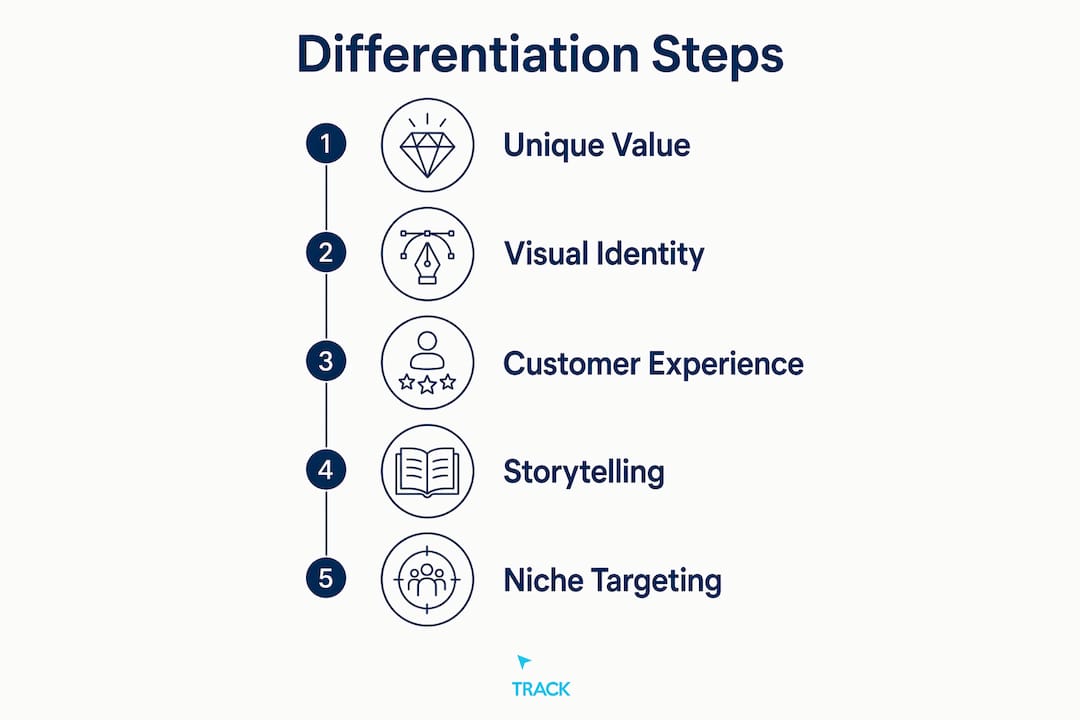
The most effective online brand differentiation strategies fall into five categories: unique value proposition, visual identity, customer experience, storytelling, and niche targeting. Each works differently depending on your market and audience.
Unique value proposition
Your unique value proposition (UVP) is the single clearest answer to "why you." It should appear in your headline, your ads, and your AI search presence. A weak UVP says "quality service at a fair price." A strong UVP says exactly who you serve, what problem you solve, and why you solve it better than anyone else.
Customer experience as a differentiator
73% of consumers consider customer experience a key factor in purchasing decisions. That makes service-led differentiation the most accessible strategy for businesses that cannot out-spend larger competitors on advertising. Fast response times, clear return policies, and personalized follow-ups all communicate brand character before a customer reads a single word of your copy.
Storytelling and retention
Brands with authentic storytelling see 20% higher customer retention, according to a Harvard Business Review study. Storytelling is not about writing a founder biography. It is about consistently framing your brand's purpose in terms your customer recognizes as their own.
Niche targeting
Trying to serve everyone online is the fastest path to invisibility. Becoming indispensable to a specific audience is the proven path to sustainable growth. Niche targeting also makes your content more likely to appear in AI-generated answers, because AI engines favor specific, authoritative sources over broad, generic ones.
Here is a comparison of the core strategies:
| Strategy | Primary benefit | Example application |
|---|---|---|
| Unique value proposition | Clarity in buying decisions | Homepage headline targeting one specific customer problem |
| Customer experience | Loyalty and word-of-mouth | Automated follow-up emails with personalized product tips |
| Authentic storytelling | Higher retention | Brand origin content tied to customer values |
| Niche targeting | Faster audience growth | Sustainability-focused product line for eco-conscious buyers |
| Visual brand identity | Instant recognition | Consistent color, typography, and tone across all channels |
Why consistent positioning is the real work of differentiation
Effective brand positioning is a decision-making system, not a slogan. It guides how you prioritize audiences, allocate budget, and behave across every customer touchpoint. Most business owners treat differentiation as a creative exercise. Experts treat it as a discipline of choosing what not to do.
Brand drift is the silent killer of differentiation. It happens when a business adds services outside its core strength, changes its tone to chase trends, or dilutes its message to appeal to a broader audience. Each individual decision seems reasonable. Together, they erase the clarity that made the brand recognizable.
The famous-to-a-few philosophy is the antidote. Instead of optimizing for reach, you optimize for resonance with a specific, high-value segment. A medical aesthetics practice that positions itself as the go-to provider for patients who want clinical precision, not just cosmetic trends, will outperform a generalist practice in both conversion and retention. Aesthetic Collective demonstrates this approach in the medical aesthetics marketing space, where niche positioning drives measurable patient acquisition.
Customers perceive differentiation in micro-moments, the small, repeatable behaviors that add up over time. The tone of a support reply. How quickly a chat message gets answered. Whether your website loads in two seconds or five. These details communicate your brand's values more clearly than any tagline.
Pro Tip: Audit every customer touchpoint once per quarter. Ask whether each one reinforces your positioning or contradicts it. Inconsistency is invisible from the inside and obvious from the outside.
How can businesses measure the impact of their differentiation?
Measuring online brand differentiation requires moving beyond impressions and clicks. The metrics that matter are the ones tied to customer behavior and revenue.
The most useful KPIs for differentiation include customer retention rate, net promoter score (NPS), branded search volume, average order value, and revenue per channel. Each of these reflects whether customers perceive your brand as distinct and worth returning to.
Revenue-based marketing is the framework that connects differentiation efforts to actual business outcomes. Instead of reporting on traffic, you report on which channels and messages produced paying customers. That shift in measurement changes how you allocate budget and which strategies you continue.
Here is a reference table for tracking differentiation impact:
| Metric | What it measures | Recommended tool |
|---|---|---|
| Customer retention rate | Whether differentiation builds loyalty | CRM analytics, Google Analytics 4 |
| Branded search volume | Brand recognition growth over time | Google Search Console |
| Net promoter score | Customer perception of uniqueness | Survey tools like Typeform or Delighted |
| Revenue per channel | Which differentiation efforts drive sales | Revenue attribution platforms |
| Average order value | Whether positioning supports premium pricing | Shopify analytics, WooCommerce reports |
Tracking marketing ROI is not optional if you want to know whether your differentiation strategy is working. Without attribution, you are guessing. With it, you can double down on what works and cut what does not.
Pro Tip: Use an SEO ROI calculator to estimate the revenue value of your organic search traffic. It gives you a baseline for comparing differentiation-driven growth against paid channels.
What are the practical steps for differentiating your brand online in 2026?
Implementing online brand differentiation is a sequential process. Skipping steps produces inconsistent results. Here is the order that works:
- 1Conduct audience research. Identify your highest-value customer segment. Understand their specific problem, their language, and what they currently believe about your category. Tools like Google Trends, Reddit, and customer interviews all surface real language you can use.
- 1Define your unique value proposition. Write one sentence that names your audience, the problem you solve, and why your solution is different. Test it with real customers before publishing it anywhere.
- 1Audit your current digital presence. Review your website, social profiles, and search listings for consistency. Identify where your messaging contradicts your positioning.
- 1Align your content with your UVP. Every blog post, product description, and social caption should reinforce the same core message. Content that drifts from your positioning dilutes your brand signal.
- 1Build your AI search presence. In 2026, customers increasingly ask ChatGPT, Google's AI Overviews, and Perplexity for recommendations. Brands that appear in those answers have structured their content to be understood and cited by AI engines. This is the frontier of brand positioning in digital marketing.
- 1Measure and refine quarterly. Use the KPIs from the previous section to evaluate whether your differentiation is producing retention, recognition, and revenue. Adjust based on data, not assumptions.
Brand positioning frameworks help businesses make consistent choices about emphasis, audience targeting, and messaging across channels. They are not static documents. They evolve as your company grows and as customer expectations shift.
Pro Tip: Differentiation thrives in everyday customer interactions. Small, consistent choices build perceived uniqueness even before a customer reads your marketing copy. Train your team on the brand voice, not just the product.
Key takeaways
Online brand differentiation is the single most reliable driver of sustainable revenue growth in competitive digital markets, requiring consistent positioning, customer experience, and measurable attribution.
| Point | Details |
|---|---|
| Define your UVP first | A clear unique value proposition is the foundation every other differentiation effort depends on. |
| Customer experience drives loyalty | 73% of consumers cite experience as a key purchase factor, making service a primary differentiator. |
| Niche targeting accelerates growth | Focused brands grow faster; sustainability-focused e-commerce brands grew 23% faster in 2024. |
| Measure revenue, not just traffic | Track retention, branded search, and revenue per channel to confirm differentiation is working. |
| AI search presence is now required | Brands structured for AI answer engines gain visibility that traditional SEO alone cannot deliver. |
Why differentiation is harder than it looks
Most business owners understand differentiation in theory. The hard part is maintaining it under pressure. When a competitor drops prices, the instinct is to match them. When a new trend appears, the instinct is to chase it. Both moves erode the positioning you built.
What I have seen consistently is that the brands with the clearest differentiation are the ones that said no more often than yes. They turned down clients outside their niche. They kept their messaging focused when every advisor told them to broaden it. That discipline is not natural. It requires a system, not just intention.
The other thing most articles skip is the operational side. Differentiation is a promise. Your operations either keep that promise or break it. A brand that promises speed needs fast fulfillment. A brand that promises expertise needs content that proves it. The gap between the brand promise and the customer experience is where differentiation dies.
The shift to AI-driven search has added a new layer. Your brand now needs to be legible to machines, not just humans. If an AI engine cannot extract a clear, specific answer from your website about what you do and who you serve, you will not appear in the answers your customers are reading. That is not a content problem. It is an infrastructure problem.
How Click Track Marketing helps you differentiate and get found
Building a differentiated brand online is only half the work. The other half is making sure the right customers can find you, and that you can prove the investment is producing revenue.
Click Track Marketing builds the infrastructure that makes both possible. We design AI-structured websites that answer engines like ChatGPT and Google's AI Overviews can read, cite, and recommend. Our AI marketing system connects your brand positioning to measurable revenue through tools like BuyerSignals, PeoplePixel, and PeopleLytics. You stop guessing which efforts are working and start seeing exactly which channels are producing customers. If you want your brand to be the answer that comes back when your ideal customer asks an AI a question you should own, start with a discovery call.
Want to know exactly which marketing is making you money?
Get a free attribution audit — we'll show you where your leads and revenue actually come from. Answer two quick questions to start.