

Quick Answer
An AI marketing agency is a firm that combines artificial intelligence with marketing strategy to deliver smarter campaigns, better targeting, and measurable revenue growth. Unlike traditional agencies that rely on manual analysis and periodic reporting, an AI-powered marketing firm uses autonomous software, predictive analytics, and real-time data to continuously improve every campaign it runs. The key distinction is that AI multiplies creative intelligence rather than replacing it. The technology amplifies human judgment. It does not substitute for it.
What services do AI marketing agencies offer to businesses?
An AI marketing agency typically delivers a core set of services that traditional firms cannot replicate at the same speed or scale. These services center on using AI to process data, personalize content, and automate decisions that would otherwise require large teams and long timelines.
The primary services include:
- AI-driven audience analysis: Scanning market data to identify who is most likely to buy, when, and through which channel.
- Personalized content creation: Using AI tools to generate and test content variations tailored to specific audience segments.
- Automated campaign optimization: Continuously adjusting bids, budgets, and creative assets based on live performance data.
- Anomaly detection: Flagging unusual drops or spikes in campaign performance before they become costly problems.
- Predictive analytics: Forecasting which leads are most likely to convert based on behavioral signals.
These services work because AI agents integrate brand judgment with market data and creative assistance in continuous loops. The result is a campaign that gets sharper over time rather than stagnating between quarterly reviews.
Pro Tip: Before signing with any AI digital marketing agency, ask how they encode your brand's voice and standards into their AI workflows. Agencies that cannot answer this question clearly are running generic automation, not true AI marketing.

The best AI marketing agencies also build what Click Track Marketing calls decision infrastructure. This means the AI does not just run ads. It identifies who visited your site, surfaces buying intent, and ties every action back to revenue. Tools like PeoplePixel and BuyerSignals are examples of this infrastructure in practice.
How does an AI marketing agency improve campaign effectiveness?
The performance gap between AI-powered and traditional marketing is measurable and significant. Marketing teams using AI agents report 73% faster campaign development and 68% shorter content creation timelines. That speed advantage compounds over time because faster iteration means more tests, more learning, and better results.
Beyond speed, the core advantage is precision. Traditional campaigns are built on historical data and educated guesses. AI-powered campaigns update in real time. If a particular ad creative stops performing on a Tuesday afternoon, the system detects it and reallocates budget before the week is over. A human analyst reviewing a monthly report would catch the same problem weeks later.
“95% of enterprise AI pilots produce zero measurable profit and loss impact without an intelligence layer that encodes brand judgment into workflows. This intelligence layer connects strategy, creative, media, and AI systems into one integrated growth engine, systematically improving marketing outcomes.”
That finding is the most important thing to understand about AI marketing. The technology alone does not produce results. The intelligence layer does. An agency that deploys AI tools without encoding your brand's strategy, audience knowledge, and creative standards into those tools is running expensive automation with no direction.
Revenue attribution is where this advantage becomes concrete for business owners. When AI connects campaign spend directly to closed revenue, you stop guessing which efforts are working. You see it in a dashboard every week. That is a fundamentally different relationship with your marketing budget.
The agencies that deliver real ROI treat AI as the connective tissue between strategy and execution. They use it to close the loop between what you spend and what you earn.
What practical steps help businesses work with an AI marketing agency?
Working with an AI marketing agency requires more preparation than hiring a traditional firm. The more context and data you bring to the relationship, the better the AI systems perform.
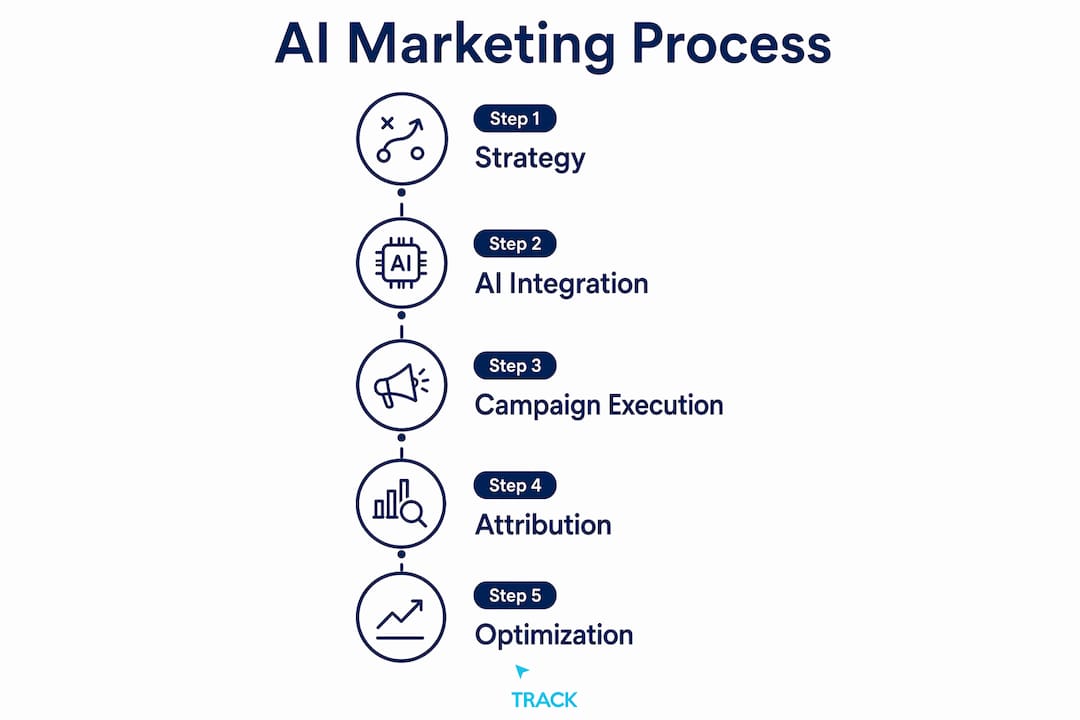
- 1Audit your existing data. AI systems need clean, organized data to function well. Before engaging an agency, consolidate your customer records, sales history, and website analytics into accessible formats.
- 2Define revenue goals, not vanity metrics. Tell the agency what a customer is worth, what your close rate is, and what your target cost per acquisition looks like. Impressions and clicks are not goals.
- 3Integrate your internal team. Your sales team knows things about your customers that no dataset captures. Build a feedback loop between your sales staff and the agency's AI workflows from day one.
- 4Establish a reporting cadence. Weekly attribution reports are more useful than monthly summaries. Require the agency to show you which specific efforts drove revenue, not just which campaigns generated traffic.
- 5Plan for iteration. AI marketing is not a set-and-forget system. Budget time each month to review findings, adjust strategy, and feed new information back into the system.
Pro Tip: Ask any AI marketing agency for small business to show you a sample attribution report before you sign. If the report shows impressions and clicks but not revenue, the agency is measuring the wrong things.
Ongoing adaptation is not optional in AI marketing. The tools evolve rapidly, and agencies that do not update their methods fall behind quickly. The best partnerships treat learning as a built-in part of the engagement, not an afterthought.
What challenges should businesses expect when partnering with an AI marketing agency?
The most common misconception about AI marketing is that the technology solves everything on its own. It does not. AI is a multiplier of creative intelligence, not a replacement for it. Businesses that hand over their marketing to an AI agency without staying engaged tend to get generic results.
Key challenges to plan for include:
- Cost variability: Basic AI marketing automation can start as low as $99 per month, but enterprise-level custom AI development involves significantly higher costs depending on scope and complexity. Know what you are buying before you commit.
- Data privacy requirements: AI systems process large volumes of customer data. Confirm that any agency you work with follows current data privacy regulations and has clear policies on data storage and use.
- Goal misalignment: If the agency optimizes for traffic and you need revenue, you will get traffic. Define success in revenue terms from the first conversation.
- Implementation complexity: Connecting AI tools to your CRM, ad platforms, and website takes time and technical work. Budget for a proper onboarding period rather than expecting results in the first two weeks.
- Over-reliance on automation: Automated systems can amplify bad strategy just as efficiently as good strategy. Human oversight of AI decisions is not optional. It is the job.
Clear communication prevents most of these problems. Agencies that set realistic timelines, explain their methods plainly, and report on revenue rather than activity are the ones worth working with.
Key Takeaways
An AI marketing agency delivers measurable results only when AI tools are paired with a structured intelligence layer that encodes brand judgment, connects spend to revenue, and adapts continuously.
| Point | Details |
|---|---|
| AI multiplies, not replaces | AI amplifies human strategy and creative judgment. It does not substitute for them. |
| Intelligence layer is critical | 95% of AI pilots fail without a layer connecting strategy, creative, and AI systems into one growth engine. |
| Speed advantage is real | AI-powered teams develop campaigns 73% faster, compounding learning and results over time. |
| Revenue attribution matters | Measure success in closed revenue, not impressions or clicks, to know what the marketing actually earns. |
| Preparation drives performance | Clean data, defined revenue goals, and internal team integration determine how well AI systems perform. |
What I have learned about AI marketing after years inside the machine
Working inside Google's Ads organization taught me one thing above everything else: attribution is the only honest conversation in marketing. Every other metric is a story you tell yourself. Revenue is the truth.
When I look at how most businesses engage with AI marketing agencies, I see the same mistake repeated. They treat AI as a vendor relationship rather than an infrastructure decision. They buy a tool or a service, wait for results, and move on when the results disappoint. The agencies that actually move the needle treat AI differently. They build it into the foundation of how campaigns are planned, executed, and measured.
The statistic that sticks with me is that 95% of enterprise AI pilots produce no measurable profit and loss impact. That is not a technology failure. That is a strategy failure. The businesses that succeed are the ones that encode their actual brand knowledge, their real customer understanding, and their specific revenue goals into the AI system from the start. The technology then amplifies that knowledge at scale.
The other thing I would tell any business owner is this: the shift from traditional SEO to Answer Engine Optimization is not coming. It is here. Customers are asking ChatGPT, Perplexity, and Google's AI Overviews for recommendations right now. If your business is not structured to appear in AI answers, you are invisible to a growing share of your market. That is an infrastructure problem, and it requires an infrastructure solution.
The agencies worth hiring in 2026 are the ones that build things you own: attribution systems, AI-ready websites, and reporting that shows you exactly where your revenue comes from. The ones selling you impressions and reach are selling you a story.
How Click Track Marketing puts AI marketing into practice
Click Track Marketing is a San Diego-based AI marketing agency built specifically for local businesses and e-commerce brands that need to be found in AI-powered search. The agency builds AI-structured websites engineered to be read and cited by answer engines like ChatGPT and Google's AI Overviews, and pairs that infrastructure with full-funnel attribution that connects every marketing dollar to actual revenue.
Proprietary tools including PeoplePixel, BuyerSignals, and PeopleLytics identify anonymous site visitors, surface real buying intent, and deliver weekly revenue attribution reports. Business owners see exactly which efforts are producing customers and which are not. If you want marketing that proves its own value, the full-funnel system behind Click Track Marketing's results is worth a close look.
Want to know exactly which marketing is making you money?
Get a free attribution audit — we'll show you where your leads and revenue actually come from. Answer two quick questions to start.