
AEO Agency vs Traditional SEO Agency
One gets you into a list of ten links. The other gets you named inside the answer. Here is the real difference, with sources, plus the cases where you should hire an SEO agency instead of us.
Quick Answer
A traditional SEO agency optimizes your site to rank in a list of search results. An AEO agency optimizes your business to be the source an AI engine cites when it writes the answer in ChatGPT, Google AI Overviews, Perplexity, Gemini or Copilot. The two used to be the same job. They are not any more: Ahrefs found that only 37.9% of AI Overview citations now come from pages ranking in the organic top 10, down from roughly 76% a year earlier. Ranking well and being cited have become separate outcomes that need separate work.
Side by side
Eight dimensions where the two disciplines genuinely diverge. Where they overlap, we say so rather than inventing a distinction.
| Dimension | Traditional SEO agency | AEO agency |
|---|---|---|
| What it optimizes for | Ranking in a list of ten blue links. Position is the product. | Being the source an AI engine names when it writes the answer. There is no list to place in. |
| Where the customer sees you | Google results page, Maps pack, sometimes a featured snippet. | Inside a ChatGPT reply, a Google AI Overview, a Perplexity answer, a Gemini or Copilot recommendation. |
| How many competitors are visible | Ten organic results plus ads. Buyers comparison shop across several of them. | A handful of cited sources, often a single named recommendation. Sixth place does not exist. |
| Core deliverables | Keyword research, content velocity, backlinks, technical fixes, Core Web Vitals. | Entity and schema graph, answer-first content structure, AI crawler access, third party corroboration, citation monitoring. |
| What proves it worked | Rank tracking, organic sessions, impressions in Search Console. | Citation share across engines, plus attribution tying an AI sourced lead back to the engine that sent it. |
| Typical time to first signal | Three to six months on competitive terms. | Schema changes can influence answers within weeks. Most businesses see first citations in 60 to 90 days. |
| How the advantage behaves | Erodes if you stop. Competitors publish past you. | Compounds. Engines that already trust you as a source keep reaching for you, which makes displacement harder. |
| Relationship to the other | Strong SEO used to guarantee AI visibility. It no longer does. | Built on an SEO foundation but no longer downstream of it. Ahrefs found only 37.9% of AI Overview citations now come from pages ranking in the organic top 10, down from about 76% a year earlier. |
What the split looks like in a real account
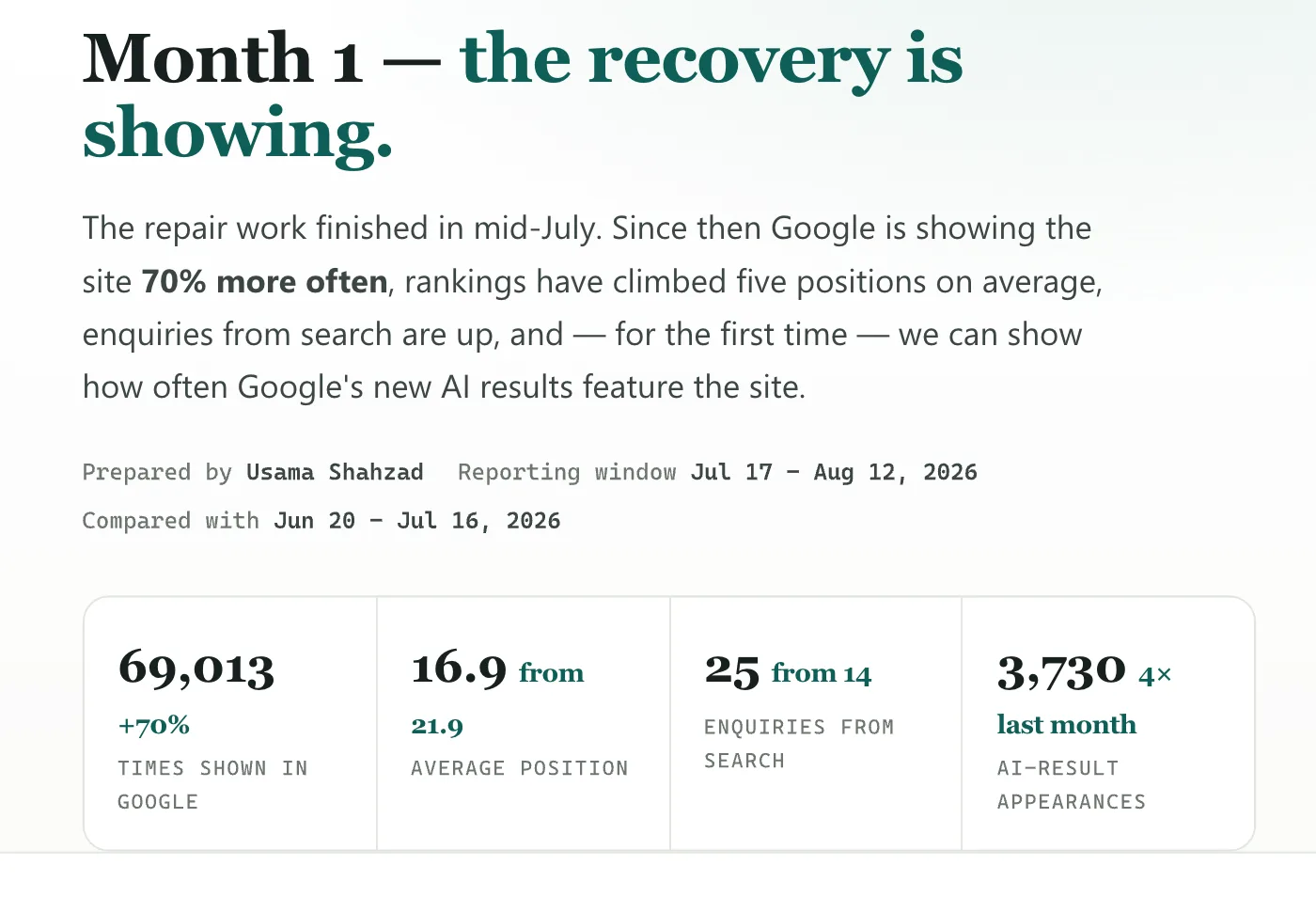
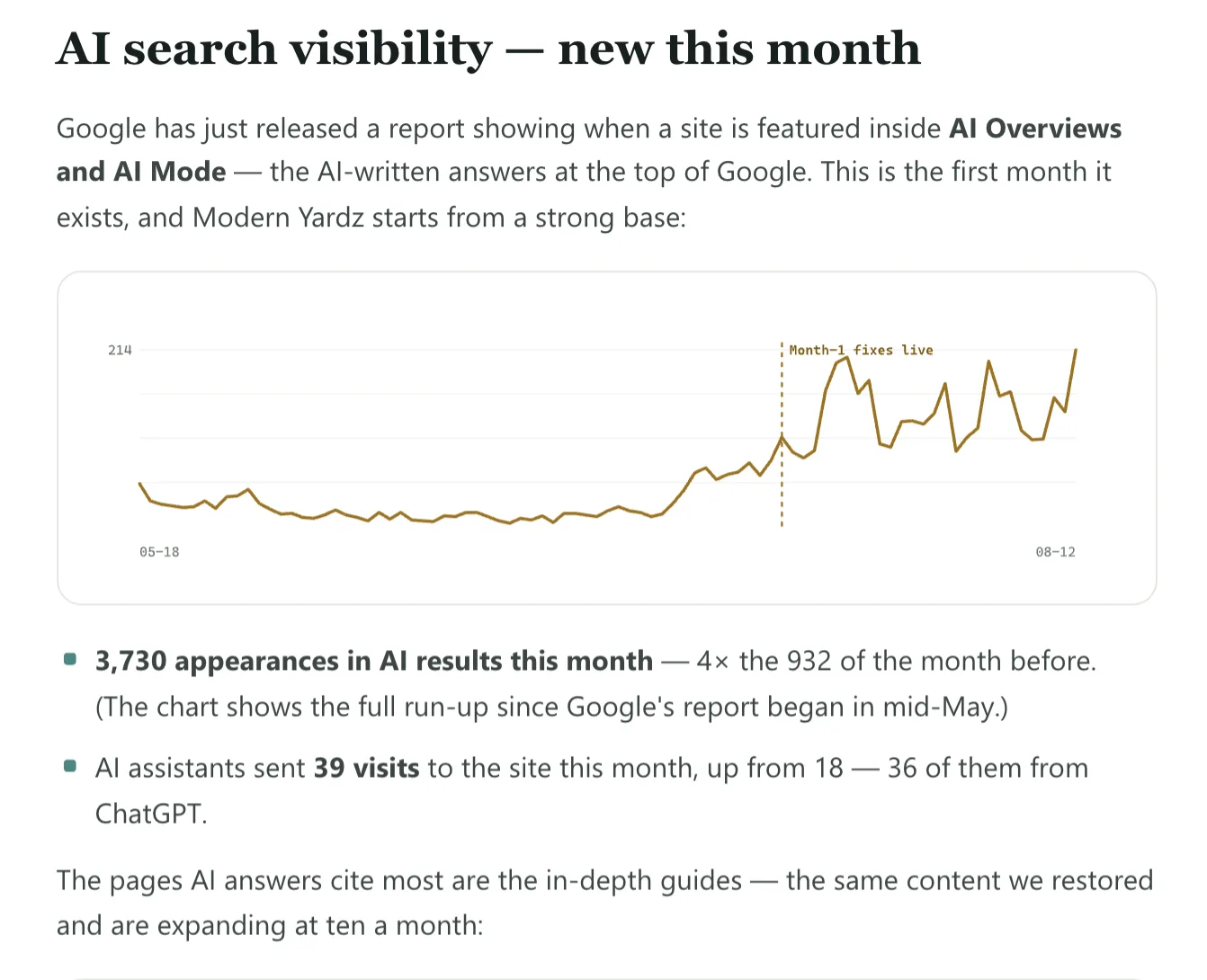
Modern Yardz is a San Diego landscaping company. These are their own reporting screens from the first month after our fixes went live, covering 17 July to 12 August 2026 against the previous month.
Why this is the whole argument
During that month the site wide average Google position was 16.9. That is not page one. Under the old rules, a site averaging sixteenth place would be close to invisible. Yet AI result appearances quadrupled to 3,730, and AI assistants sent 39 visits to the site, 36 of them from ChatGPT.
That is the Ahrefs finding showing up in one account. Citation no longer waits for ranking. An agency measuring only average position would have reported a modest month and missed the part that actually changed.
Modern Yardz separately ranks at position 1.4 for its main head term, “landscape design and build san diego”. The 16.9 figure above is the average across every query the site appears for, which is a different measurement. See the full Modern Yardz case study.
When you should hire an SEO agency instead
We turn these engagements down. Taking them would waste your money and produce a case study we could not defend.
- You sell something people search by name and then comparison shop. An AI answer naming one provider is not how that purchase gets made.
- Your site has real technical debt. Crawl errors, thin pages and slow load times cap AEO too, because engines read the same site.
- You have no reviews, no citations and no third party corroboration. AEO amplifies authority. It does not manufacture it.
- Your market is not asking AI about your category yet. Some verticals genuinely are not, and we check before quoting.
When AEO is the higher return move
These are the conditions where the work pays for itself fastest.
- Your buyers ask for a recommendation rather than a list. Lawyers, contractors, dentists, medical practices, home services.
- You rank well in Google but leads have flattened. That gap is often an AI answer resolving the query before the click.
- You are in a market where nobody has done this yet. The first mover advantage in AI citation is real and it is closing.
- You need to prove where leads come from. AEO without attribution is a story. With it, it is a number.
The Root Agency, 60 days to number one
Steve Root of The Root Agency went from no AI visibility to the number one ChatGPT recommended Allstate agent in Baton Rouge, in 60 days. Not a ranking. A recommendation, by name, inside the answer.
Click Track Marketing also earns Google AI Overview citations for competitive San Diego marketing terms. We run this system on ourselves before we sell it.
Read the full Root Agency case studyDecided AEO is the right discipline but not sure whether to hire it out? We compare hiring an agency against building it in-house, including the seven step checklist if you want to run it yourself.
Sources
- 37.9% of AI Overview citations come from pages in the organic top 10, down from roughly 76% a year earlier
- Ahrefs, analysis of 863,000 keywords and 4 million AI Overview URLs, 2026
- AI Overviews appear on roughly 48% of tracked Google searches
- BrightEdge, February 2026
- Organic click-through rate falls by around 58% to 61% when an AI Overview is present
- Multiple 2026 analyses, including Ahrefs and BrightEdge
- ChatGPT reached roughly 900 million weekly active users
- OpenAI, February 2026
- Traffic arriving from LLMs converts several times better than traditional organic traffic
- Seer Interactive and Semrush, 2026. Reported multiples vary widely by study and vertical, so treat the direction as reliable and the exact multiple as not.
AI search figures move quickly. Where studies disagree we have said so rather than picking the most flattering number. Client figures are from that client’s own reporting, published with permission.

Not sure which one you need?
The AI visibility audit answers it with data. We score where you currently appear across ChatGPT, Perplexity, Gemini and Google AI Overviews, and tell you plainly if SEO fundamentals should come first.
AEO vs SEO: common questions
Ready to Dominate AI Search Results?
Book a free strategy call and we'll show you exactly where your brand appears (and doesn't) in ChatGPT, Google AI Overviews, and Perplexity.
“They set up automation for every pipeline stage, so nothing falls through the cracks. David and his team are genuinely invested in our success.”
— Christopher Whitney · Google Review