

What are AEO services?
AEO services are specialized marketing solutions that optimize your brand's content and online presence so AI-powered answer engines cite and recommend you. Instead of chasing a page-one ranking, you're building the infrastructure that gets your business named when someone asks ChatGPT, Google AI Overviews, or Perplexity a question you should be answering.
The core work covers several distinct areas:
- Entity clarity: Making your brand name, description, and category consistent across your website, Google Business Profile, LinkedIn, and third-party directories so AI engines can identify and trust you
- Structured content: Writing answer-first, question-based content that AI can extract and cite directly
- Schema markup: Implementing FAQ, How-To, and Article schema so AI parsers understand exactly what your content is
- Authority signals: Earning mentions on trusted third-party sites like review platforms, comparison pages, and industry publications
- AI visibility monitoring: Tracking how often and how accurately your brand appears in AI-generated answers
The shift matters because nearly 60% of Google queries now end without a click. Buyers are getting answers directly from AI, and if your brand isn't cited in those answers, you're invisible to that buyer regardless of your organic rankings.
How do AEO services differ from traditional SEO?

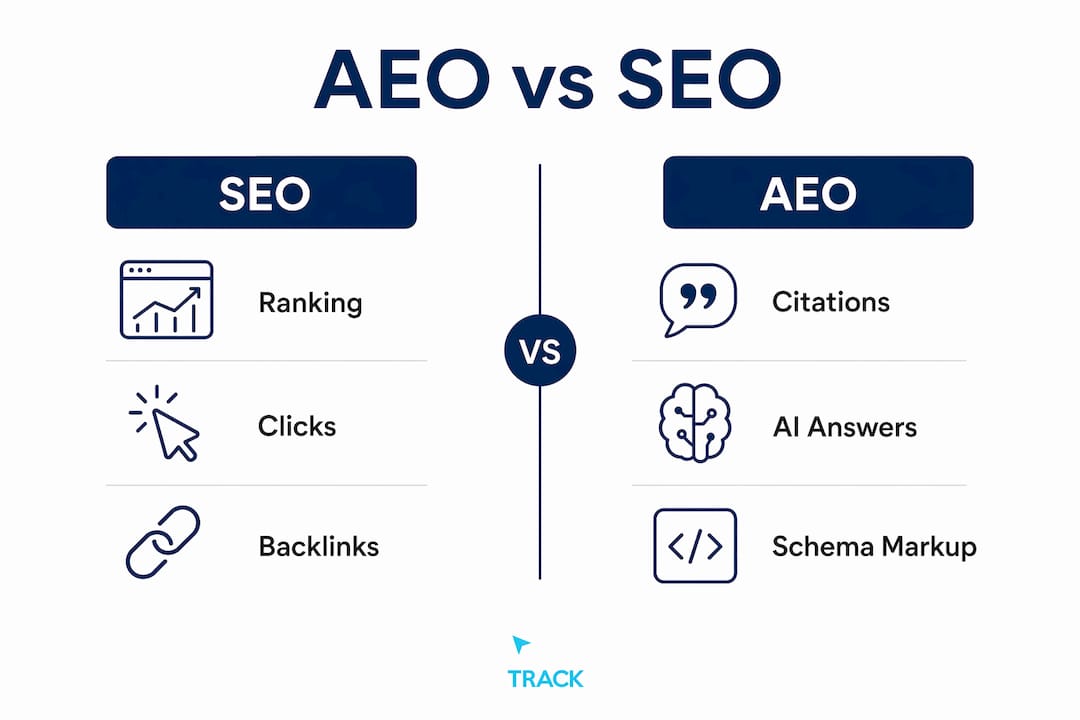
SEO and Answer Engine Optimization share a foundation, but they measure success in completely different ways. SEO targets rankings and clicks; AEO targets brand mentions and citations in AI-generated responses.
The practical differences are significant:
- Content format: SEO rewards long-form, keyword-rich narrative articles. AEO rewards modular, self-contained answer blocks that AI can extract a specific passage from and confidently cite.
- Success metrics: SEO measures rankings and organic traffic. AEO measures brand mention rate, citation frequency, and sentiment accuracy in AI responses.
- Schema importance: Schema markup is helpful for SEO. For AEO, it's critical. FAQ schema in particular maps questions to answers in a format AI engines are built to extract.
- Competition surface: SEO puts you in the top 10 results. AEO puts you in the first one to three brands an AI names. There is no second page.
- Entity naming: SEO is relatively forgiving about brand name consistency. AEO is strict. Inconsistent naming across the web fragments your mention count and suppresses citations.
Strong SEO fundamentals are a prerequisite for AEO success. Crawlable HTML, authoritative backlinks, and quality content give AI engines the foundation they need to trust and cite you. AEO builds on that foundation rather than replacing it.
What does a professional AEO service actually include?
Professional AEO services follow a phased approach. A typical engagement covers an audit, citation gap analysis, content optimization, technical schema implementation, and ongoing monitoring. Here's what each phase delivers:
- AI visibility audit: Baseline assessment of how your brand currently appears across ChatGPT, Perplexity, and Gemini, including which prompts trigger citations and which don't
- Entity modeling: Aligning your brand name, description, and category across every digital property so AI engines read a consistent signal
- Answer-first content creation: Writing or restructuring pages to lead with direct answers to buyer questions, not warm-up paragraphs
- Schema implementation: Adding FAQ, How-To, and Article schema to your highest-priority pages
- Authority building: Securing mentions on third-party sources AI engines already trust, including industry publications, comparison sites, and review platforms
- Prompt tracking and monitoring: Continuously testing target questions in AI engines and tracking whether your brand is cited, at what position, and with what sentiment
Most engagements run in 90-day phases. The first phase establishes the technical foundation and fixes entity gaps. The second phase focuses on content and authority. Ongoing monitoring catches changes in AI behavior and competitor movement.
Pro Tip: Schema markup for AI is not just about Google rich results. Even schema types that no longer trigger SERP features still act as semantic signals that AI parsers read when deciding whether to cite your content.
What ROI can you expect from professional AEO services?
The business case for AEO is concrete. AI-referred traffic converts at a substantially higher rate than baseline organic search traffic, which means the leads coming from AI citations are materially better quality than what most paid campaigns deliver.
At the program level, the results scale further. Advanced AEO programs have demonstrated significant growth in AI-referred trials and influenced substantial revenue within months using structured protocols. One documented case study tracked total revenue attributed to AI discovery over a six-month period.
The mechanism is straightforward. When a buyer asks an AI about a product or service category, they arrive at your site already informed. They've compared options, understood pricing context, and formed a preference. That pre-qualification is what drives the conversion lift.
AEO ROI rarely shows up first in traffic volume. It shows up in citation frequency, brand mention rate, and assisted conversions tracked inside your CRM. Those indicators surface earlier than traditional SEO gains and compound over time.
How do you choose the right AEO service provider?
The evaluation criteria for an AEO provider are different from what you'd use for a traditional SEO agency. Look for these specifically:
- Entity expertise: Can they audit and fix your brand's entity consistency across all digital properties?
- Proven case studies: Do they have documented outcomes showing AI citation growth and revenue impact, not just traffic reports?
- Technical schema depth: Do they implement and maintain JSON-LD structured data, or do they treat schema as a checkbox?
- Prompt tracking capability: Can they show you which buyer questions trigger citations and which don't?
- Attribution infrastructure: Can they connect AI-driven leads to actual revenue in your CRM?
Trust signals matter here. Look for agencies that publish their methodology, show real client outcomes with numbers, and can explain how they measure success beyond impressions. Certifications and platform partnerships with tools like Semrush's AI Visibility Toolkit or HubSpot AEO are worth noting.
The in-house versus agency question depends on your team's existing capabilities. In-house works when you already own content, schema, and analytics workflows. External AEO services make sense when you lack entity modeling expertise, schema depth, or visibility into how AI systems reference your brand.

Pro Tip: Ask any prospective provider how they attribute AI-driven leads to revenue. If they can't answer that question with a specific tool or methodology, you'll end up with citation data but no proof that it's producing customers.
How Click Track Marketing approaches AEO differently
Click Track Marketing was built specifically for the shift from traditional search to AI-driven discovery. The agency's core premise is that a website AI engines can't read and you can't measure is a liability, not an asset.
The infrastructure starts with AI-structured website builds, engineered so that answer engines can parse, understand, and cite your content. That technical foundation is paired with AEO strategy that covers entity modeling, schema implementation, and answer-first content. But the part that separates Click Track Marketing from most providers is what happens after the citation.
Proprietary tools close the loop between AI visibility and revenue. PeoplePixel and BuyerSignals identify who is visiting your site and surface real buying intent, including visitors who arrive from AI referrals and never fill out a form. PeopleLytics is the revenue attribution platform, delivered as a weekly dashboard that shows exactly which marketing efforts are producing customers. OnboardIQ handles the client experience from day one.
The result is that you can see not just whether your brand is being cited in AI answers, but whether those citations are turning into revenue. That accountability is what most AEO providers don't offer.
Pro Tip: Before signing with any AEO provider, ask to see a sample attribution report. The question isn't "are we getting cited?" It's "are those citations producing customers and revenue?"
Is AEO a long-term investment or a short-term fix?
AEO is infrastructure, not a campaign. The brands that win in AI search are the ones that build consistent, machine-readable signals over time, not the ones that run a one-time optimization sprint.
The long-term benefits of sustained AEO work include:
- Compounding citation authority: The more consistently AI engines cite your brand, the more they trust it. Citation history reinforces future citations.
- Brand presence in training data: Content published today can become part of AI training sets, shaping how future models describe your brand and category.
- Reduced dependence on paid traffic: A brand that AI engines consistently recommend generates qualified traffic without a cost-per-click attached to every visit.
- Competitive moat: Entity clarity and structured data take time to build. Brands that start now create a gap that late movers will struggle to close.
The shift from clicks to citations as the primary measure of search visibility is not reversing. AI Overviews, ChatGPT, and Perplexity are where buyers increasingly start their research, and that behavior is accelerating, not stabilizing.
What challenges do businesses face when implementing AEO?
The most common obstacle is entity confusion. When your brand name, description, and category appear differently across your website, Google Business Profile, LinkedIn, and third-party directories, AI engines receive conflicting signals and suppress citations. Fixing this requires a systematic audit across every digital property, not just your own site.
Content structure is the second major challenge. Most existing content was written for human readers and traditional search, not for AI extraction. Restructuring pages to lead with direct answers, adding FAQ sections, and implementing proper schema takes time and editorial discipline.
Measurement is the third hurdle. You cannot track AEO performance in Google Search Console. Monitoring requires directly querying AI engines with your target buyer questions and tracking citation rate, position, and sentiment over time. Providers who lack dedicated prompt tracking tools are essentially flying blind.
Finally, authority gaps are hard to close quickly. AI engines favor brands with mentions across independent, trusted sources. Building that presence on comparison pages, review platforms, and industry publications is a sustained effort, not a one-week sprint.
What do AEO services cost?
AEO service pricing varies by scope and provider model. Most professional agencies structure engagements in one of three ways: project-based work for a defined audit and implementation phase, monthly retainer arrangements for ongoing optimization and monitoring, or performance-based models tied to citation growth or lead outcomes.
Project-based engagements covering an initial audit, entity cleanup, schema implementation, and content restructuring typically run in the range of a few thousand to tens of thousands of dollars depending on site complexity and the number of target prompts. Monthly ongoing programs, which include prompt tracking, content updates, and authority building, are priced separately and vary widely by agency.
No publicly listed pricing is available for Marcel Digital, AEO Engine, or Orange Marketing. Click Track Marketing does not publish standard rates publicly. For any provider, the right question is not the monthly fee but the cost per attributed customer once attribution is properly tracked.
How do you measure AEO effectiveness over time?
AEO effectiveness requires new analytics tools beyond traditional SEO metrics. The core metrics to track are:
- Brand mention rate: The percentage of relevant AI queries where your brand appears. This is your primary AEO KPI.
- Citation position: First mention in an AI answer converts at a materially higher rate than third or later.
- Sentiment accuracy: Is the AI describing your brand, pricing, and positioning correctly?
- Source page attribution: Which of your URLs does AI cite most? That page is your strongest AEO asset.
- Competitive mention rate: How does your citation rate compare to direct competitors on the same queries?
Manual testing remains the most reliable baseline method. Build a list of priority buyer questions and test them monthly across ChatGPT, Perplexity, and Gemini. Log whether your brand is cited, where it appears, and how it's described. Tools like HubSpot AEO, Semrush's AI Visibility Toolkit, and Citany automate this tracking at scale.
The comparison below covers the four providers most active in professional AEO services today.
| Provider | Service Focus | Unique Capabilities | Best For | Google Rating |
|---|---|---|---|---|
| Marcel Digital | SEO and AEO integration | Early AI search adoption, proven client case studies | Businesses expanding AI search presence with integrated marketing | , |
| AEO Engine | Dedicated AEO platform | Advanced analytics, prompt tracking specific to AI answer engines | Brands seeking focused AEO expertise and AI citation tools | , |
| Orange Marketing | Full-service marketing with AEO | Strong SEO, AEO, and traditional marketing integration | Enterprises wanting cohesive marketing plus AI optimization | , |
| Click Track Marketing | AI-first AEO with revenue attribution | PeoplePixel, BuyerSignals, PeopleLytics, OnboardIQ | Businesses requiring measurable ROI and revenue proof from AEO | , |
Marcel Digital stands out as an early adopter of AI search optimization with documented client outcomes, making it a credible choice for businesses that want integrated digital marketing alongside AEO.
AEO Engine takes the narrowest focus of the four, building its entire platform around AI citation tracking and prompt-level analytics. For teams that already have content and SEO covered and need dedicated AEO tooling, it's a natural fit.
Orange Marketing suits larger organizations that want AEO woven into a broader marketing program rather than managed as a standalone channel.
Click Track Marketing's differentiator is attribution. The proprietary tool stack connects AI-driven citations to identified visitors and tracked revenue, answering the question most AEO providers leave open: is this producing customers?
How Click Track Marketing can help you get started
If you've read this far and you're still unsure whether your brand is showing up in AI answers, that uncertainty is the problem. Click Track Marketing builds the infrastructure that answers it.
The agency's work starts with an AI visibility audit that shows exactly where your brand stands across ChatGPT, Perplexity, and Google AI Overviews, and where competitors are being cited instead of you. From there, the team builds the technical foundation, structures your content for AI extraction, and deploys the attribution tools that connect citations to revenue. You can start with the free AEO checklist to see where your brand stands right now, or review how the full AI marketing system works before booking a call.
Key Takeaways
Professional AEO services build the technical and content infrastructure that gets your brand cited in AI-generated answers, where buyers increasingly make purchasing decisions before ever visiting a website.
| Point | Details |
|---|---|
| AEO vs. SEO distinction | AEO measures brand mention rate and citation frequency; SEO measures rankings and clicks. |
| Conversion quality | AI-referred traffic from AEO efforts converts 4.4 times higher than baseline organic search traffic. |
| Technical foundation | Schema markup, entity consistency, and answer-first content are the three non-negotiable AEO requirements. |
| Program-level ROI | Advanced AEO programs have demonstrated up to 6 times growth in AI-referred trials and influenced millions in revenue within six months using structured protocols. |
| Click Track Marketing | Connects AEO citations to revenue through PeoplePixel, BuyerSignals, and PeopleLytics, giving businesses proof that AI visibility is producing customers. |
Want to know exactly which marketing is making you money?
Get a free attribution audit — we'll show you where your leads and revenue actually come from. Answer two quick questions to start.