

Quick Answer
The fastest way to win local SEO in San Diego is to hire or build a program that fixes your Google Business Profile, cleans up your business listings, publishes real location pages, and generates reviews on a steady schedule, all tracked back to actual booked jobs. The businesses that see results in 90 days do these things together, not one at a time. Expect early movement in Google Maps visibility within four to six weeks and measurable lead growth by month three.
“**TL;DR:** - Effective local SEO in San Diego requires simultaneous efforts in Google Business Profile optimization, citation cleanup, unique location pages, and review generation systems. - Building a connected infrastructure with schema markup and attribution tracking is essential to measure lead conversions, not just improve rankings. - Achieving significant visibility gains typically takes 8 to 12 weeks, with measurable lead increases often visible by the third month. - Agencies should provide transparent attribution reports and clear ownership of tasks; red flags include guaranteed rankings and lack of local client references. - Answer Engine Optimization is becoming critical, requiring answer-first content, FAQ schema, and entity signal consistency to gain AI citation visibility.”
Table of Contents
- What San Diego Local SEO Agencies Deliver Today
- How Do You Choose the Right San Diego Local SEO Agency?
- The 90-Day Plan for Local SEO Wins
- AI and Answer Engine Optimization: What It Changes for Local SEO
- Pricing, Timelines, and What Reasonable ROI Looks Like
- Proof and Trust: What Credible Case Studies Actually Contain
- Click Track Marketing's Perspective: Infrastructure Beats Vanity
- How Click Track Marketing Helps San Diego Businesses Get Found and Get Paid
- Sources
- FAQ
What San Diego Local SEO Agencies Deliver Today
A proposal that just says "we'll optimize your SEO" tells you nothing. A real local SEO deliverable list is specific enough that you could hand it to any competent marketer and know exactly what gets built.
Here's what should show up in a legitimate scope of work:
- Google Business Profile (GBP) optimization: complete category selection, services list, attributes, posts on a regular cadence, and a substantial minimum photo count at launch.
- Citation and NAP cleanup: your business name, address, and phone number matched exactly across directories like Yelp, Apple Maps, and industry-specific listings.
- LocalBusiness schema markup: structured data added to your website's code so search engines and AI systems can read your hours, service area, and reviews without guessing.
- Location and service pages: unique, substantive pages for each neighborhood or service you cover, not one page with the city name swapped out five times.
- Review generation systems: automated request flows tied to completed jobs, plus a plan for responding to every review, good or bad.
- Local link building and PR: coverage or backlinks from San Diego news outlets, chambers, or industry associations.
- Reporting tied to attribution: not just ranking positions, but which pages and campaigns produced calls, form fills, or booked appointments.
Ownership matters as much as the task list. Ask who writes the location pages (a writer with local knowledge, not a template generator), who manages review requests (usually automated software, but someone has to monitor it), and who owns the monthly reporting call. If nobody can answer those three questions clearly, the deliverables on paper won't turn into results in practice. Click Track Marketing's local SEO services spell out each of these tasks with a named owner, which is the standard every proposal should meet.
How Do You Choose the Right San Diego Local SEO Agency?
Not every agency selling "San Diego SEO services" actually understands San Diego. A firm that treats Chula Vista, La Jolla, and North Park as interchangeable zip codes in a template will produce interchangeable results: mediocre ones.
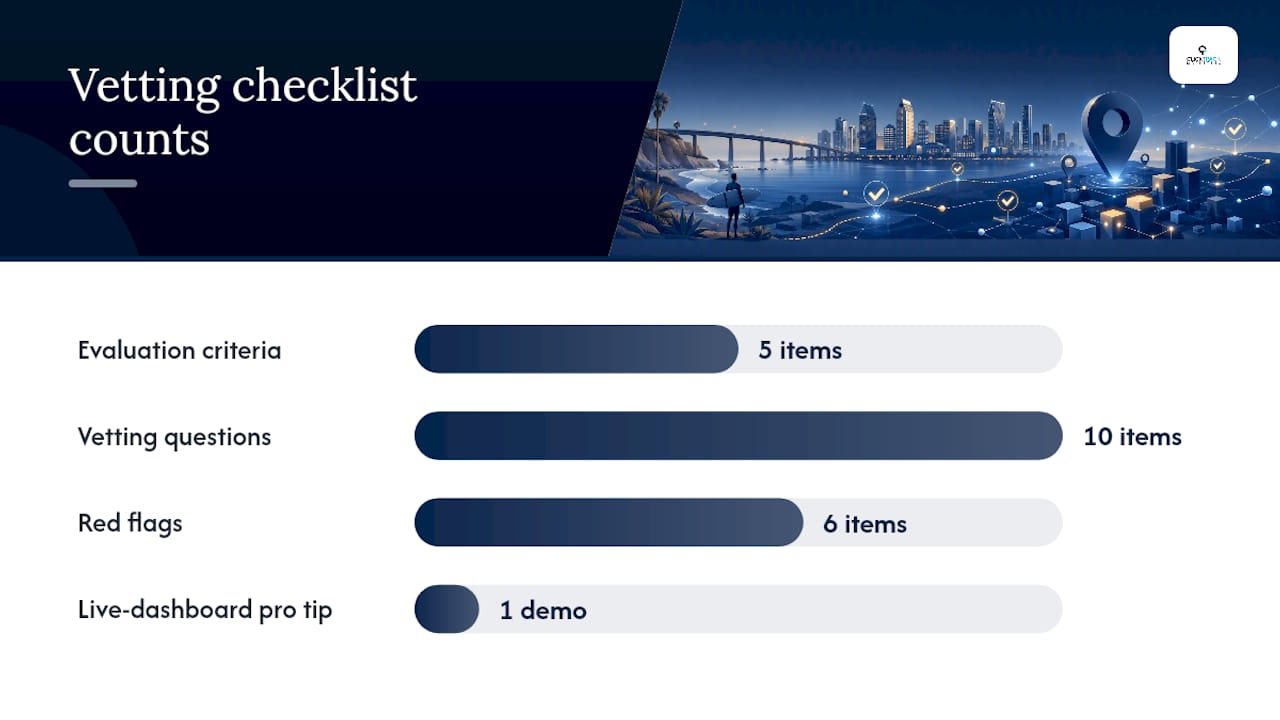
Rank your evaluation criteria in this order:
- 1Revenue attribution capability. Can they show which specific leads came from organic search versus paid versus referral, tied to dollars?
- 2GBP and AEO expertise. Do they understand how AI Overviews and Google Maps ranking factors differ from traditional blue-link SEO?
- 3Transparent reporting. Will you get a dashboard you can check anytime, or a PDF once a month?
- 4References from similar local businesses. Not testimonials on a slide, actual contacts you can call.
- 5Local market experience. Have they ranked businesses in your specific San Diego neighborhood or service area before?
Ten questions worth asking during vetting: How do you measure success beyond rankings? What does your GBP optimization checklist include? How many location pages will you build and who writes them? What's your review generation process? Can I see a client's actual attribution report? What's your typical timeline for measurable lead increases? Do you use schema markup, and can you show an example? How do you handle AI Overview visibility? What's included versus billed as an add-on? What happens if I cancel?
Six red flags that should end the conversation: guaranteed rankings, no mention of attribution or lead tracking, pricing based only on "packages" with no scope detail, no local case studies, reluctance to name past clients, and reporting limited to keyword position screenshots.
Pro Tip: Ask every prospective agency to show you one client's dashboard live on a screen share. If they hesitate or say it's "proprietary," that's a signal they don't actually track results the way they claim.
The 90-Day Plan for Local SEO Wins
Local SEO doesn't reward patience for its own sake. It rewards a sequence. Here's how the first three months should break down for a San Diego business starting from scratch.
- 1Weeks 1 to 4: Claim and fully complete your Google Business Profile. Fix every NAP inconsistency across directories. Upload at least 20 photos covering your storefront, team, and work product. Add LocalBusiness schema to your website. Set up a direct review request link and send it to your last 90 days of customers.
- 2Weeks 5 to 8: Build three to five unique location or service pages, each written for a specific neighborhood or offering rather than duplicated boilerplate. Begin outreach to local directories and industry associations for citations. Start a regular cadence of GBP posts and local content, roughly one to two pieces a week.
- 3Weeks 9 to 12: Pitch local press and industry publications for coverage and backlinks. Join a local business network like the San Diego Chamber of Commerce for both link value and referral relationships. Monitor direction requests and call volume in GBP Insights. Set up attribution tracking so every new lead can be traced to its source, then adjust based on what's actually converting.
By day 90, most businesses following this sequence see the Maps visibility gains and direction request increases documented in SerpNap's audit of local SEO programs, which found a median 156% jump in Maps visibility and an 89% increase in direction requests after GBP optimization. Results vary by industry and starting point, but the sequence itself doesn't change.
AI and Answer Engine Optimization: What It Changes for Local SEO
Answer Engine Optimization, or AEO, is the practice of structuring your online presence so AI systems like ChatGPT, Google's AI Overviews, and Perplexity cite your business directly in their answers, not just so Google ranks you in the traditional ten blue links. It's a different visibility channel with different rules, and it's growing fast enough that ignoring it means losing customers who never see a search results page at all.
Google's AI Overviews now appear in roughly 23% of "near me" searches, with that share climbing higher for categories like restaurants. If your business isn't structured to be cited in that answer box, a competitor's will be instead.
The tactical checklist for AEO looks different from classic on-page SEO:
- Write answer-first content: state the direct answer to a likely question in the first sentence, then explain.
- Structure pages with clear headings that mirror how people actually ask questions.
- Add FAQ schema so AI systems can extract question and answer pairs directly.
- Build entity signals across platforms: consistent business information on GBP, directories, and YouTube, since AI models cross-reference multiple sources before citing one.
- Monitor which AI platforms mention your business and adjust content based on gaps.
Clean entity data paired with schema markup produces roughly a 2.4x lift in AI visibility compared to sites without structured data, according to practitioner analysis of nearly 700 local queries. Platform behavior varies too: ChatGPT tends to favor structured websites, while Perplexity pulls more heavily from YouTube and Reddit. A local SEO strategy that only chases blue-link rankings is optimizing for half the search landscape.
Pricing, Timelines, and What Reasonable ROI Looks Like
Local SEO pricing in San Diego typically follows one of three models: flat monthly retainers, project-based fees for one-time builds like location pages or GBP overhauls, or pay-per-result arrangements tied to booked appointments. Monthly retainers for a genuinely complete local SEO program tend to scale with the number of service areas and how competitive your industry is; a single-location dentist and a five-city HVAC company are not buying the same scope.
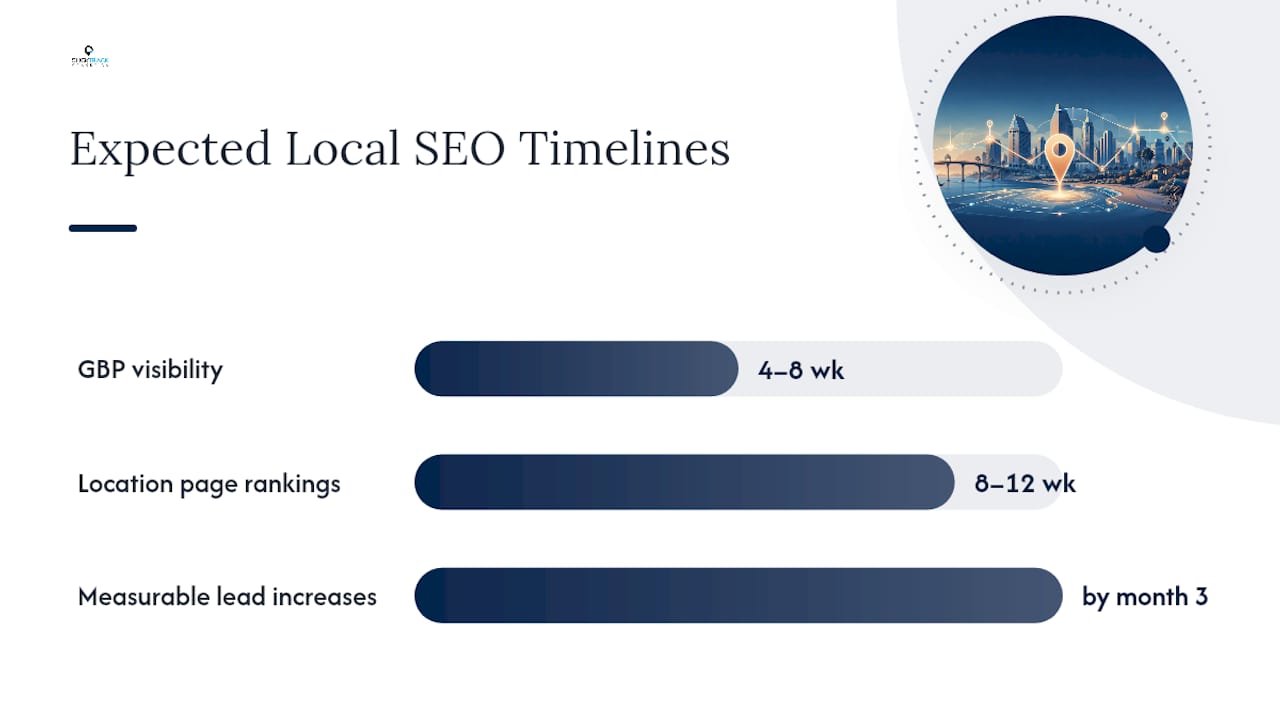
Expect these general timelines:
- GBP visibility improvements: 4 to 8 weeks after full optimization.
- Location page rankings: 8 to 12 weeks for new pages to gain traction.
- Measurable lead increases: typically by month 3, assuming reviews, citations, and GBP work are all moving together.
The real ROI question isn't "did rankings go up." It's whether the leads that came in can be traced to a dollar figure, which is where attribution tools separate a serious program from a vanity-metrics report.
Proof and Trust: What Credible Case Studies Actually Contain
A screenshot of a keyword jumping from position 12 to position 4 proves almost nothing about your bottom line. A credible local SEO case study shows dated before-and-after metrics tied to actual revenue or booked jobs, names the channels involved, and explains what changed and when.
What to look for before trusting any agency's proof points:
- Specific dates for when work started and when results were measured.
- Revenue or lead numbers, not just ranking positions or "visibility scores."
- A named author or strategist behind the work, not an anonymous "our team."
- Evidence of local presence: a real San Diego address, phone number, or office, not just a claim of "serving San Diego."
- Product or platform features that make attribution possible, rather than promises to "track everything."
Click Track Marketing's approach leans on this same standard. Editorial and strategy content on local SEO topics is written under named author David Esau, and the agency's attribution stack, including PeoplePixel for visitor identification, BuyerSignals for intent data, and PeopleLytics for weekly revenue reporting, exists specifically to answer the question every business owner actually cares about.
“The right proof isn't a rankings screenshot. It's a dashboard that shows which specific page, campaign, or review request turned into a phone call, and which turned into a paying customer.”
Click Track Marketing's Perspective: Infrastructure Beats Vanity
Most local SEO advice treats rankings as the finish line. They're not. A business can rank first in the map pack and still not know which of those clicks turned into revenue, which is the actual measure that matters.
Infrastructure-first local SEO means building GBP, schema, and attribution as one connected system from day one, not bolting on tracking after the fact. On a new client's first day, the priority isn't a flashy homepage redesign. It's fixing entity data and installing the tools that show, in plain numbers, which efforts are producing customers. Rankings without attribution are a guess dressed up as a strategy.
How Click Track Marketing Helps San Diego Businesses Get Found and Get Paid
Click Track Marketing is the infrastructure alternative to a traditional local SEO retainer that reports on rankings alone. Instead of handing you a monthly ranking report and calling it done, the agency builds your Google Business Profile, local pages, and review systems alongside Answer Engine Optimization so your business shows up when someone asks ChatGPT or Google's AI Overviews a local question, and then ties every one of those visits back to actual booked revenue through PeopleLytics.
That combination matters because most San Diego business owners aren't short on marketing activity. They're short on proof that the activity is producing customers. If you want a clear picture of where your visibility gaps are, start with the free AEO checklist to see how your current setup measures up. If you're ready for a deeper look, Click Track Marketing's AI SEO services cover the full build, from GBP and local pages to attribution reporting, and a short audit call is the fastest way to see what's currently working and what's leaving leads on the table.
Sources
Want to know exactly which marketing is making you money?
Get a free attribution audit — we'll show you where your leads and revenue actually come from. Answer two quick questions to start.