

Quick Answer
Meta ads are a sophisticated advertising platform that uses artificial intelligence and data-driven targeting to help outdoor brands reach the right audiences and maximize conversions. Understanding how meta ads work for outdoor brands means grasping three core systems: AI-driven audience expansion, campaign automation through Advantage+ Shopping Campaigns, and server-side attribution via the Conversions API. Get all three right, and you have a paid media system that finds buyers, tests creative, and measures revenue with real accuracy.
What are the key Meta ad campaign types for outdoor brands?
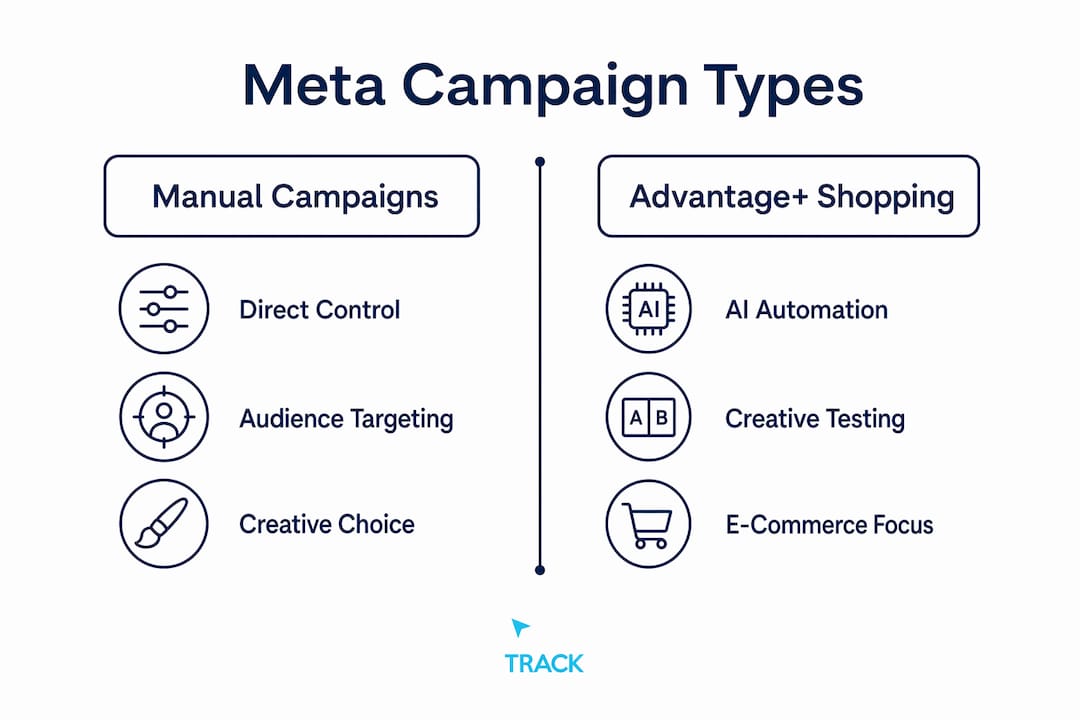
Meta offers two primary campaign structures for outdoor brand marketers: manual sales campaigns and Advantage+ Shopping Campaigns (ASC). Each serves a different purpose depending on where your account stands in terms of conversion history and budget.
Manual campaigns give you direct control over audience targeting, placements, and creative. They work well when you are testing a new product line, entering a new geographic market, or running a brand awareness push for an outdoor gear launch. The tradeoff is that manual campaigns require more active management and produce results more slowly.

ASC is Meta's AI-driven campaign type built for e-commerce. ASC combines up to 150 creative assets in one ad set, continuously testing combinations and shifting budget toward the highest conversion probability. That means Meta's system handles prospecting and remarketing simultaneously, without requiring you to build separate audience sets for each.
One underused feature in ASC is the existing customer budget cap. ASC automatically allocates budget between prospecting and remarketing, but you can cap how much goes toward existing customers. For outdoor brands focused on new customer acquisition, setting this cap prevents your budget from concentrating on people who already bought a tent or a hydration pack from you last season.
| Campaign type | Best for | Key control |
|---|---|---|
| Manual sales campaign | New accounts, brand testing, niche targeting | Full audience and placement control |
| Advantage+ Shopping Campaign | Established accounts, e-commerce scaling | Creative testing, budget automation |

Pro Tip: Run ASC only when your Meta Pixel has recorded at least 50 purchase events per week. Below that threshold, the AI lacks enough signal to allocate budget accurately.
How does Meta audience targeting work for outdoor gear ads?
Meta's audience targeting splits into two distinct layers: hard guardrails and soft suggestions. Hard guardrails include location, language, and exclusions. These are absolute. If you exclude past purchasers or restrict ads to the continental United States, Meta will not override those settings.
Soft suggestions are different. Age ranges, interest categories, and behavioral signals like "outdoor enthusiasts" or "hiking gear buyers" are inputs that guide the AI, not walls that contain it. Meta's AI delivers ads beyond initial selections when it identifies users with a higher conversion likelihood, even if those users fall outside your selected interests.
This is where Detailed Targeting Expansion (DTE) becomes critical to understand. DTE has been the default setting since 2022. Up to 40, 70% of impressions in a given campaign can come from outside your selected detailed targeting. For outdoor brands, that means an ad targeting "trail running" enthusiasts may reach a broader fitness audience that converts at a higher rate than the narrower segment you defined.
DTE works best under specific conditions. Accounts spending under $500 per day or generating fewer than 50 purchase events per week see weaker results from DTE because the algorithm lacks enough data to expand intelligently. In those cases, sticking with tighter detailed targeting produces more predictable results.
Here is how to approach audience strategy based on account maturity:
- 1New accounts or low spend: Use specific interest targeting with DTE turned off. Build conversion history before letting the AI expand.
- 2Mid-tier accounts ($200, $500/day): Enable DTE and monitor impression share from outside selected interests. Adjust if cost per purchase rises without volume gains.
- 3Established accounts (over $500/day): Move toward broad Advantage+ audiences. Broad targeting with Advantage+ can outperform detailed interest targeting once the campaign has sufficient conversion history.
Pro Tip: Check your audience breakdown report in Ads Manager weekly. If more than 60% of conversions come from outside your selected interests, your defined targeting is doing less work than Meta's AI. That is a signal to test a fully broad audience.
Why accurate attribution tracking matters for outdoor brand campaigns
Pixel-only tracking is no longer sufficient for outdoor brands running Meta ads. Browser privacy restrictions and Apple's App Tracking Transparency (ATT) framework create gaps in client-side data that distort your reported return on ad spend (ROAS).
The solution is combining the Meta Pixel with the Conversions API (CAPI). CAPI sends purchase events directly from your server to Meta, bypassing browser limitations entirely. Using CAPI alongside Pixel can yield a 10, 20% uplift in attributed conversions. That uplift is not new revenue. It is revenue that was always there but was invisible to your reporting.
The most common implementation error is failing to deduplicate events. When both Pixel and CAPI fire a Purchase event for the same transaction, Meta counts it twice. A mismatch in event_id between client and server calls inflates ROAS and sends the algorithm the wrong optimization signal. The fix is straightforward: generate a unique event_id at order confirmation and pass the identical value through both Pixel and CAPI for every purchase event.
For iOS users who have opted out of tracking, Meta's Aggregated Event Measurement (AEM) framework fills part of the gap. AEM prioritizes up to 8 conversion events per domain using aggregated and modeled data. This means your campaign can still receive optimization signals from opted-out users, though at a lower resolution than standard tracking.
No single measurement tool captures the full picture. Layering Pixel, CAPI, AEM, GA4, and media mix modeling provides more reliable insights than Ads Manager alone. For outdoor brands with seasonal peaks around spring and fall gear cycles, cross-channel validation is especially important for accurate paid ads ROI tracking.
Pro Tip: Validate your CAPI setup using Meta's Event Match Quality score in Events Manager. A score above 6.0 indicates strong server-side signal. Below that, check whether you are passing customer email, phone, and IP address with each event.
How to optimize Meta ads performance for outdoor brands
Creative variety is the single biggest lever in Advantage+ campaigns. Meta's AI needs options to test. Uploading a single image and one video gives the algorithm nothing to work with. Advertisers can upload up to 150 creative assets which Meta continuously combines and tests across placements and audience segments. For outdoor brands, that means mixing lifestyle photography, product close-ups, user-generated content from trail runs or camping trips, and short video testimonials.
Budget distribution between prospecting and remarketing is the second major optimization lever. Most outdoor brands over-invest in remarketing because the ROAS looks better on paper. Remarketing converts people who were already close to buying. Prospecting builds the pool that feeds remarketing over time. Use the existing customer budget cap in ASC to keep prospecting spend healthy, and track retargeting performance separately to understand true incremental value.
Measurement discipline separates brands that scale from those that plateau. Tie every campaign back to actual purchase revenue, not click-through rate or cost per link click. Use revenue-based marketing principles to evaluate whether a campaign is producing customers, not just activity. When you see a creative combination performing well in Ads Manager, cross-reference it against GA4 and your e-commerce platform before scaling budget. Ads Manager can overcount. Your source of truth is the revenue number in your store backend.
Key takeaways
Meta ads for outdoor brands perform best when AI-driven campaign automation, accurate server-side attribution, and creative variety work together as a single system rather than separate tactics.
| Point | Details |
|---|---|
| Use ASC for scaling | Advantage+ Shopping Campaigns automate targeting and creative testing once you have 50+ weekly purchase events. |
| Understand DTE | Up to 40, 70% of impressions may come from outside selected interests; monitor and adjust based on conversion data. |
| Combine Pixel and CAPI | Server-side tracking recovers lost conversions from iOS restrictions and browser blockers. |
| Deduplicate events | Pass a unique event_id through both Pixel and CAPI to prevent inflated ROAS and bad optimization signals. |
| Measure against revenue | Tie campaign performance to actual purchase revenue, not Ads Manager metrics alone. |
What I have learned running Meta ads for outdoor brands
The biggest mistake I see outdoor brand marketers make is treating Meta's AI as a black box they cannot influence. You absolutely can influence it. The inputs you control are creative assets, audience guardrails, budget caps, and conversion signal quality. Get those four right, and the AI does the heavy lifting. Get them wrong, and you will spend months optimizing a system that is working against you.
The second pattern I see consistently is over-reliance on narrow interest targeting. Targeting "backpacking" or "fly fishing" feels intuitive. It matches how you think about your customer. But Meta's algorithm often finds better buyers in adjacent audiences you would never have selected manually. The data from DTE is not a bug. It is the system telling you something about your actual customer that your assumptions missed.
Attribution is where I have seen the most money wasted. Brands look at a 4x ROAS in Ads Manager and scale budget, only to find their actual revenue does not move proportionally. That gap almost always traces back to duplicate conversion events or Pixel-only tracking that misses iOS users. Fix the measurement first. Then scale.
The brands that win on Meta in 2026 are not the ones with the biggest budgets. They are the ones who treat marketing attribution as infrastructure, not an afterthought. Build the measurement foundation before you build the campaigns. The creative and the targeting will follow.
How Click Track Marketing helps outdoor brands run better Meta ads
Click Track Marketing builds the attribution infrastructure that makes Meta ad campaigns measurable and accountable. The agency's full-funnel AI marketing system covers proper Pixel and CAPI setup, event deduplication, Advantage+ campaign structure, and weekly revenue reporting through PeopleLytics. You see exactly which campaigns, creatives, and audiences are producing customers, not just clicks. If you are running Meta ads for an outdoor brand and your reported ROAS does not match your actual revenue, that gap is solvable. Book a discovery call with Click Track Marketing to find out where the measurement breaks down and what it takes to fix it.
Want to know exactly which marketing is making you money?
Get a free attribution audit — we'll show you where your leads and revenue actually come from. Answer two quick questions to start.