

Quick Answer
Outdoor design marketing budget planning is the process of allocating resources across channels and campaigns to generate leads, build visibility, and grow revenue in the landscape and outdoor design industry. Most outdoor design firms treat marketing spend as a discretionary line item. The ones that grow treat it as infrastructure, and they plan it the same way they plan a construction project: with clear goals, phased spending, and measurable outcomes.
What does outdoor design marketing budget planning require?
Effective budget planning starts with two inputs: clear business goals and reliable past performance data. Without both, you are guessing. With both, you can build a plan that connects every dollar to a specific outcome.
Your goals should be specific and tied to revenue. "Get more leads" is not a goal. "Generate 40 qualified inquiries per month at a cost per lead under $120" is. That level of specificity forces you to think about which channels can realistically deliver those results and at what cost.

Past performance data tells you which campaigns produced revenue and which ones burned budget. If you do not have clean data from prior years, start building it now. A basic CRM, a spreadsheet tracking spend by channel, and a simple attribution model are enough to get started.
The table below outlines the core tools every outdoor design marketer needs before building a budget.
| Tool | Purpose |
|---|---|
| CRM (e.g., HubSpot, Jobber) | Track leads, follow-up sequences, and conversion rates |
| Analytics platform (e.g., Google Analytics 4) | Measure website traffic and source attribution |
| Budget spreadsheet or template | Allocate spend by channel and track actuals vs. plan |
| Revenue attribution dashboard | Connect marketing spend to closed revenue |
| Seasonal marketing calendar | Align campaign timing with demand cycles |
Pro Tip: Set up your CRM and attribution tracking before you spend a dollar on ads. Without lead tracking in place, up to 95% of website visitors leave without inquiry and you have no record they were ever there.
How to estimate costs and allocate your budget by category
Marketing budgets for landscape businesses typically range from 5% to 10% of annual revenue, depending on growth goals. A firm focused on maintaining its current client base sits closer to 5%. A firm actively expanding into new service areas or markets should plan for 8% to 10%.
Once you know your total budget, break it into categories. The most common mistake outdoor design marketers make is pouring everything into paid ads while neglecting the infrastructure that converts those clicks into clients. A balanced allocation model looks like this:
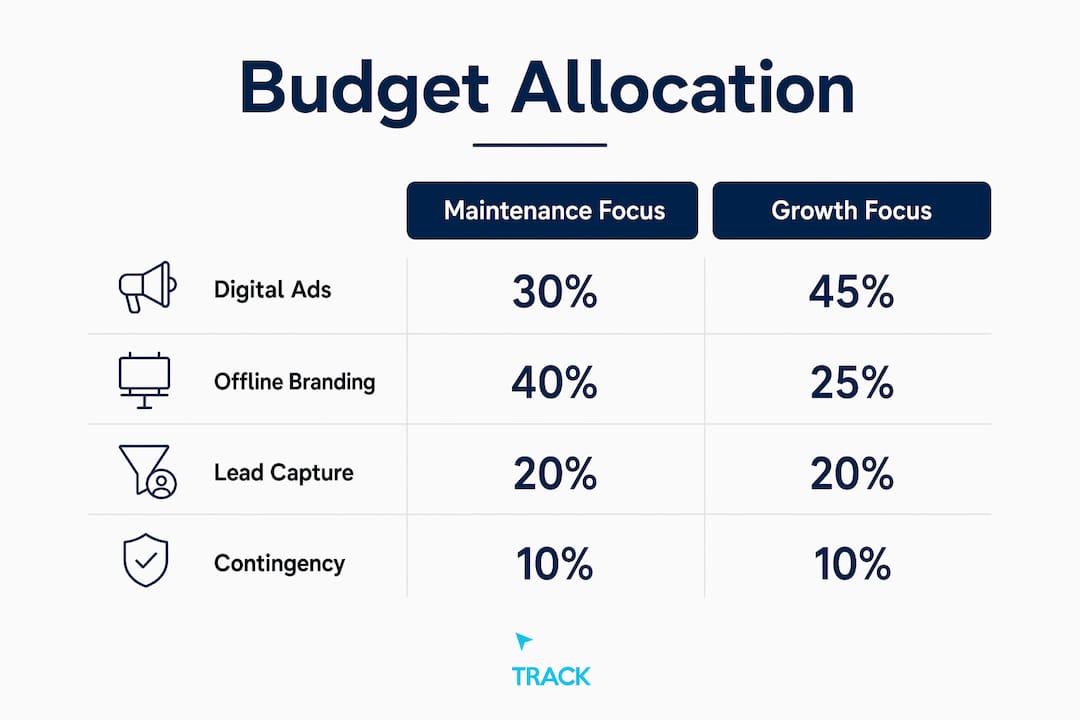
| Category | Maintenance focus | Growth focus |
|---|---|---|
| Digital advertising (paid search, social) | 30% | 40% |
| Content creation and SEO | 20% | 20% |
| Brand awareness (events, sponsorships) | 15% | 10% |
| Lead nurturing and CRM tools | 20% | 20% |
| Contingency reserve | 15% | 10% |
Outdoor design marketing performs best when digital ad spend is balanced with offline brand awareness. Paid ads generate immediate leads. Brand campaigns build the reputation that makes those leads easier to close.
Always include a contingency buffer. A 10% to 20% reserve protects you when a campaign underperforms, a platform raises its rates, or a seasonal spike demands extra spend. Skipping the contingency is the single fastest way to blow a budget mid-year.
Pro Tip: Tie your budget phases to your project calendar. If your busiest installation season runs april through october, front-load your awareness spend in february and march. That way leads are already in your pipeline when capacity opens up.
What are the best practices for prioritizing marketing strategies within budget limits?
The right prioritization framework starts with one question: which investments protect and convert the leads you already have before you spend money chasing new ones?
Infrastructure-first marketing means building the systems that capture and follow up with leads before scaling ad spend. Just as a landscape project sequences drainage and utilities before planting, your marketing budget should fund CRM setup, automated follow-up, and a website built for conversion before it funds Google Ads or Meta campaigns.
Use these criteria to rank every line item in your budget:
- Revenue potential: Does this channel have a documented history of producing closed jobs, not just clicks?
- Goal alignment: Does this spend support your stated growth target for the year?
- Lead retention: Does this investment prevent leads from falling through the cracks after first contact?
- Audience reach: Does this channel put you in front of the specific homeowners or commercial clients you want?
- Measurability: Can you tie this spend to revenue within 90 days?
The most common pitfall in outdoor design marketing is spending heavily on brand awareness before the lead capture system is ready. You can run a flawless Meta campaign and lose every lead because no one follows up within 24 hours. Phased budgeting prevents this by requiring each foundational layer to be in place before the next layer of spend is approved.
A second common mistake is treating retargeting as optional. Retargeting campaigns reach people who already visited your site and showed intent. They convert at a higher rate and lower cost than cold traffic. For outdoor design firms with limited budgets, retargeting often delivers the best return per dollar spent.
How do you monitor and adjust your marketing budget effectively?
Tracking marketing effectiveness requires focusing on revenue attribution, not vanity metrics. Impressions and clicks tell you a campaign ran. Revenue attribution tells you whether it paid for itself.
Set up a monthly review cadence with three questions: Which channels produced qualified leads? What was the cost per lead by channel? How many of those leads closed into revenue? Those three numbers tell you where to increase spend and where to cut.
Here is a simple four-step process for quarterly budget reviews:
- 1Pull revenue by source. Use your CRM and attribution dashboard to identify which channels drove closed revenue, not just leads.
- 2Compare spend to outcome. Calculate cost per acquisition by channel. Any channel above your target cost per acquisition gets reduced or paused.
- 3Identify underperforming periods. Look for months where spend was high but leads were low. Adjust the following year's calendar to shift spend away from those windows.
- 4Reallocate the contingency. Move unused contingency funds to the channel with the best current return, not the channel with the most impressions.
Regular budget reviews tied to performance data prevent the most common budget failure: continuing to fund channels out of habit rather than results.
Pro Tip: AI-enabled attribution platforms like Click Track Marketing's PeopleLytics deliver weekly revenue dashboards that show exactly which campaigns are producing customers. That level of visibility removes the guesswork from budget adjustments and lets you act on data instead of instinct.
Key Takeaways
Outdoor design marketing budget planning works best when infrastructure comes first, spend is phased to match demand cycles, and every dollar is tied to measurable revenue outcomes.
| Point | Details |
|---|---|
| Set revenue-based budget targets | Allocate 5%, 10% of annual revenue to marketing, scaled to your growth goals. |
| Build infrastructure before scaling ads | CRM, attribution tracking, and lead follow-up must be in place before paid campaigns launch. |
| Use phased budget allocation | Front-load awareness spend before peak season to fill the pipeline at the right time. |
| Reserve 10%, 20% as contingency | A buffer prevents mid-year budget failures when campaigns underperform or costs rise. |
| Review performance monthly | Measure cost per acquisition by channel and reallocate based on revenue, not impressions. |
Why I treat marketing budgets like construction blueprints
I have worked with outdoor design firms that spent $8,000 a month on Google Ads and could not tell me how many jobs that spend produced. Not because the data did not exist. Because no one had built the system to capture it. That is not a media buying problem. That is an infrastructure problem.
The parallel to landscape project planning is exact. Design-build experts consistently find that skipping the finalized design phase leads to budget blowouts and costly rework. Marketing budgets fail the same way. When you skip the planning phase and go straight to spending, you end up rebuilding the foundation mid-campaign, which costs more and produces less.
The shift toward AI-structured marketing platforms has made this even more consequential. When a homeowner asks ChatGPT or Google's AI Overviews which outdoor design firm to hire in their area, the answer comes from firms whose digital infrastructure is built to be read and cited by those systems. Firms that invested only in aesthetics, a beautiful website with no structured data and no attribution, are invisible in that answer.
My advice is direct: treat your marketing budget as a capital investment, not an operating expense. Plan it with the same rigor you apply to a $200,000 installation project. Define the outcome, sequence the spend, build the infrastructure first, and measure everything against revenue.
How Click Track Marketing supports outdoor design marketing budgets
Click Track Marketing builds the marketing infrastructure that outdoor design firms need to plan, track, and prove their spend.
The full-funnel AI marketing system connects your website, lead capture, and revenue attribution into one measurable platform. PeoplePixel identifies anonymous visitors before they inquire. BuyerSignals surfaces who is actively in the market right now. PeopleLytics delivers a weekly revenue dashboard that ties every campaign to closed revenue. For outdoor design professionals who want to know whether their marketing is actually making money, that level of visibility changes how you plan and where you spend. Schedule a discovery call to see how the system applies to your business.
Want to know exactly which marketing is making you money?
Get a free attribution audit — we'll show you where your leads and revenue actually come from. Answer two quick questions to start.