

Quick Answer
Revenue attribution marketing is the practice of assigning credit for closed revenue to the specific marketing and sales touchpoints that contributed to a sale, so you can see which channels and campaigns actually drive money, not just clicks. If you want to make smarter budget decisions this week, start by verifying that your CRM deal-stage fields map to a revenue value and that GA4 is firing a purchase event with an order ID.
Tools like GA4, Marketing Mix Modeling, and Click Track Marketing's PeopleLytics platform exist precisely to close this loop. Organizations that implement solid attribution report a 19% improvement in budget allocation accuracy. That is the difference between spending on what looks good and spending on what works.
Table of Contents
- How Does Revenue Attribution Differ from Conversion Tracking?
- What Are the Main Attribution Models and When Should You Use Each?
- How Do You Choose the Right Attribution Approach for Your Business?
- What Data and Technical Infrastructure Do You Actually Need?
- How Do You Implement a Revenue Attribution System Step by Step?
- How Do You Measure and Report Revenue Attribution Results?
- What Are the Most Common Attribution Mistakes and How Do You Fix Them?
- How Click Track Marketing Builds Revenue Attribution for You
- Key Takeaways
- Why Infrastructure Beats Model Selection Every Time
- Ready to See Where Your Revenue Actually Comes From?
- What David Esau Actually Thinks About Revenue Attribution
- FAQ
- Further Reading and Authoritative Sources
How Does Revenue Attribution Differ from Conversion Tracking?
Conversion tracking records events: a click, a form fill, a lead. Revenue attribution goes further by linking those touchpoints to closed deals and actual dollar amounts. The distinction matters more than most teams realize.

For an e-commerce brand with a two-day purchase cycle, a conversion event and a revenue event are nearly the same thing. For a B2B company with a 90-day sales cycle, they are completely different. A lead captured in January may not close until April, and three other channels may have touched that prospect in between. Conversion tracking sees the lead. Revenue attribution sees the deal.
Platform-reported conversions also tend to overcount. Each ad platform claims credit using its own attribution window, so Google, Meta, and LinkedIn may all claim the same sale. Cross-system reconciliation against your CRM is the only way to get a number you can trust.
What Are the Main Attribution Models and When Should You Use Each?
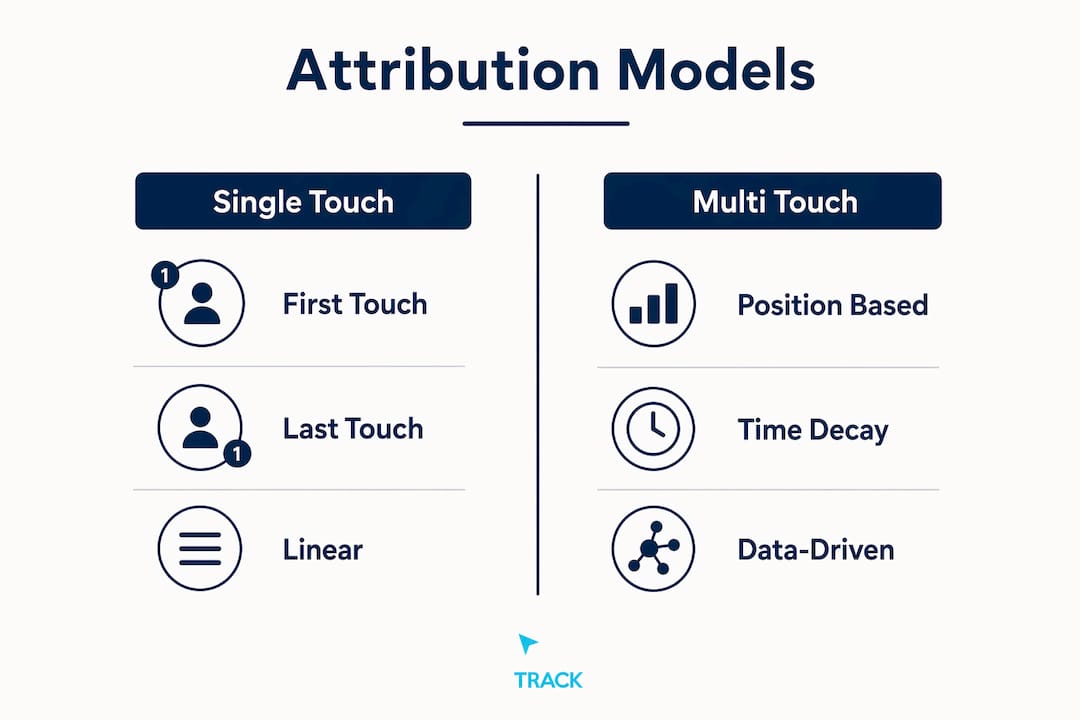
Attribution models fall into two families: single-touch and multi-touch. Each distributes credit differently, and each answers a different business question.
Single-touch models assign all credit to one interaction:
- First-touch: 100% credit to the first interaction. Best for measuring awareness channels. Its weakness is that it ignores everything that happened after that first contact.
- Last-touch: 100% credit to the final interaction before conversion. Simple to implement and easy to explain, but it systematically undervalues the channels that built consideration. Branded search and retargeting tend to look artificially strong here.
Multi-touch models spread credit across the journey:
- Linear: Equal credit to every touchpoint. Balanced and easy to explain, but it treats a brand awareness blog post the same as a demo request page.
- Time-decay: More credit to touchpoints closer to conversion. Works well for long nurture cycles where late-stage content genuinely carries more weight.
- Position-based (U-shaped): 40% to first touch, 40% to last touch, 20% split across the middle. A practical choice for lead-generation businesses that value both discovery and closing.
- W-shaped: Adds a third anchor point at lead creation, giving roughly equal weight to first touch, lead creation, and opportunity creation. Useful for B2B teams tracking pipeline stages.
- Data-driven: Machine learning assigns credit based on which paths actually converted versus those that did not. It is the default in GA4 and Google Ads, but it requires sufficient data volume to produce reliable results, typically 300 or more conversions per month.
Pro Tip: There is no perfect model. Pick the one whose limitations align with the decision you need to make, then use Marketing Mix Modeling and incrementality testing alongside it to validate results.
For a deeper look at how these models compare in practice, the marketing attribution guide at Click Track Marketing walks through model selection by business type.
How Do You Choose the Right Attribution Approach for Your Business?
The right model depends on three factors: sales cycle length, typical touchpoint count, and your current data volume.
Short sales cycles with few touchpoints (direct e-commerce, simple SaaS trials) can start with last-touch or first-touch and get useful signals quickly. The implementation cost is low and the data requirements are minimal.
Mid-length cycles with 3 to 5 touchpoints benefit most from position-based attribution. It credits both the channel that introduced the lead and the one that closed it, without requiring the data volume that data-driven models demand.
Long, complex B2B cycles with many touchpoints and months between first contact and close need time-decay or data-driven approaches. If your monthly conversion volume is below 300, start with time-decay and plan to migrate to data-driven once volume grows.
Data-driven models are worth the investment when you have the volume, but they are not a shortcut. Fragmented data across marketing, sales, and finance will produce unreliable outputs regardless of how sophisticated the algorithm is. Fix the data before upgrading the model.
What Data and Technical Infrastructure Do You Actually Need?
Attribution is only as accurate as the data feeding it. Before choosing a model, confirm you have these in place:
- Revenue events firing with order IDs or deal values in GA4 or your analytics platform
- Consistent UTM parameters across every paid and organic channel
- CRM deal-stage fields mapped to revenue amounts and close dates
- Offline conversion imports connecting CRM closed-won data back to ad platforms
- A consistent user identifier (email hash, customer ID) for identity stitching across sessions and devices
CRM-to-analytics integration is the most commonly skipped step. Without it, you are attributing leads, not revenue.
Pro Tip: Run a monthly reconciliation between your CRM's closed-won revenue and your analytics platform's reported revenue. A gap of more than 10 to 15% signals a tracking or mapping problem worth fixing before you trust any attribution output.
Privacy regulations add another layer of complexity. CCPA in California and GDPR for any EU visitors restrict cookie-based tracking and third-party data sharing. Apple's iOS privacy changes have reduced signal fidelity for mobile campaigns. These constraints make server-side tagging and first-party data collection more important than ever. Marketing Mix Modeling is particularly useful here because it works at the aggregated channel level and requires no cookies.
How Do You Implement a Revenue Attribution System Step by Step?
A working attribution system typically takes 8 to 12 weeks to reach a reliable pilot state. Here is a practical rollout sequence:
- 1Discovery and data audit (weeks 1 to 2): Map every revenue source, ad platform, CRM field, and analytics event. Identify gaps between what fires and what closes.
- 2Instrumentation (weeks 3 to 4): Implement or fix revenue events, UTM standards, and CRM field mapping. Set up offline conversion imports.
- 3Pilot (weeks 5 to 6): Run your chosen attribution model against 60 to 90 days of historical data. Compare attributed revenue to CRM closed-won revenue.
- 4Validation (weeks 7 to 8): Run a geo holdout or audience holdout test on one channel to check whether the model's credit assignments reflect actual lift.
- 5Scale and report (weeks 9 to 12): Expand to all channels, set a reporting cadence, and document the model's known limitations for stakeholders.
| Phase | Typical Duration | Key Role | Budget Range |
|---|---|---|---|
| Discovery and audit | 1 to 2 weeks | Analyst or RevOps | , |
| Instrumentation | 2 weeks | Developer plus analyst | , |
| Pilot and validation | 4 weeks | Analyst | , |
| Scale and reporting | 4 weeks | Analyst plus stakeholders | , |
Pro Tip: Do not wait for perfect data to start. A pilot with 80% clean data teaches you more than six months of planning. You will find the remaining gaps faster by running the model than by auditing in isolation.
For a detailed walkthrough of connecting spend to revenue outcomes, see Click Track Marketing's guide on tying marketing spend to revenue.
How Do You Measure and Report Revenue Attribution Results?
Focus your reporting on revenue outcomes, not activity metrics. The KPIs that matter:
- Attributed revenue by channel: Which channels are generating closed deals, not just leads.
- Incremental lift: The revenue gain directly caused by a campaign, measured against a holdout group.
- Cost per incremental dollar: Total spend divided by incremental revenue. This is the number that tells you whether a channel is profitable.
- Attribution accuracy rate: How closely your model's attributed revenue matches CRM closed-won revenue in reconciliation.
For validation, geo holdouts and audience holdouts are the most reliable methods. Pause a channel in one region or for one audience segment, keep it running for another, and compare outcomes. The difference is your actual lift. Pair this with Marketing Mix Modeling for upper-funnel channels where individual tracking is incomplete.
A weekly reporting cadence works for most teams. Monthly is acceptable for longer sales cycles. The goal is a consistent rhythm so stakeholders trust the numbers rather than questioning them each time. Channel-level ROI tracking templates can help structure this, and Click Track Marketing's guide on tracking ROI by channel covers the reporting setup in detail.
What Are the Most Common Attribution Mistakes and How Do You Fix Them?
Double counting across platforms is the most frequent problem. Google, Meta, and LinkedIn each use their own attribution windows, so they will all claim the same conversion. Fix: designate one system of record (usually your CRM or GA4) and reconcile all platform reports against it.
Inconsistent UTMs break the tracking chain. A single campaign with three different UTM naming conventions will appear as three separate sources. Fix: document a UTM taxonomy and enforce it with a shared spreadsheet or a UTM builder tool before any campaign goes live.
Model mismatch happens when a team uses last-touch attribution for a 6-month B2B sales cycle. The model credits the final touchpoint and starves every awareness channel of budget. Fix: match the model to the sales cycle length using the framework in the section above.
Missing operational context means attribution numbers that no one trusts. If territory rules, quota structures, and finance mappings are not integrated into your attribution system, sales and finance will reject the numbers marketing produces. Fix: involve RevOps and finance in the attribution design from the start, not after the fact.
How Click Track Marketing Builds Revenue Attribution for You
Click Track Marketing's product suite is built around one question: is the marketing making money?
- PeopleLytics is the revenue attribution platform. It delivers a weekly reporting dashboard that shows exactly where revenue is coming from and which efforts are producing it, without requiring you to build the reporting infrastructure yourself.
- PeoplePixel identifies the anonymous visitors most businesses never see, connecting site behavior to real people and feeding that signal into attribution.
- BuyerSignals surfaces intent data so you know which prospects are actively in the market right now, not just who visited last month.
- OnboardIQ makes the client setup process straightforward from day one, so the data infrastructure is built correctly from the start rather than retrofitted later.
The approach comes from years at Google working on Ads strategy, where the core lesson was consistent: the businesses that win are the ones that can see clearly what is working and put more behind it. Click Track Marketing brings that same discipline to companies that have never had access to it.
Key Takeaways
Revenue attribution marketing works when the underlying data infrastructure is solid, the model matches the sales cycle, and revenue outcomes replace vanity metrics as the primary reporting standard.
| Point | Details |
|---|---|
| Attribution vs. conversion tracking | Attribution links touchpoints to closed revenue; conversion tracking only records clicks and events. |
| Model selection | Match the model to your sales cycle: single-touch for short cycles, multi-touch or data-driven for complex ones. |
| Data requirements | Revenue events, consistent UTMs, CRM deal mapping, and offline conversion imports are all required before any model produces reliable output. |
| Budget accuracy | Organizations with solid attribution report a 19% improvement in budget allocation accuracy. |
| Click Track Marketing | PeopleLytics delivers weekly revenue attribution reporting so you can see which efforts are producing revenue without building the system yourself. |
Why Infrastructure Beats Model Selection Every Time
Most teams spend their energy picking the right attribution model when the real leverage is in the data plumbing underneath it. A data-driven model fed by fragmented, inconsistent data will produce less useful output than a simple time-decay model built on clean, unified CRM and analytics data.
Phased implementation is the right approach. Get the instrumentation right in weeks one through four, run a pilot, and validate before scaling. You will learn more from a 60-day pilot with real data than from months of planning.
The one thing worth prioritizing above everything else: unify your identifiers. A consistent customer ID across your CRM, analytics platform, and ad accounts is the foundation that makes every other attribution decision more reliable.
Ready to See Where Your Revenue Actually Comes From?

Click Track Marketing closes the loop between your marketing spend and your revenue. PeopleLytics delivers a weekly attribution dashboard that shows exactly which channels and campaigns are producing customers, so you can put more behind what works and stop funding what does not. The approach is grounded in years of Google Ads strategy experience and built for businesses that want accountability, not impressions.
If you want a practical starting point, the free AEO checklist gives you a concrete set of steps to make your site readable by AI answer engines alongside your attribution setup. Or, if you are ready to talk through your specific situation, book a discovery call and get a clear picture of what a working attribution system would look like for your business.
What David Esau Actually Thinks About Revenue Attribution
Most attribution conversations focus on the model. Which one is most accurate? Which one does GA4 use by default? Those are the wrong questions for most businesses.
The real problem is almost always upstream. Teams are trying to run sophisticated attribution on data that was never designed to support it. UTMs are inconsistent, CRM fields are empty, and no one has ever reconciled platform-reported revenue against actual closed-won deals. Picking a better model does not fix any of that.
The businesses that get real value from attribution are the ones that treat it as an infrastructure project first and a reporting project second. They fix the data, align RevOps, and then let the model do its job. The model almost does not matter once the foundation is solid.
Further Reading and Authoritative Sources
These resources are worth bookmarking when you are designing tests, validating results, or making the case internally for attribution investment:
- Revenue attribution overview from Outsales covers model types and practical limits in plain language.
- Attribution model comparison by sales cycle from SiteTracking is a useful reference for matching models to business context.
- Attribution model explainer from Ad Stack covers MMM, incrementality testing, and when to stack approaches.
- Revenue attribution and operational alignment from Fullcast explains why RevOps integration determines whether attribution numbers get trusted.
- What is revenue attribution from Shopify is a clear starting point for e-commerce teams new to the concept.
- Revenue attribution and finance integration from NetSuite covers the CRM-to-finance connection that most guides skip.
- Click Track Marketing's revenue-based marketing guide explains how attribution fits into a broader revenue-first marketing strategy.
Want to know exactly which marketing is making you money?
Get a free attribution audit — we'll show you where your leads and revenue actually come from. Answer two quick questions to start.